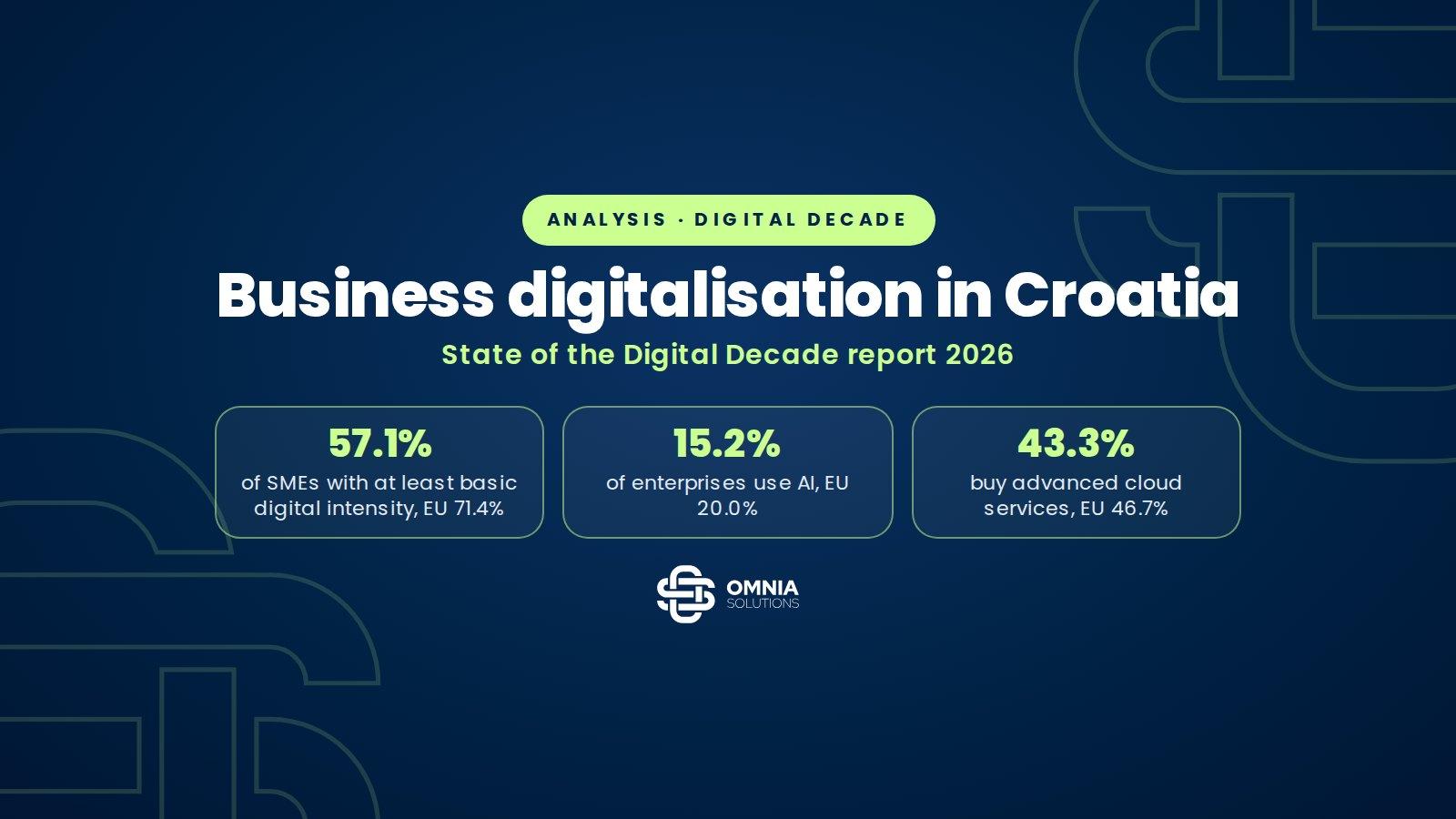
On 17 June 2026 the European Commission published its fourth State of the Digital Decade report. For Croatia it shows a divided picture. Networks are above the EU average on fibre and 5G coverage, citizens are above average on basic digital skills, and businesses lag behind. Only 57.1% of Croatian small and medium-sized enterprises have at least a basic level of digital intensity, against 71.4% in the EU, which puts Croatia 23rd of 27 member states. Artificial intelligence is used by 15.2% of enterprises (EU 20.0%) and advanced cloud services by 43.3% (EU 46.7%). The 2030 targets are 33 percentage points away on digital intensity and 60 points away on artificial intelligence. At the same time, the EU and the state are offering new instruments in July 2026, above all HBOR’s digital transition loan from the recovery plan at 2% for direct loans up to EUR 400,000 and the call for process innovation in S3 areas.
This analysis draws on the Commission’s country report for Croatia, Eurostat’s 2025 datasets on business digitalisation and data from the Croatian Bureau of Statistics. It explains what the report measures, where Croatia stands on six indicators that matter for businesses, how it compares with other member states, how the use of artificial intelligence and cloud is changing, and which funding programmes businesses can use.
In brief
- SME digital intensity is the main weakness. Croatia ranks 23rd in the EU with 57.1%. The EU average jumped from 57.9% to 71.4% in two years, while Croatia moved from 56.0% to 57.1%.
- Artificial intelligence is used by 15.2% of enterprises, 19th place. Use grew 29% in a year, but 48% in the EU. Large enterprises in Croatia use it three times as often as small ones.
- On cloud (43.3%, 15th), data analytics (41.9%) and basic digital skills of citizens (63.4%) Croatia is close to or above the EU average.
- The Commission recommends that Croatia speed up the uptake of artificial intelligence in SMEs and microenterprises and better connect vouchers, financial instruments and digital innovation hubs.
- Croatia allocates EUR 1.5 billion of its recovery plan to digital measures and EUR 0.9 billion from cohesion policy. Part of the measures end by the end of 2026, so the Commission warns of a risk that investment stops after the recovery plan.
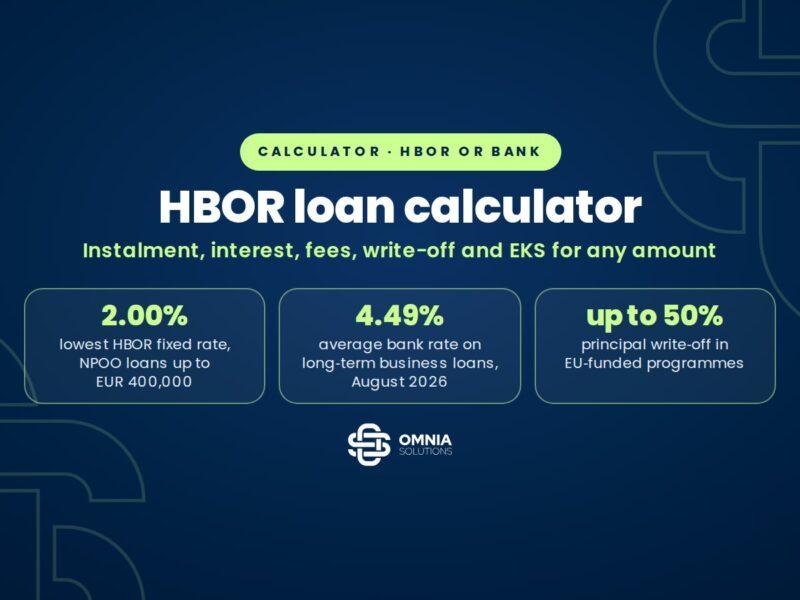
- From 1 July 2026 HBOR grants digital transition loans at a fixed 2.00% for direct loans up to EUR 400,000, and the call for process innovation in S3 areas, worth EUR 17.2 million, opens on 1 September 2026.
Sources: 10, listed at the end · How we check our information · Report an error
Key figures
Croatia in the Digital Decade, 2025 data
Source: European Commission, State of the Digital Decade 2026, country report Croatia (17 June 2026); Eurostat (isoc_e_dii, isoc_eb_ai, isoc_cicce_use); HBOR, Investments in digital transition programme (NPOO).
What the State of the Digital Decade report measures
The Digital Decade policy programme to 2030 succeeded the DESI index and sets measurable targets in four areas. By 2030 at least 90% of small and medium-sized enterprises should have at least a basic level of digital intensity, and 75% of all enterprises should use artificial intelligence, cloud computing and data analytics. Alongside these are targets of 80% of citizens with basic digital skills and 20 million employed ICT specialists, roughly 10% of employment.
Basic digital intensity is a simple measure. Eurostat tracks twelve digital activities, from internet connection speed and the share of employees using computers to online sales, use of cloud, artificial intelligence and cybersecurity measures. An enterprise that performs at least four of the twelve has at least a basic level. The bar is low, so a share below 60% means that a large part of Croatian small and medium-sized enterprises use digital tools only marginally.
The data in the 2026 report refer to 2025 and come from Eurostat’s surveys on ICT use, which in Croatia are carried out by the Croatian Bureau of Statistics.
Where Croatia stands on six indicators that matter for businesses
The chart shows six indicators relating to businesses and the labour market. On three Croatia lags behind the EU average, on two it is above and on one it is level. The largest disparity is in SME digital intensity, 14.3 percentage points below the average. On artificial intelligence the gap is 4.8 points and on cloud 3.4 points.
Interactive chart
Six Digital Decade indicators: Croatia, the EU and the 2030 target
SMEs with at least basic digital intensity
Enterprises using artificial intelligence
Enterprises buying advanced cloud services
Enterprises performing data analytics
Individuals with at least basic digital skills
ICT specialists in total employment
SMEs with at least basic digital intensity
Enterprises using artificial intelligence
Enterprises buying advanced cloud services
Enterprises performing data analytics
Individuals with at least basic digital skills
ICT specialists in total employment
SMEs with at least basic digital intensity
Enterprises using artificial intelligence
Enterprises buying advanced cloud services
Enterprises performing data analytics
Individuals with at least basic digital skills
ICT specialists in total employment
2025 data. Enterprise indicators cover enterprises with 10 or more employees, digital intensity covers SMEs (10 to 249). The ICT specialist target is 20 million employed in the EU, roughly 10% of employment.
Show the data in a table
| Indicator | Croatia 2025 | EU 2025 | HR target 2030 | EU target 2030 | HR vs EU | HR vs EU target |
|---|---|---|---|---|---|---|
| SMEs with at least basic digital intensity | 57.1% | 71.4% | 90% | 90% | −14.3 pp | −32.9 pp |
| Enterprises using artificial intelligence | 15.2% | 20.0% | 20% | 75% | −4.8 pp | −59.8 pp |
| Enterprises buying advanced cloud services | 43.3% | 46.7% | 75% | 75% | −3.4 pp | −31.7 pp |
| Enterprises performing data analytics | 41.9% | 39.9% | 30% | 75% | +2.0 pp | −33.1 pp |
| Individuals with at least basic digital skills | 63.4% | 60.4% | 80% | 80% | +3.0 pp | −16.6 pp |
| ICT specialists in total employment | 4.9% | 5.0% | 7% | 10% | −0.1 pp | −5.1 pp |
Source: European Commission, State of the Digital Decade 2026, country report Croatia (17 June 2026), key performance indicators table; Eurostat. Calculation: Omnia Solutions.
Data analytics is the only business indicator on which Croatia was above the EU average in 2025, with 41.9% against 39.9%, but the share fell from 51.7% in two years while it rose in the EU from 33.3%. The Commission therefore writes that the uptake of analytics and advanced technologies in Croatia has weakened. On basic digital skills of citizens Croatia is above the EU average with 63.4% (60.4%), but far from the 80% target. ICT specialists make up 4.9% of employment, almost equal to the EU average, and the national target is 7%.
The national targets reveal how modest the ambition is. For artificial intelligence Croatia set a national target of 20% of enterprises by 2030, exactly today’s EU average and less than a third of the Union’s target. The national target for data analytics, 30%, has already been exceeded. The Commission notes that only 54% of Croatia’s trajectories for 2025 are on track.
How far Croatian SMEs trail the other member states
On SME digitalisation Croatia sits in a group with Latvia, Poland, Hungary and Slovakia, between 57 and 60%, and only Greece, Romania and Bulgaria are behind it. Slovenia ranks 18th with 65.7%, and the median member state is at 73.0%. Finland (94.0%), Denmark (92.5%) and the Netherlands (88.8%) lead. Twelve member states are below the EU average, which is pulled up by large economies such as Germany, Spain and Italy.
Interactive chart
EU member states 2025: SME digital intensity, artificial intelligence and cloud
Finland
Denmark
Netherlands
Sweden
Belgium
Malta
Italy
Ireland
Luxembourg
Spain
Cyprus
Germany
Lithuania
Austria
Estonia
EU-27 average
Czechia
France
Slovenia
Portugal
Hungary
Poland
Latvia
Croatia
Slovakia
Greece
Romania
Bulgaria
Small and medium-sized enterprises (10 to 249 employees) performing at least 4 of 12 digital activities, 2025. With 57.1% Croatia ranks 23rd of 27, level with Slovakia. Finland, Denmark and the Netherlands lead.
Show the data in a table
| Country | SMEs, basic digital intensity | Artificial intelligence | Cloud computing |
|---|---|---|---|
| Finland | 94.0% | 37.8% | 73.1% |
| Denmark | 92.5% | 42.0% | 67.6% |
| Netherlands | 88.8% | 33.2% | 65.8% |
| Sweden | 86.5% | 35.0% | 67.6% |
| Belgium | 84.4% | 34.5% | 58.5% |
| Malta | 83.5% | 21.5% | 65.1% |
| Italy | 79.5% | 16.4% | 68.1% |
| Ireland | 79.3% | 19.6% | 63.0% |
| Luxembourg | 76.7% | 33.6% | 43.7% |
| Spain | 75.4% | 20.3% | 37.9% |
| Cyprus | 74.4% | 9.3% | 48.5% |
| Germany | 73.6% | 26.0% | 46.0% |
| Lithuania | 73.5% | 21.3% | 54.9% |
| Austria | 73.0% | 30.0% | 41.7% |
| Estonia | 72.1% | 23.4% | 56.2% |
| EU-27 average | 71.4% | 20.0% | 46.7% |
| Czechia | 70.5% | 17.6% | 42.9% |
| France | 69.4% | 18.2% | 36.5% |
| Slovenia | 65.7% | 21.6% | 43.0% |
| Portugal | 63.9% | 11.5% | 34.1% |
| Hungary | 59.8% | 10.4% | 40.8% |
| Poland | 59.0% | 8.4% | 45.8% |
| Latvia | 58.5% | 12.2% | 37.8% |
| Croatia | 57.1% | 15.2% | 43.3% |
| Slovakia | 57.1% | 18.0% | 32.9% |
| Greece | 56.0% | 8.9% | 21.3% |
| Romania | 44.3% | 5.2% | 22.1% |
| Bulgaria | 38.3% | 8.6% | 15.7% |
Source: Eurostat, datasets isoc_e_dii (E_DI3_GELO, 10 to 249 employees), isoc_eb_ai (E_AI_TANY) and isoc_cicce_use (E_CC1_SI), 2025 data. Ranking: Omnia Solutions.
The dynamics are more worrying than the level. For SMEs the Commission calculates annual progress of 1.0% for Croatia and 11.0% for the EU. For Croatia that is practically stagnation. Part of the jump in the EU average probably comes from activities included in the index, such as artificial intelligence and cloud, which rose sharply in most member states in two years and more slowly in Croatia. On artificial intelligence Croatia ranks 19th with 15.2%, behind Slovenia (21.6%) and Slovakia (18.0%). On cloud it ranks 15th with 43.3%, where the gap to the average is smallest.
Data from the Croatian Bureau of Statistics from December 2025 confirm the picture. Artificial intelligence is used by 15% of enterprises and by 40% of large ones. Cloud in any form is used by 47% of enterprises, 14% employ ICT specialists and online sales make up 18% of total sales (2024 data).
Is the use of artificial intelligence and cloud growing in Croatia
It is, but more slowly than in the Union. The share of enterprises using artificial intelligence in Croatia rose from 8.7% in 2021 to 15.2% in 2025, and in the EU from 7.7% to 20.0%. Croatia was above the EU average in 2021 and below it in 2025. On cloud the curves are closer, 34.6% against 34.0% in 2021 and 43.3% against 46.7% in 2025.
Interactive chart
Use of artificial intelligence and cloud by enterprises since 2021
Show the data in a table
| Year | Croatia, artificial intelligence | EU-27, artificial intelligence | Croatia, cloud | EU-27, cloud |
|---|---|---|---|---|
| 2021 | 8.7% | 7.7% | 34.6% | 34.0% |
| 2023 | 7.9% | 8.1% | 40.7% | 39.0% |
| 2024 | 11.8% | 13.5% | 38.6% | – |
| 2025 | 15.2% | 20.0% | 43.3% | 46.7% |
Enterprises with 10 or more employees. Solid lines show artificial intelligence, dashed lines cloud. The years on the axis are not evenly spaced because Eurostat collects some indicators every second year, and there is no EU cloud figure for 2024. Hover over or tap the chart.
Source: Eurostat, isoc_eb_ai (E_AI_TANY) and isoc_cicce_use (E_CC1_SI).
The ratio between large and small enterprises is similar to the EU’s. Artificial intelligence is used by 12.8% of small enterprises in Croatia, 25.5% of medium-sized and 39.6% of large ones, and in the EU by 17.0% of small against 55.0% of large. At Union level the Commission records a 36 percentage point gap in cloud use between large enterprises and SMEs.
What the Commission recommends to Croatia and what ends with the recovery plan
The Commission’s first recommendation to Croatia for 2026 concerns businesses. It calls for faster uptake of artificial intelligence and advanced technologies in SMEs and microenterprises, support for cloud, data and edge solutions, measures targeted at enterprises with low digital intensity, and better delivery of vouchers, financial instruments and European digital innovation hubs. The report finds that support is growing but fragmented, and that the stronger results of large enterprises have not spread to the rest of the economy. The other recommendations concern ICT specialists, gigabit networks in rural and island areas, public services, growth finance for innovative firms and the cybersecurity of SMEs.
Money is the second question. Croatia allocates 21% of its National Recovery and Resilience Plan, EUR 1.5 billion, to digital measures, and EUR 0.9 billion from cohesion policy, 10% of its cohesion funds. According to the report, 39% of the measures in Croatia’s national Digital Decade roadmap end by the end of 2026, and at EU level 58% of the public budget for such measures expires by 2027. The Commission therefore warns that investment could stop when the recovery plan ends, and asks member states to adjust their national roadmaps by December 2026 and link them to the next multiannual budget and the future Competitiveness Fund.
What the EU funds in July 2026, HBOR’s digital transition loan and the process innovation call
In July 2026 businesses have two instruments that respond to the report’s findings. The first is HBOR’s Investments in Digital Transition programme from the recovery plan, in force since 1 July 2026. It finances tangible and intangible assets for strategic digital projects, with working capital up to 30% of the loan. For the private sector the interest rate on direct loans is a fixed 2.00% a year for amounts up to EUR 400,000, while for larger amounts HBOR sets a rate that with subsidy cannot fall below 1.50%. Repayment runs up to 20 years, with a grace period of up to 3 years. A direct HBOR loan generally starts at EUR 100,000 and a loan through a commercial bank at EUR 50,000, with the bank’s rate capped at 3.50%. The programme was made possible by HBOR’s recapitalisation in June 2026, in which EUR 410 million came from the recovery plan. Details are in our article on HBOR’s new programmes for digital and green transition and defence.
The second is the call Process Innovation in S3 Areas (PK.1.3.11), worth EUR 17.19 million, with grants of EUR 150,000 to 450,000 and intensity of up to 50% for innovation aid and up to 75% for costs under the de minimis rule. It is aimed at micro, small and medium-sized manufacturers, and every project must include a process or organisational innovation linked to digitalisation or the green transition, for example production automation software, an ERP system or sensors in production. Applications are accepted from 1 September to 31 December 2026 or until the funds are used up. We described the conditions in our guide to the Process Innovation in S3 Areas call.
A new round of digital vouchers for SMEs had not been published by mid-July 2026. HBOR has also announced a programme for SME investments in research, development and artificial intelligence from 10 August 2026, with loans of EUR 100,000 to 1,000,000 at 2% interest.
What this means for businesses
- The basic digital intensity threshold is low, four of twelve activities. A company that introduces an ERP system, online sales, cloud and basic cybersecurity measures clears it immediately.
- HBOR’s digital transition loan, at 2% for direct loans up to EUR 400,000, is open to companies of all sizes, including large ones, which are excluded from most grant calls. All HBOR programmes and conditions are in our guide HBOR loans for entrepreneurs 2026.
- Manufacturers planning automation, ERP or sensor systems can cover part of the cost with a grant under the process innovation call in S3 areas and the rest with a loan. What Industry 4.0 and 5.0 mean and which technologies calls recognise is in our article on Industry 4.0, 5.0 and 6.0.
- Applications that combine digitalisation with energy savings do better, because most calls require a contribution to the digital or green transition, and HBOR also offers a principal write-off for energy efficiency.
- Investment in artificial intelligence has the most room to grow, since the EU target is 75% of enterprises and Croatia is at 15%. Calls such as Process Innovation in S3 Areas ask for exactly that contribution to the digital transition. Open and upcoming calls are tracked in our overview of business incentives in Croatia 2026, and the basics of applying in our guide EU grants for businesses in Croatia 2026.
Methodology: indicator values for Croatia and the EU are taken from the key performance indicators table in the Commission’s country report (Digital Decade 2026 Country Report Croatia, 17 June 2026) and checked against the Eurostat datasets isoc_e_dii (digital intensity, version 3, enterprises with 10 to 249 employees), isoc_eb_ai (artificial intelligence), isoc_cicce_use (intermediate and sophisticated paid cloud services), isoc_eb_das (data analytics), isoc_sk_dskl_i21 (digital skills, ages 16 to 74) and isoc_sks_itspt (ICT specialists). Enterprise indicators cover enterprises with 10 or more employees excluding the financial sector. Digital intensity and cloud are surveyed every second year, so progress is calculated as a geometric average over two years. Rankings are calculated from exact values, and in the case of a tie both member states receive the better rank. Differences in percentage points are rounded to one decimal.
This article is part of a series of analyses on Croatia and the EU. Research and development spending is covered in our article on R&D spending in Croatia, the EU and the world.
Frequently asked questions
What is the Digital Decade and how does it differ from DESI?
The Digital Decade is an EU policy programme with measurable targets to 2030 in four areas, skills, infrastructure, business digitalisation and public services. It succeeded the DESI index. The Commission publishes an annual State of the Digital Decade report and country reports, and member states have national roadmaps with their own targets.
Where does Croatia stand on business digitalisation in 2025?
57.1% of Croatian small and medium-sized enterprises have at least a basic level of digital intensity, against 71.4% in the EU, which is 23rd place of 27. Artificial intelligence is used by 15.2% of enterprises (19th) and advanced cloud services by 43.3% (15th). On data analytics (41.9%) Croatia is above the EU average.
What does basic digital intensity mean?
Eurostat tracks twelve digital activities, from a fast internet connection and online sales to use of cloud, artificial intelligence and cybersecurity measures. An enterprise that performs at least four of them has at least a basic level. The EU target is for 90% of SMEs to reach that level by 2030.
What 2030 targets has Croatia set?
In its national roadmap Croatia adopted the targets of 90% of SMEs with basic digital intensity, 75% of enterprises using cloud and 80% of citizens with basic digital skills. For artificial intelligence it set a lower target of 20% of enterprises, for data analytics 30% and for ICT specialists 7% of employment.
Which programmes fund business digitalisation in 2026?
From 1 July 2026 HBOR grants digital transition loans from the recovery plan at a fixed 2.00% for direct loans up to EUR 400,000, with repayment up to 20 years. The call Process Innovation in S3 Areas offers grants of EUR 150,000 to 450,000 to manufacturing SMEs for projects that include digitalisation, with applications from 1 September 2026.
Why does the Commission warn about the end of the recovery plan?
A large part of digital measures in member states is financed from the Recovery and Resilience Facility, which ends in 2026. Croatia allocates EUR 1.5 billion of its plan to digital measures, and 39% of the measures in its national Digital Decade roadmap expire by the end of 2026. The Commission asks member states to adjust their roadmaps by December 2026 and secure continued funding.

About the author
Davor Nikolić, MSc in Political Science
Co-founder and director of Omnia Solutions. He prepares and implements projects co-financed by EU and national funds, mainly in innovation, entrepreneurship and industry. From 2012 to 2014 he was an advisor in the Cabinet of the Minister of Entrepreneurship and Crafts, and from 2014 to 2018 a senior expert advisor for the implementation, evaluation and contracting of EU business projects at the Ministry of Economy, Entrepreneurship and Crafts. As a project manager, he has worked on the preparation and implementation of European and international projects with a total value of more than EUR 60 million. Since 2025 he has been an external member of the European Affairs Committee of the Croatian Parliament. He is a doctoral candidate in International Relations at the Faculty of Social Sciences, University of Ljubljana.
Sources
- European Commission, State of the Digital Decade 2026, COM(2026) 288 (17 June 2026)
- European Commission, Digital Decade 2026 Country Report Croatia (Council document ST 10476/26 ADD 5)
- European Commission, Digital Decade 2026 country reports
- Eurostat, Digital intensity of enterprises (isoc_e_dii), metadata and 2025 data
- Eurostat, Artificial intelligence in enterprises (isoc_eb_ai), data for Croatia
- Eurostat, Cloud computing in enterprises (isoc_cicce_use), data for Croatia
- Croatian Bureau of Statistics, Usage of ICT in enterprises, 2025 (8 December 2025)
- HBOR, Investments in digital transition under the NPOO programme (from 1 July 2026, in Croatian)
- HAKOM, State of the Digital Decade report 2026 published (10 July 2026)
- tportal, HBOR launches new lending programmes (6 July 2026, in Croatian)
Planning to digitalise production or operations?
Let us check which programme fits your investment, an HBOR loan, a grant or a combination
We will review your project, the conditions of HBOR’s digital transition loan and the open calls, and propose the most favourable financing mix. The introductory call is free.