Interest rates, fees and conditions were checked on 29 October 2026 on the official websites of HBOR and the Croatian National Bank.
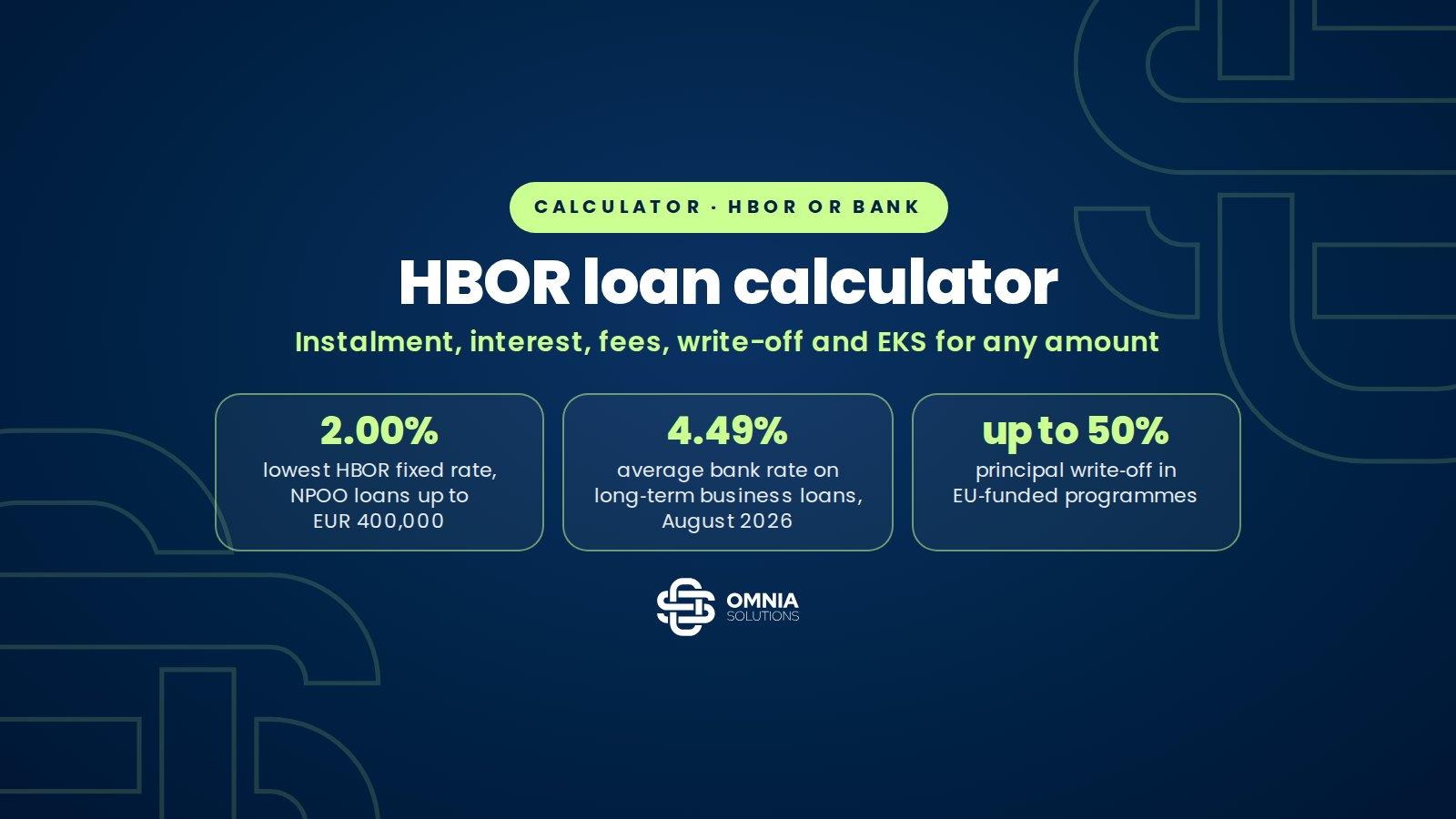
The calculator on this page compares an HBOR loan with a bank loan for the same amount, term and grace period and shows the instalment, total interest, fees, principal write-off and effective interest rate. In October 2026, HBOR programmes carry fixed interest rates from 2.00% to 4.00% for loans of up to EUR 400,000, and four programmes funded from EU sources lend half of the loan at 0.00% with a write-off of up to 40 or 50% of the principal. In August 2026, banks charged an average of 4.49% on new long-term loans to companies. For a EUR 200,000 loan over 10 years with 2 years of grace, HBOR’s Private sector investments programme at 3.90% costs EUR 49,341.98 in interest and fees, and an average bank loan with a 1% fee EUR 59,700.23, a difference of EUR 10,358.25.
In brief
- HBOR’s lowest published rate is 2.00% fixed, for direct loans of up to EUR 400,000 from the National Recovery and Resilience Plan (NPOO) for the digital and green transition and for defence and security, and for SME investments in research, development, innovation and artificial intelligence of up to EUR 1,000,000.
- Loans for production modernisation, sustainable tourism, agricultural processing and energy efficiency lend half of the principal at 0.00%, without a processing or commitment fee, with a write-off of up to 40 or 50% of the principal once the criteria are met.
- For private sector investments, young people, women and start-ups, working capital and EU projects, HBOR charges 0.30% for processing and 0.25% a year on the undrawn amount on direct loans, and on loans via a bank the bank may charge the borrower at most the same. The NPOO programmes have no processing fee. Under HBOR’s fee regulation, early repayment carries no fee, also for loans via a bank.
- Banks agree interest and fees on business loans case by case. None of the seven banks whose fee schedules we reviewed publishes a processing fee for business loans. The calculator starts from 1%, the top of the range of 0.25 to 1% we found in a county public call from 2026.
- The largest difference in HBOR’s favour comes from the 0.00% share of the loan and the principal write-off. For classic programmes and amounts above EUR 400,000 the difference depends on the actual offer, so enter the rate you were offered.
Interactive calculator
Loan cost comparison, HBOR and bank
| Item | HBOR | Bank |
|---|---|---|
| Monthly instalment during grace (interest only) | EUR 650.00 | EUR 765.00 |
| Monthly instalment during repayment | EUR 2,428.56 | EUR 2,493.13 |
| Monthly instalment after write-off | no write-off | |
| Total interest | EUR 48,741.98 | EUR 57,700.23 |
| Fees | EUR 600.00 | EUR 2,000.00 |
| Principal write-off | EUR 0.00 | none |
| Total cost of the loan (interest and fees less write-off) | EUR 49,341.98 | EUR 59,700.23 |
| Total you repay | EUR 249,341.98 | EUR 259,700.23 |
| Annual percentage rate (EKS) | 4.03% | 4.88% |
Saving with HBOR
EUR 10,358.25
Notes on the calculation
Chart
Cumulative cost of the loan over the years
The lines show interest and fees paid, less any write-off. The horizontal axis shows years from disbursement, and a drop in the orange line marks the principal write-off. Hover over or tap the chart.
Repayment plan by year
| Year | HBOR instalments | HBOR interest | HBOR write-off | HBOR principal at year end | Bank instalments | Bank interest | Bank principal at year end |
|---|
JavaScript is needed to calculate other amounts. The default example is shown.
This is an estimate, not an offer. HBOR or the bank sets the rate, fees, grace period and write-off in the loan decision, based on creditworthiness and the programme terms on the day of the decision. Rates are nominal and calculated monthly (annual rate divided by 12), the loan is disbursed in full at the start, and the EKS is calculated from monthly cash flows. If a principal write-off is included, the EKS includes it, whereas the EKS in an offer does not.
Sources: HBOR lending programmes and fee regulation, CNB Table G6 (August 2026). Checked on 29 October 2026.
How to use the calculator
The calculator compares two loans with the same amount, term and grace period. When you choose an HBOR programme, it fills in the programme’s interest rate, fees and maximum principal write-off. For the bank, the default is the Croatian National Bank (CNB) average rate for the term you chose and a processing fee of 1%. The average by term does not depend on the loan amount, so for larger loans enter the average by amount from the CNB table below or the rate you were offered. You can change every field and enter the offer you received.
- Amount and term. Enter the term including the grace period, as HBOR states it. A 10-year loan with 2 years of grace has 8 years of principal repayment.
- Grace period. Under HBOR’s General Terms of Lending, only interest on the drawn amount is paid during the grace period, which is included in the repayment term. The calculator applies the same grace period to the bank loan, although banks do not always grant one.
- Repayment method. HBOR as a rule contracts equal principal instalments and approves annuities on request. Banks most often offer annuities. With equal principal instalments the first instalment is higher and total interest is lower.
- Programmes with a 0.00% share. HBOR sets the rate on the other half of production modernisation, sustainable tourism and agricultural processing loans according to risk, and for energy efficiency loans the bank sets it. The calculator assumes the same rate as for the bank loan for that half. The actual rate depends on credit rating and collateral, so replace it with the rate from your offer.
- Amounts above EUR 400,000. In most programmes HBOR or the bank sets the rate for these amounts, with a subsidy of 1.00 to 3.00 percentage points depending on the type of investment and the programme. The calculator then shows an estimate, the bank rate less the SME subsidy stated with the programme, which should be replaced with the rate from your offer.
- EU projects. The rate in this programme depends on credit rating and collateral, from 3.24% to 12.71% under HBOR’s indicative table of 1 July 2026. The calculator uses 4.79%, the rate for a satisfactory rating (BB) with normal collateral. At that rate, an HBOR loan of EUR 200,000 with the term and grace period of Example 2 costs EUR 60,915.47 in interest and fees, which is EUR 1,215.24 more than a bank loan at the CNB average with a 1% fee. For this programme the comparison therefore depends on the rating and collateral HBOR determines.
- Principal write-off. The write-off, or capital rebate, is state aid granted only once the programme criteria are met. The calculator applies it at the end of the grace period, when the investment is usually completed, and deducts it from the EU-funded part of the loan. The rest is repaid until the end of the term, and you can change the write-off month in the advanced settings.
HBOR programme interest rates and fees in October 2026
The table summarises the terms of the private sector programmes open on the day we checked. The interest rates in the table are fixed. The fees come from HBOR’s regulation on fees for its services, version 4.2, in force from 1 October 2026.
| Programme | Interest rate | Processing and commitment fee | Repayment term and grace | Loan amount | Principal write-off |
|---|---|---|---|---|---|
| Private sector investments | up to EUR 400,000 3.90%, or 3.40% for special areas, agriculture, green and digital projects, RDI, social infrastructure, defence and exporters; above EUR 400,000 per offer, with a subsidy of 1.50 to 3.00 pp | 0.30% and 0.25% a year (no processing fee for defence) | up to 20 years, grace up to 3 (exceptionally 5) years | via a bank from EUR 50,000, direct from EUR 100,000, up to 75% of the investment | none |
| Young people, women, start-ups and special segments | direct 3.90%, via a bank at most 3.00% | 0.30% and 0.25% a year | up to 12 years, grace up to 3 years (exceptionally up to 14 years) | up to EUR 400,000, via a bank from EUR 50,000, direct from EUR 100,000 | none |
| NPOO, digital and green transition, defence and security | direct up to EUR 400,000 2.00%, above that at least 1.50%; digital transition via a bank at most 3.50% | no processing fee, 0.25% a year | up to 20 years, grace up to 3 years | direct from EUR 100,000, via a bank from EUR 50,000 | none |
| SME investments in RDI and AI (NPOO) | 2.00% | no processing fee, 0.25% a year | up to 15 years, grace up to 3 years | above EUR 100,000 up to EUR 1,000,000 (start-ups up to EUR 500,000) | none |
| Production modernisation loans | 0.00% on 50% of the loan from the ERDF, HBOR part risk-based | no fees | up to 15 years, grace up to 3 years | EUR 100,000 to 3,000,000 | up to 50% |
| Sustainable tourism loans | 0.00% on 50% of the loan from the ERDF, HBOR part risk-based | no fees | up to 20 years, grace up to 4 years | EUR 250,000 to 7,000,000 | up to 50%, for loans above EUR 500,000 |
| Agricultural processing loans | 0.00% on 50% of the loan from the CAP Strategic Plan, HBOR part risk-based | no fees | up to 20 years, grace up to 3 years | EUR 200,000 to 3,000,000 | up to 40% |
| Energy efficiency loans for businesses (via a bank) | 0.00% on 50% of the loan from the ERDF, bank part at the bank’s rate | no fees | up to 17 years, grace up to 3 years | up to EUR 3,000,000 | up to 50% |
| Working capital, long-term loan | up to EUR 400,000 4.00% | 0.30% and 0.25% a year | up to 6 years, grace up to 2 years | via a bank from EUR 50,000, direct from EUR 500,000 | none |
| EU projects | by credit rating and collateral from 3.24% to 12.71%, with a satisfactory rating and normal collateral 4.79%; fixed up to EUR 400,000, above that per offer | 0.30% and 0.25% a year | up to 20 years, grace up to 3 (exceptionally 5) years | via a bank from EUR 50,000, direct from EUR 100,000 | none |
The commitment fee of 0.25% a year is charged on the contracted but undrawn amount, from signing the contract until the loan moves into repayment. Programmes with a principal write-off do not charge it either. When a loan is granted via a commercial bank, the bank may charge the end borrower a processing fee of at most HBOR’s fee for direct lending, and neither HBOR nor the bank charges a fee for early repayment.
In the programmes for young people, women and start-ups and for RDI and AI investments, for businesses that cannot receive state aid or de minimis aid the effective interest rate may not be lower than the European Commission reference rate for that borrower. According to HBOR’s notice of 1 July 2026, the base rate for Croatia is 2.71% and the reference rates range from 3.31% to 12.71%, depending on credit rating and collateral.
What banks charge companies for loans
Banks set the interest rate on a business loan for each client separately, based on credit rating, collateral and term. The most reliable public indicator is the CNB’s statistics on interest rates on new loans to non-financial corporations, so the calculator uses the CNB average for the latest published month as the default bank rate.
| Type of new loan to a company | Average interest rate, August 2026 |
|---|---|
| Short-term loans, up to 1 year | 3.46% |
| Long-term loans, total | 4.49% |
| Long-term loans, 1 to 5 years | 4.37% |
| Long-term loans, over 5 years | 4.59% |
| Loans up to EUR 250,000, all terms | 4.04% |
| Loans up to EUR 250,000, rate fixed for 5 to 10 years | 4.69% |
| Loans of EUR 250,000 to 1,000,000, all terms | 4.13% |
| Loans of EUR 250,000 to 1,000,000, rate fixed for 5 to 10 years | 4.23% |
| Loans of EUR 250,000 to 1,000,000, rate fixed for over 10 years | 4.06% |
| Loans above EUR 1,000,000, all terms | 3.95% |
| Loans above EUR 1,000,000, rate fixed for 5 to 10 years | 3.97% |
Monthly averages fluctuate because they depend on how many large loans were granted in the month. Long-term loans to companies averaged 3.97% in June, 3.80% in July and 4.49% in August 2026, when the volume of new long-term loans was half that of July. Replace the calculator’s bank rate with your bank’s offer as soon as you have it.
The calculator chooses the bank rate by term only, while the CNB average also depends on the loan amount and the initial rate fixation period. For loans of EUR 250,000 or more, the averages by amount are below the 4.59% average for terms over 5 years, while for loans of up to EUR 250,000 with a rate fixed for 5 to 10 years the average is higher. For larger loans the comparison at the average by term therefore favours HBOR more than one at the average by amount, and for smaller loans the reverse applies. That is why Example 3 uses the average by amount.
Variable-rate loans are linked to a reference rate, to which the bank adds a margin. On 28 October 2026, three-month EURIBOR stood at 2.618%, six-month EURIBOR at 2.960% and twelve-month EURIBOR at 3.290%, according to Deutsche Bundesbank statistics. The national reference rate (NRS), calculated by the CNB, ranges from 0.33% to 0.79% for the euro in the second quarter of 2026, depending on the type. The cost of a variable-rate loan depends on how the rate moves in future, whereas the rates in HBOR’s programmes in the table are fixed.
None of the seven banks we reviewed on 29 October 2026, namely Zagrebačka banka, PBZ, Erste, OTP banka, Raiffeisenbank, Addiko and HPB, publishes a processing fee for business loans in its public fee schedules for business clients. The only official 2026 document in which we found such fees is the public call of Koprivnica-Križevci County of 10 April 2026 for subsidised working capital loans. In it, the banks state a fee of 0.25% (PBZ), 0.5% (Zagrebačka banka), 0.75% (HPB) and 1% (Erste). The calculator starts from 1.00%, the top of that range, which tilts the comparison in HBOR’s favour. In Example 2 the saving is EUR 10,358.25 with a bank fee of 1%, EUR 9,358.25 with 0.5% and EUR 8,858.25 with 0.25%. In its tariff for business clients, Addiko charges 3.00%, at least EUR 135, for early repayment of loans with a term of more than one year, and Erste charges 2.00% for withdrawing or changing a loan application.
How the instalment, total cost and EKS are calculated
The calculator works month by month, and the monthly interest rate is the annual rate divided by 12, as in HBOR’s own loan calculator. The loan is disbursed in full at the start, and repayment begins after the grace period.
- Annuity. The monthly instalment after the grace period follows the formula A = P × i / (1 − (1 + i)−n), where P is the principal, i the monthly interest rate and n the number of repayment months without grace.
- Equal principal instalments. The same share of principal, P / n, is repaid each month, with interest on the outstanding debt, so instalments fall over time.
- Grace period. In each month of grace only interest is paid, P × i.
- Total cost. The sum of all interest and fees less the principal write-off. If the write-off exceeds interest and fees, the cost is negative, meaning you repay less in total than you received.
- EKS. The effective interest rate (efektivna kamatna stopa, EKS) is the annual rate at which the present value of all instalments equals the amount disbursed less fees. The calculator derives it from the monthly internal rate of return (IRR) as (1 + IRR)12 − 1. That is why the EKS is slightly above the nominal rate even without fees, for example 4.69% at a rate of 4.59%. The EKS in an offer is calculated under the CNB’s decision on the effective interest rate and the actual payment dates, so it may differ by a few hundredths. When a principal write-off is included, the calculator includes it in the EKS, so the EKS can even be negative. Such an EKS is not comparable with the EKS in an offer, because the write-off is granted only once the criteria are met and is not part of the contracted repayment plan.
- Principal write-off. The amount written off reduces the EU-funded part of the loan, and the instalment is recalculated for the remaining months. The EU-funded part and the HBOR part are repaid pro rata.
We checked the calculation with 34 tests against an independent calculation in Python (numpy-financial) and against closed-form formulas. All examples below were calculated with the same calculator.
Example 1. A EUR 50,000 loan for a young entrepreneur
A young company invests EUR 50,000 in equipment and repays the loan over 7 years, with 12 months of grace. HBOR’s programme for young people, women and start-ups via a bank has a rate of up to 3.00% and a fee of up to 0.30%, and we compare it with a bank loan at the CNB average of 4.59% with a 1% fee.
| Item | HBOR, young people, women and start-ups, via a bank | Bank loan |
|---|---|---|
| Interest rate | 3.00% fixed | 4.59% |
| Monthly instalment during grace | EUR 125.00 | EUR 191.25 |
| Monthly instalment during repayment | EUR 759.68 | EUR 795.77 |
| Total interest | EUR 6,197.23 | EUR 9,590.59 |
| Processing fee | EUR 150.00 | EUR 500.00 |
| Total cost | EUR 6,347.23 | EUR 10,090.59 |
| EKS | 3.12% | 4.97% |
In this example the HBOR loan is cheaper by EUR 3,743.35. Via a bank the programme as a rule does not grant loans below EUR 50,000, so smaller investments need other sources, such as the HAMAG-BICRO micro loan, which we compared with HBOR and a bank in HAMAG loans in practice. All options for young people, women and start-ups are described in our guide Grants and loans for young people, women and start-ups 2026.
Example 2. A EUR 200,000 loan for equipment
A small company invests EUR 200,000 in equipment, with a 10-year term and 2 years of grace. We compare the Private sector investments programme at 3.90%, an NPOO loan for the digital or green transition at 2.00% and a bank loan at 4.59%.
| Item | HBOR, Private sector investments | HBOR, NPOO direct | Bank loan |
|---|---|---|---|
| Interest rate | 3.90% fixed | 2.00% fixed | 4.59% |
| Monthly instalment during grace | EUR 650.00 | EUR 333.33 | EUR 765.00 |
| Monthly instalment during repayment | EUR 2,428.56 | EUR 2,256.17 | EUR 2,493.13 |
| Total interest | EUR 48,741.98 | EUR 24,592.75 | EUR 57,700.23 |
| Processing fee | EUR 600.00 | EUR 0.00 | EUR 2,000.00 |
| Total cost | EUR 49,341.98 | EUR 24,592.75 | EUR 59,700.23 |
| EKS | 4.03% | 2.02% | 4.88% |
| Saving compared with the bank | EUR 10,358.25 | EUR 35,107.48 | baseline |
The NPOO loan at 2.00% is intended for strategic digital and green projects and for investments in defence and security, which must respect the principle of doing no significant harm to the environment. If an investment does not fall into these categories, the realistic comparison is with the Private sector investments programme, where HBOR is EUR 10,358.25 cheaper than the average bank loan with a bank fee of 1%, or EUR 8,858.25 with a fee of 0.25%. We describe the NPOO programmes in HBOR’s programmes for the digital and green transition and defence.
Example 3. A EUR 1,000,000 loan with a principal write-off
A manufacturing SME invests in a new production line and applies for a EUR 1,000,000 production modernisation loan, with a 12-year term and 2 years of grace. Half of the loan comes from the ERDF at 0.00%. For the bank we use the CNB average by amount, 4.06% for loans of EUR 250,000 to 1,000,000 with an initial rate fixation of over 10 years in August 2026, because it matches the loan amount and a long fixed-rate period. This average changes from month to month, and it was 4.40% in June and 4.39% in July. We assume that the rate on the HBOR part, which is set according to risk, is the same, 4.06%. For comparison we also show the Private sector investments programme, with an estimated rate of 2.56%, which is 4.06% less a subsidy of 1.50 percentage points, and a bank loan at 4.06% with a 1% fee.
| Scenario | Monthly instalment during repayment | Total interest | Principal write-off | Total cost | Saving compared with the bank |
|---|---|---|---|---|---|
| Production modernisation, no write-off | EUR 9,243.19 | EUR 149,783.23 | EUR 0.00 | EUR 149,783.23 | EUR 159,783.23 |
| Production modernisation, 20% write-off | EUR 7,576.53 | EUR 149,783.23 | EUR 200,000.00 | EUR −50,216.77 | EUR 359,783.23 |
| Production modernisation, 50% write-off | EUR 5,076.53 | EUR 149,783.23 | EUR 500,000.00 | EUR −350,216.77 | EUR 659,783.23 |
| Private sector investments, estimate 2.56% | EUR 9,454.30 | EUR 185,715.87 | EUR 0.00 | EUR 188,715.87 | EUR 120,850.60 |
| Bank loan, 4.06% | EUR 10,153.05 | EUR 299,566.46 | none | EUR 309,566.46 | baseline |
The result depends on the assumed rates. At the average by term of 4.59%, which the calculator sets for terms over 5 years, the saving from production modernisation without a write-off would be EUR 180,336.78. If HBOR set 4.79% for its part, as in the EU projects table for a satisfactory rating and normal collateral, the saving without a write-off against a bank loan at 4.06% would be EUR 131,414.34.
The write-off does not change total interest, because it is deducted from the ERDF part at 0.00%, but it lowers the instalment, because the amount written off is not repaid. With a 50% write-off the company repays EUR 649,783.23 in total, against EUR 1,149,783.23 without a write-off. For production modernisation loans the write-off criteria are Industry 4.0 solutions (10% for each solution accounting for at least 10% of the principal), digitalisation of business processes (2% per solution) and alignment with the Smart Specialisation Strategy (5%). Industry 4.0 and digitalisation solutions are proven with a statement from a court-appointed expert. Read more in Capital rebate, how to write off up to 50% of an HBOR loan and in our guide HBOR production modernisation loans.
When a bank loan is the better choice
- The investment is already paid for. Programmes with a principal write-off only recognise costs incurred after the investment notice or loan application and paid after the loan decision.
- The amount is too small. Via a bank HBOR as a rule does not grant loans below EUR 50,000, and directly below EUR 100,000, or EUR 500,000 for working capital.
- The money is needed quickly. In our experience, a decision on an HBOR loan via a bank has taken about 6 months.
- The investment is not eligible. Under HBOR’s General Eligibility Criteria, buying real estate or movable assets from related parties and investments for personal purposes are not eligible, and obligations to financial institutions can be refinanced with an investment loan only exceptionally, with HBOR’s prior consent.
- The offers are similar. If the rate offered for an amount above EUR 400,000 is close to the bank’s, the term, grace period, collateral and fees decide, and the calculator shows them through total cost and EKS.
What to check when comparing offers
- Besides the nominal rate and the instalment, compare the EKS and the total cost.
- Check whether the rate is fixed or variable. Rates in HBOR’s programmes are fixed, and a variable rate depends on EURIBOR or the NRS.
- Ask the bank for all fees, for processing, commitment and early repayment. HBOR charges no early repayment fee, while some banks charge up to 3%.
- A longer term lowers the instalment but raises total interest. The calculator shows both.
- Only include a principal write-off if the investment meets the programme criteria at the time of application. For agricultural processing loans, a project that does not meet the minimum write-off criteria is not eligible.
- Ask the bank and HBOR for a repayment plan and compare it with the yearly plan from the calculator.
We describe all HBOR programmes, documentation and the rules on when an investment may start in our guide HBOR loans for entrepreneurs 2026, and when a business plan or an investment study is needed in The key prerequisites for approval of investment loans. How Omnia Solutions prepares an HBOR loan application, direct or via a bank, is explained on HBOR loans, advisory and application preparation.
Frequently asked questions
Is an HBOR loan cheaper than a bank loan?
For the same amount and term it usually is, except for EU projects, where the rate depends on credit rating and collateral and may be higher than a bank’s. A EUR 200,000 loan over 10 years costs EUR 49,341.98 in interest and fees under HBOR’s Private sector investments programme at 3.90%, and EUR 59,700.23 as a bank loan at the CNB average of 4.59% with a 1% fee. With a bank fee of 0.25% the difference is EUR 8,858.25. The difference is largest in programmes with half of the loan at 0.00% and a principal write-off.
What is the interest rate on an HBOR loan in 2026?
The published fixed rates are 2.00% for the NPOO programmes and for SME investments in RDI and artificial intelligence, at most 3.00% for young people, women and start-ups via a bank, 3.24% to 12.71% for EU projects, depending on credit rating and collateral (4.79% with a satisfactory rating and normal collateral), 3.40% or 3.90% for private sector investments of up to EUR 400,000 and 4.00% for working capital. Programmes with a principal write-off lend half of the loan at 0.00%. For larger amounts HBOR or the bank sets the rate, with a subsidy.
What is the average bank interest rate on loans to companies?
According to the CNB, in August 2026 banks charged an average of 4.49% on new long-term loans to non-financial corporations, namely 4.37% for terms of 1 to 5 years and 4.59% for terms of more than 5 years. Short-term loans averaged 3.46%. The bank sets the actual rate based on creditworthiness and collateral.
What fees does HBOR charge?
On direct loans HBOR charges 0.30% for processing, at least EUR 100 and at most EUR 50,000, and 0.25% a year as a commitment fee on the undrawn amount. On loans via a bank HBOR charges the bank 0.15% for processing, and the bank may charge the borrower at most 0.30% for processing and 0.25% a year as a commitment fee. The NPOO programmes have no processing fee, and loans for production modernisation, sustainable tourism, agricultural processing and energy efficiency have no commitment fee either. Early repayment carries no fee, also for loans via a bank.
How is the EKS of a loan calculated?
The EKS is the annual rate at which all instalments, discounted to present value, equal the amount disbursed less fees. With monthly repayment the EKS is slightly above the nominal rate even without fees. In the calculator a principal write-off lowers the EKS, and with a large write-off it can even be negative. The EKS in an offer does not include the write-off, because it is granted only once the criteria are met.
How long is the grace period at HBOR and what is paid during it?
The longest grace period is 2 years for working capital, 3 years for most investment programmes and 4 years for sustainable tourism loans, and exceptionally up to 5 years. Only interest on the drawn amount is paid during the grace period, which is included in the repayment term.
Can the calculator replace an offer from a bank or HBOR?
No. The calculator shows an estimate based on published programme terms and average bank rates. HBOR or the bank sets the rate, fees, grace period and write-off in the loan decision, after assessing creditworthiness and the investment.
Sources
- HBOR, Private sector investments, programme in force from 10 August 2026, and full programme text (PDF), pp. 3 to 5
- HBOR, Entrepreneurship of young people, women, start-ups and other special segments, programme of 1 July 2026, PDF, pp. 2 and 3
- HBOR, Investments in the digital transition (NPOO), green transition and defence and security, programmes of 1 July 2026, and SME investments in RDI and AI, programme of 10 August 2026
- HBOR, Production modernisation loans, Sustainable tourism loans, Agricultural processing loans (applications from 28 October 2026) and Energy efficiency loans for businesses
- HBOR, Working capital, programme of 1 January 2026, and EU projects, programme of 1 September 2026, with the table of nominal interest rates of 1 July 2026
- HBOR, notice on the base, discount and reference rates, as of 1 July 2026
- HBOR, Regulation on fees for services provided by HBOR, version 4.2 of 1 October 2026, pp. 13 to 15 and 17, and Fees in lending
- HBOR, Decision on the General Terms of Lending, July 2026, pp. 8 and 9, and HBOR’s loan calculator
- CNB, Interest rates of credit institutions, Table G6 and Table G3, modified on 30 September 2026, and release for July 2026 of 31 August 2026
- CNB, National reference rate, second quarter of 2026, published on 28 August 2026
- Deutsche Bundesbank, money market rates (EURIBOR), values of 28 October 2026
- Koprivnica-Križevci County, public call for business loans, working capital, 10 April 2026
- Addiko Bank, tariff for business clients, 15 October 2026, and Erste, extract from the Corporate Banking tariff, 1 February 2025
All sources were reviewed on 29 October 2026. Programme terms may change, and the calculations are for information only and are not an offer. HBOR or the bank sets the interest rate, fees and write-off in the loan decision.
HBOR or bank
Let us check which loan suits your investment better and whether you meet the programme conditions
We will review your investment, the offers you have and the write-off criteria, and prepare your HBOR loan application, direct or via a bank. The introductory call is free.