The production modernisation loan of HBOR (Croatian Bank for Reconstruction and Development) is intended for micro, small and medium-sized enterprises in manufacturing that invest in new equipment, automation and digitalisation. The loan amounts to EUR 100,000 to 3,000,000. Half of the loan is financed from the European Regional Development Fund (ERDF) at 0% interest, and if the criteria are met, HBOR can write off up to 50% of the disbursed principal. The write-off depends on how many Industry 4.0 and digitalisation solutions the investment introduces and on whether it is aligned with the Smart Specialisation Strategy. Applications are submitted directly to HBOR, electronically.
This guide covers the programme conditions, the write-off criteria with a sample calculation, the required documentation, the step-by-step procedure and a comparison with other HBOR loans. The data are summarised from HBOR’s official programme and annexes, as of 19 October 2026.
In brief: key conditions
- Beneficiaries: micro, small and medium-sized enterprises registered for manufacturing (section C of NKD 2025) with a business unit or branch in Croatia.
- Loan amount: EUR 100,000 to 3,000,000, as a rule up to 85% of the investment value excluding VAT.
- Interest: 0% fixed on the half of the loan from the ERDF; on HBOR’s half, a fixed rate based on risk assessment.
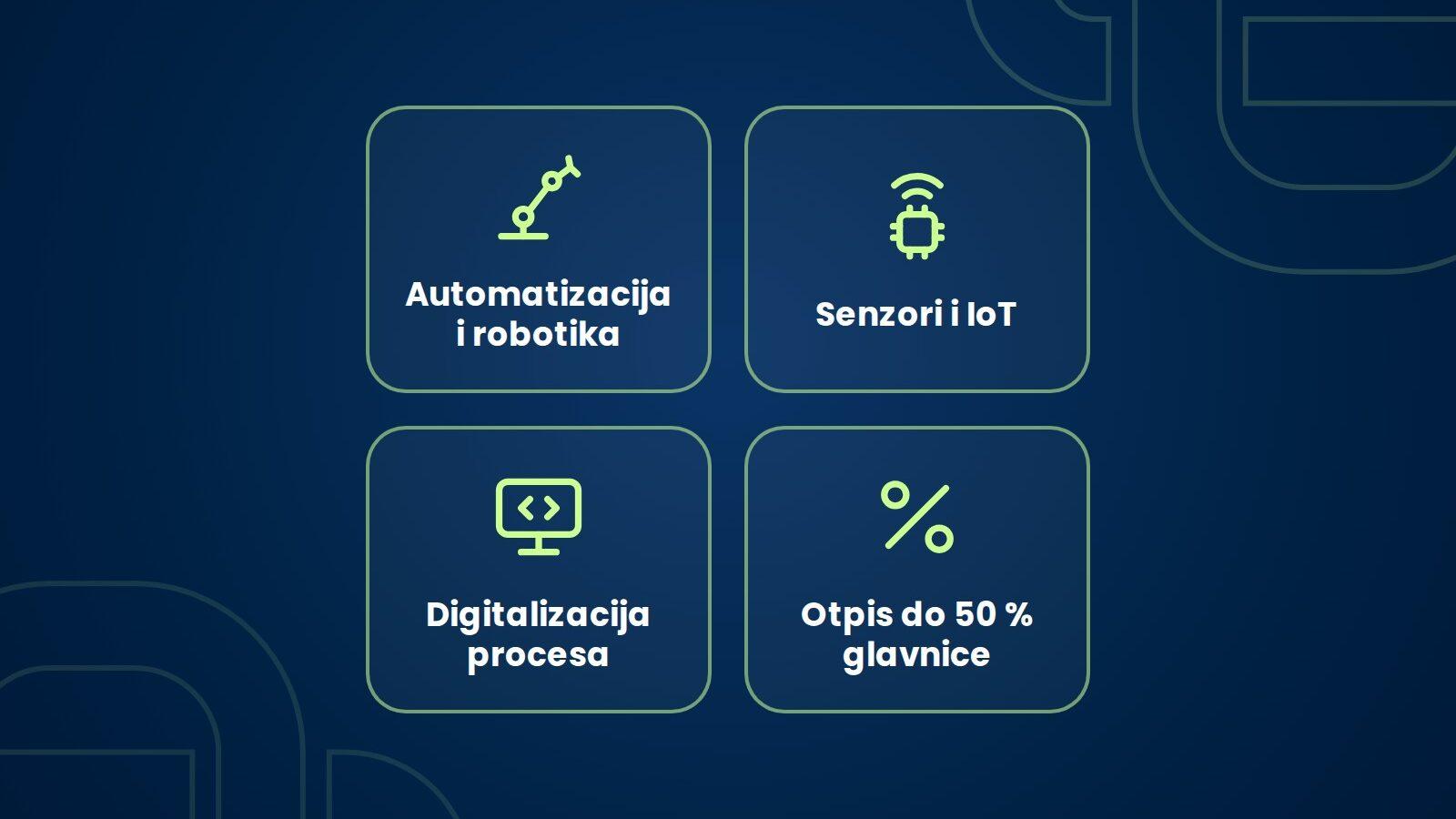
- Principal write-off (capital rebate): up to 50% of the total disbursed principal.
- Repayment: up to 15 years, including a grace period of up to 3 years.
- Working capital: up to 30% of the loan amount.
- Fees: no fee for processing the application or reserving the funds.
- Submission: directly to HBOR, electronically only; applications have been accepted since 29 January 2025.
How large a write-off can you achieve? Send us the loan amount you are planning and we will calculate how much of the loan carries 0% interest and the largest possible principal write-off. The rules are summarised on our page HBOR loan for production modernisation. The exact percentage depends on the criteria your investment meets.
What is the HBOR loan for production modernisation?
Loans for Production Modernisation (Krediti za modernizaciju proizvodnje) are a financial instrument that HBOR implements with funds from the European Regional Development Fund and its own funds, in a 50:50 ratio. The programme was launched on 29 January 2025, and HBOR announced at the time that EUR 79.7 million had been secured for it, half from the ERDF and half from HBOR’s own funds. The instrument was developed with the Ministry of Regional Development and EU Funds and the Ministry of Economy.
The aim of the programme is for manufacturing companies to invest in digital transformation, automation and Industry 4.0 solutions. This is why the principal write-off is tied to precisely such solutions. The programme was updated on 15 June 2026, and the conditions in this guide correspond to that version.
Who can apply for the loan?
Micro, small and medium-sized enterprises as defined by the European Commission (Recommendation 2003/361/EC) that are registered for manufacturing activities, that is, section C of the National Classification of Activities 2025 (NKD 2025), can apply for the loan. The business unit or branch in Croatia must be registered no later than the signing of the loan agreement.
The following, among others, are not eligible for the loan:
- large companies and undertakings in difficulty;
- activities excluded under the State aid and ERDF rules, for example the production and processing of tobacco and investments related to fossil fuels;
- entrepreneurs that have already contracted a loan under this programme, as one beneficiary can receive only one loan.
If you are investing in a slaughterhouse or a plant for processing cereals, fruit or vegetables, also see HBOR’s Loans for Processing of Agricultural Products (Krediti za preradu poljoprivrednih proizvoda), for which applications are accepted from 28 October 2026.
What can be financed?
The loan finances investments in fixed assets, that is, tangible and intangible assets, that constitute an initial investment. Four types of investment are eligible:
- setting up a new business unit;
- extending the capacity of an existing business unit;
- diversifying the output of a business unit into products it has not produced before;
- a fundamental change in the overall production process.
If they are linked to the initial investment, the following can also be financed:
- strengthening digital skills and training employees, including e-learning;
- accessibility features for persons with disabilities;
- investments in renewable energy sources.
Working capital may account for no more than 30% of the contracted loan amount, and the purchase of land no more than 10% of the loan amount (15% for derelict or former industrial sites with buildings).
What is not financed
- investments started or completed before the Investment Notification (Najava ulaganja) or the application was submitted;
- refinancing of existing loans;
- VAT, except for entrepreneurs that are not registered for VAT or carry out VAT-exempt activities;
- investments outside Croatia;
- investments that do not comply with the “do no significant harm” (DNSH) principle for the environment or do not meet the climate resilience requirements.
The loan cannot be used to co-finance or pre-finance grants, and aid received from this instrument cannot be reimbursed from grants.
Loan conditions
| Item | Condition |
|---|---|
| Loan amount | EUR 100,000 to 3,000,000 |
| Financing share | as a rule up to 85% of the investment value excluding VAT; if regional aid is granted, no more than 75%, as the own contribution for fixed assets must be at least 25% |
| Sources of funds | ERDF and HBOR, in a 50:50 ratio |
| Interest on the ERDF part | 0.00% per year, fixed |
| Interest on HBOR’s part | fixed, set for each loan based on risk assessment |
| Capital rebate | up to 50% of the total disbursed principal, from the ERDF part |
| Repayment period | up to 15 years, including a grace period of up to 3 years |
| Instalments | as a rule equal monthly, quarterly or semi-annual instalments |
| Drawdown period | as a rule up to 12 months, a longer period is also possible |
| Fees | no fee for processing the application or reserving the funds; other fees on HBOR’s part in line with HBOR’s rulebook |
| Collateral | based on HBOR’s risk assessment (e.g. debentures, bills of exchange, pledges on assets, guarantees) |
| Lending method | direct, the application is submitted to HBOR electronically only |
Funds for fixed assets are paid directly to the supplier or contractor, and working capital can be paid into the beneficiary’s account with documentation on its purpose. Refunds are possible only for costs incurred after the Investment Notification was submitted (or, if no Notification was submitted, after the loan application was submitted) and paid after the loan approval decision.
Capital rebate: how the write-off of up to 50% of the principal works
The capital rebate is a write-off of part of the loan principal. It is granted as State aid in the form of a grant, and it is the part of the loan financed from the ERDF that is written off. In total it can amount to no more than 50% of the disbursed principal and must stay within the permitted aid intensity for the individual beneficiary.
The write-off percentage is added up according to three criteria from Annex 2 of the programme:
| Criterion | Write-off | Condition |
|---|---|---|
| A. Industry 4.0 solutions (smart factory) | 10% for each solution | the cost of each solution must be at least 10% of the total loan principal |
| B. Digital solutions for business processes | 2% for each solution | the solution must be included in the Digital Transformation Plan and the List of Planned Products and Solutions |
| C. Alignment with the Smart Specialisation Strategy (S3) to 2029 | 5% | the result of the investment falls within one of the S3 thematic areas |
| Total | no more than 50% | the criteria can be combined |
What counts as an Industry 4.0 solution
Annex 2 lists four groups of solutions:
- automation and robotisation of processes and of control and monitoring;
- the Internet of Things (IoT) and sensors;
- machines controlled by artificial intelligence;
- manufacturing information systems for data exchange during and after production.
Several products can form one solution if they work as a whole in the production process. This is why it is important to decide in advance how the solutions will be grouped, as a solution is recognised only if its cost reaches 10% of the loan principal. To learn what Industry 4.0 is and how it differs from Industry 5.0, read the guide Industry 4.0, 5.0 and 6.0.
Digital solutions for business processes
Each digital solution adds 2%. Examples from Annex 2 are ERP, document management systems, HR systems, CRM, business process management, fleet and asset management, digital archives and registers, digital signatures, payment systems and system integrations. The related infrastructure and equipment are also eligible.
Smart Specialisation Strategy (S3)
For an additional 5%, the result of the investment must fall within one of the seven thematic priority areas of S3 to 2029: personalised healthcare; smart and clean energy; smart and green transport; security and dual use; sustainable and circular food; customised and integrated wood products; digital products and platforms. The link is explained in the business plan or investment study.
Sample calculation
Fictitious example. The example is for illustration only; actual conditions depend on HBOR’s assessment. A furniture manufacturer is planning an investment of EUR 1,400,000 excluding VAT and is applying for a loan of EUR 1,000,000 (71% of the investment value). Half of the loan, EUR 500,000, comes from the ERDF at 0% interest. An Industry 4.0 solution is recognised if it costs at least EUR 100,000, that is, 10% of the principal.
| Solution | Cost | Write-off |
|---|---|---|
| Robotic machining cell (I4.0) | EUR 260,000 | 10% |
| Sensors and IoT machine monitoring (I4.0) | EUR 140,000 | 10% |
| Manufacturing information system, MES (I4.0) | EUR 120,000 | 10% |
| ERP system (digital solution) | – | 2% |
| Document management system (digital solution) | – | 2% |
| Wood products, S3 area | – | 5% |
| Total | 39% = EUR 390,000 |
Had the investment included one more Industry 4.0 solution of at least EUR 100,000, the write-off would have been 49%. More than 50% is not possible even with more solutions, and the write-off must also stay within the permitted aid intensity for that entrepreneur.
How large a write-off can you achieve? Send us the loan amount you are planning and we will calculate how much of the loan carries 0% interest and the largest possible principal write-off. The rules are summarised on our page HBOR loan for production modernisation. The exact percentage depends on the criteria your investment meets.
How the criteria are demonstrated
- Before approval (ex ante): an authorised court expert in electronics, electrical engineering, computer science or telecommunications confirms that the solutions in the Digital Transformation Plan (Plan digitalne transformacije) and the List of Planned Products and Solutions (Popis planiranih produkata i rješenja) are indeed Industry 4.0 or digitalisation solutions. Contracts, offers or pro forma invoices are attached as well. Alignment with S3 is explained in the business plan or investment study.
- After the investment (ex post): the expert confirms that the solutions have been implemented and installed and that they are covered by the loan agreement, with evidence such as photographs or a list of employees with licences.
- Rebate request: after the investment, HBOR’s form “Request for Approval of the Capital Rebate – KMP” (Zahtjev za odobrenje kapitalnog rabata – KMP) is submitted.
Read more about how the principal write-off works in our guide to the capital rebate.
What documentation is required?
HBOR publishes the forms and the list of documentation on the programme page. The most important parts are:
- HBOR application and forms: the application for direct lending (KMP), client and investment tables, statements on eligibility, company size, aid received and related persons, a statement on the use of the property and forms on beneficial owners.
- Business plan or investment study: for loans up to EUR 400,000 a business plan using HBOR’s template, and for larger amounts, as a rule, an investment study; the exact requirement is set out in the documentation list for this programme. HBOR does not prepare these documents.
- Rebate documentation: the form “Expected Criteria for the Capital Rebate – KMP” (Očekivani kriteriji za kapitalni rabat – KMP), the Digital Transformation Plan, the List of Planned Products and Solutions and the court expert’s statement.
- Environmental criteria: the Self-Assessment Questionnaire and the Questionnaire for Assessing Alignment with the Paris Agreement, and evidence on the DNSH principle and climate resilience in line with Annex 3.
- Technical documentation: offers and pro forma invoices and, if construction is involved, the main design and permits.
- Financial and status documentation: financial statements and other documents depending on the legal form, and documentation for the collateral.
DNSH and climate resilience
According to Annex 3, the project must not cause significant harm to any of the six environmental objectives: climate change mitigation, climate change adaptation, water and marine resources, the circular economy, pollution prevention and biodiversity. Compliance is demonstrated by citing the folder and page of the main design or the item in the bill of quantities, and if no main design is needed, by a separate study prepared by authorised experts. The climate resilience of the infrastructure is also shown, in line with the European Commission’s technical guidance for the 2021–2027 period. Where the modernisation concerns production itself, this is demonstrated for all sites, buildings or business units where production takes place.
Step-by-step procedure
- Eligibility check: activity in section C, company size, type of investment and excluded activities.
- Investment Notification: costs are recognised only from the submission of the Notification or the application. According to HBOR’s answers to frequently asked questions, if more than 6 months pass between the Notification and the application, costs are recognised only from the submission of the application, and an investment started before then may become ineligible.
- Structuring the investment: grouping the Industry 4.0 solutions so that each reaches 10% of the principal, selecting the digital solutions and making the link with S3.
- Preparing the documentation: business plan or investment study, Digital Transformation Plan, court expert’s statement, DNSH and forms.
- Electronic submission of the application via the form on HBOR’s programme page.
- Processing at HBOR: formal check, financial and non-financial analysis, credit proposal, decision, agreement and collateral. HBOR does not publish a processing time.
- Drawing down the loan: as a rule within 12 months, through payments to suppliers.
- Demonstrating the criteria and requesting the rebate after the investment has been carried out.
Most common mistakes
- The investment started before the Investment Notification or the application. The start means the start of works, the first legally binding order for equipment or any other commitment that makes the investment irreversible, whichever comes first. The purchase of land, permits and feasibility studies are not considered the start.
- An Industry 4.0 solution does not reach 10% of the principal. In that case it does not bring a 10% write-off. Grouping equipment into a single unit should be planned before the application.
- The solutions are not described in the Digital Transformation Plan. The expert confirms only solutions from the Plan and the List of Planned Products.
- DNSH is not built into the main design. Revising the design afterwards prolongs the preparation.
- No own contribution has been planned. With regional aid, at least 25% of the fixed asset costs must be covered without public support.
From practice: PG Orehovec
For PG Orehovec from Veliki Bukovec, which raises and processes poultry, Omnia Solutions prepared the application under this programme. The investment in expanding capacity and automating the slaughterhouse is worth almost EUR 2 million, the loan amounts to around EUR 1.45 million and the 50% capital rebate to approximately EUR 730,000. The project included an investment study, a Digital Transformation Plan and documentation on DNSH and climate resilience. Read the full case study.
Comparison with other HBOR loans
| Loans for Production Modernisation | Loans for Processing of Agricultural Products | Energy Efficiency Loans | Private Sector Investment | |
|---|---|---|---|---|
| For whom | SMEs in manufacturing (section C) | SME processors: slaughterhouses, cereals, fruit and vegetables | entities of all sizes and legal forms in the manufacturing and commercial services sectors, registered for at least 1 year | private sector: companies, sole proprietorships (obrt), family farms (OPG), cooperatives, etc. |
| Amount | EUR 100,000 to 3,000,000 | EUR 200,000 to 3,000,000 | up to EUR 3,000,000 | direct, as a rule from EUR 100,000; via a bank from EUR 50,000 |
| Interest | 0% on half of the loan; HBOR’s part based on risk | 0% on half of the loan; HBOR’s part based on risk | 0% on the ERDF part; the bank’s part as set by the bank | up to EUR 400,000: 3.40% or 3.90% fixed |
| Principal write-off | up to 50% | up to 40% | up to 50% | none |
| Repayment | up to 15 years, grace period up to 3 | up to 20 years, grace period up to 3 | up to 17 years, grace period up to 3 | up to 20 years, grace period up to 3 (exceptionally up to 5) |
| Submission | directly to HBOR, electronically | directly to HBOR | via commercial banks | directly or via a bank |
More detail: HBOR loans for entrepreneurs 2026, HBOR energy efficiency loans and HBOR loans: advice and application preparation.
How can Omnia Solutions help you?
Omnia Solutions from Zagreb prepares applications for HBOR loans on a turnkey basis. For this programme, this includes:
- checking the eligibility of the company and the investment;
- structuring the investment and estimating the possible write-off according to the Annex 2 criteria;
- preparing the business plan or investment study and the Digital Transformation Plan;
- coordinating with the court expert and the designer on DNSH and climate resilience;
- submitting the application and communicating with HBOR until the decision;
- support in drawing down the loan and demonstrating the criteria for the rebate.
Planning an investment in production? Email us at info@omniasolutions.hr or call us on 097 7969 679. Send us your planned loan amount and we will calculate the possible write-off. The introductory call is free.
Frequently asked questions
What is the HBOR loan for production modernisation?
It is an HBOR financial instrument for micro, small and medium-sized enterprises in manufacturing. A loan of EUR 100,000 to 3,000,000 is financed half from the European Regional Development Fund, at 0% interest on that part, and if the criteria are met, a write-off of up to 50% of the disbursed principal is possible.
Who can apply for the HBOR loan for production modernisation?
Micro, small and medium-sized enterprises registered for manufacturing (section C of NKD 2025) with a business unit or branch in Croatia, no later than the signing of the agreement. Undertakings in difficulty and activities excluded under the aid rules are not eligible, and one beneficiary can receive only one loan.
What share of the investment does HBOR finance?
As a rule, up to 85% of the investment value excluding VAT. If regional aid is granted, the entrepreneur must provide at least 25% of the fixed asset costs without public support, so HBOR then finances no more than 75%.
What is the interest rate?
On the half of the loan from the ERDF, the interest rate is 0.00% per year, fixed. On HBOR’s half, a fixed rate applies that HBOR sets for each loan based on risk assessment.
How is the write-off of up to 50% of the principal achieved?
The write-off is added up according to the criteria: 10% for each Industry 4.0 solution costing at least 10% of the loan principal, 2% for each digital business process solution and 5% for alignment with the Smart Specialisation Strategy to 2029. In total no more than 50% of the disbursed principal. Industry 4.0 and digitalisation solutions are confirmed by an authorised court expert before and after the investment, and alignment with S3 is explained in the business plan or investment study.
What counts as an Industry 4.0 solution?
According to Annex 2, these are automation and robotisation of processes, the Internet of Things and sensors, machines controlled by artificial intelligence and manufacturing information systems for data exchange during and after production. Several products can form one solution if they work as a whole.
Can I use the loan to finance working capital or land?
Yes, with limits. Working capital may account for no more than 30% of the contracted loan amount, and the purchase of land no more than 10% of the loan amount (15% for derelict or former industrial sites with buildings).
Can I start the investment before the loan is approved?
Not before submitting the Investment Notification or the loan application. Investments started before then are not eligible, and only costs incurred after the Notification or application and paid after the loan approval decision are refunded.
What documentation is required?
The application and HBOR’s forms, a business plan (for loans up to EUR 400,000) or an investment study, the Digital Transformation Plan, the List of Planned Products and Solutions, the court expert’s statement, the form on the expected criteria for the rebate, the questionnaires on environmental criteria and evidence on the DNSH principle, and offers and pro forma invoices.
How long does the procedure take?
HBOR does not publish a processing time. The duration depends on the complexity of the investment and the completeness of the documentation, and the investment study, the Digital Transformation Plan, the court expert’s statement and the DNSH documentation usually take the most time.
How can I find out the possible write-off for my investment?
Send us the planned loan amount by email or call us, and we will calculate how much of it carries 0% interest and the largest possible write-off. The exact percentage depends on the number and value of the Industry 4.0 and digitalisation solutions and on alignment with S3.
Sources
- HBOR: Loans for Production Modernisation (programme page and forms)
- HBOR: Lending programme, amendment of 15 June 2026
- HBOR: Annex 1 – Ineligible activities and loan beneficiaries (8 June 2026)
- HBOR: Annex 2 – Criteria for the capital rebate
- HBOR: Annex 3 – Instructions on DNSH and infrastructure resilience
- HBOR: announcement of the programme launch (29 January 2025)
- HBOR: Frequently asked questions, general (Investment Notification)
- Smart Specialisation Strategy to 2029: thematic priority areas (ministry form)
- HBOR: Energy Efficiency Loans for Businesses and Private Sector Investment
- Omnia Solutions: PG Orehovec case study (6 May 2026)
The conditions are summarised from official sources as of 19 October 2026 and may change. Check the final availability and conditions in HBOR’s official documentation or with us. The decision on the loan and the capital rebate is made by HBOR.