HBOR loans for processing of agricultural products: conditions, up to 40% principal write-off and documentation
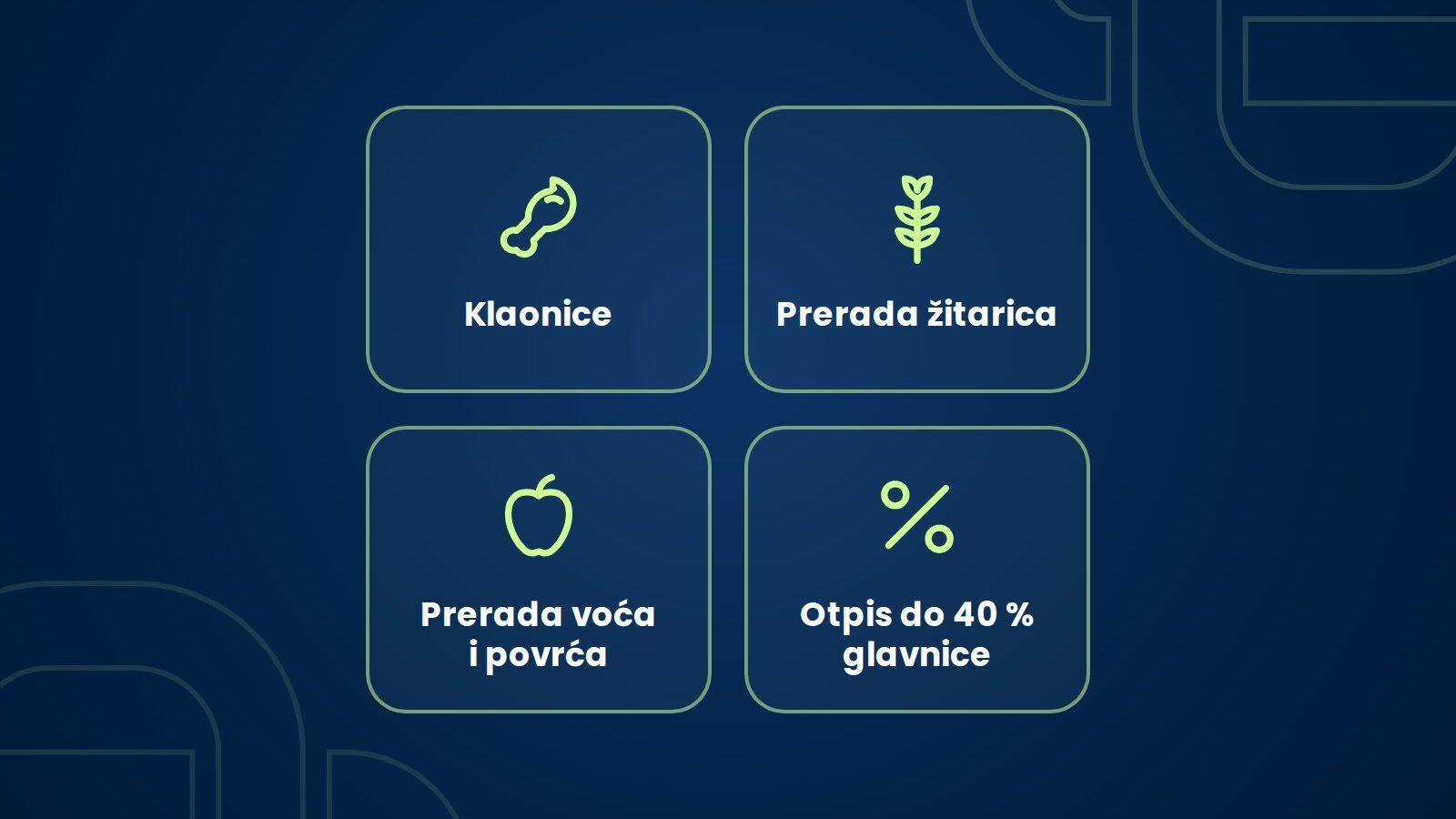
From 28 October 2026, HBOR (Croatian Bank for Reconstruction and Development) accepts applications for Loans for Processing of Agricultural Products (Krediti za preradu poljoprivrednih proizvoda). This is a new financial instrument from the Common Agricultural Policy Strategic Plan (CAP Strategic Plan, SP ZPP) for micro, small and medium-sized processors investing in slaughterhouses, cereal processing plants or fruit and/or vegetable processing plants. The loan amounts to EUR 200,000 to 3,000,000. Interest on half of the loan is 0%, and a write-off of up to 40% of the principal (capital rebate) is also possible. The condition is that the investment increases processing capacity by more than 5% or establishes new capacity.
In brief: key conditions
- Beneficiaries: micro, small and medium-sized processors of agricultural products (companies, sole proprietorships (obrt), family farms (OPG), cooperatives, producer organisations and other legal entities) with a registered office or branch in Croatia.
- Sectors: slaughterhouses, cereal processing, fruit and/or vegetable processing.
- Loan amount: EUR 200,000 to 3,000,000, as a rule up to 85% of the estimated investment value.
- Interest: 0.00% fixed on the half of the loan from CAP Strategic Plan funds; on HBOR’s half, a fixed rate based on risk assessment.
- Repayment: up to 20 years, including a grace period of up to 3 years.
- Principal write-off (capital rebate): up to 40% of the total disbursed principal, depending on the capacity increase and the origin of the raw material.
- Fees: no fee for processing the application or reserving the funds.
- Deadlines: applications from 28 October 2026; disbursements until 31 December 2029.
- Not eligible: working capital, refinancing and investments started before the Investment Notification (Najava ulaganja) or the loan application.
What are HBOR’s Loans for Processing of Agricultural Products?
The Ministry of Agriculture, Forestry and Fisheries, as the managing authority for the CAP Strategic Plan 2023–2027, has entrusted HBOR with implementing the financial instrument “Loans for Processing of Agricultural Products”. The funds are provided by the CAP Strategic Plan and HBOR in a 50:50 ratio. The aim is more favourable financing for investments that strengthen the competitiveness and market position of processors in particularly sensitive sectors.
In the Strategic Plan, the programme is listed as intervention 73.11.FI “Support for investments in the processing of agricultural products” (Potpora za ulaganja u preradu poljoprivrednih proizvoda). For SP ZPP loans with a capital rebate, implemented by HAMAG-BICRO (Croatian Agency for SMEs, Innovations and Investments) and HBOR, the Ministry has announced a total of almost EUR 47 million. How much of this is earmarked for this HBOR programme alone has not been made public.
The loan is granted directly: you submit the application and documentation to HBOR, without a commercial bank. Only one loan under this programme can be contracted with one beneficiary, including its linked and partner enterprises.
We compared HBOR’s other programmes, with interest rates from 2% and a write-off of up to 50% of the principal, in the guide HBOR loans for entrepreneurs.
Who can apply for the loan?
Micro, small and medium-sized enterprises as defined by the European Commission (Recommendation 2003/361/EC) that process agricultural products can apply for the loan. The legal form is not decisive: they can be companies, producer organisations, sole proprietors (obrt), natural persons carrying out an independent activity, family farms, cooperatives and other legal entities.
In addition, the following conditions must be met:
- both the raw material and the final product after processing must be agricultural products listed in Annex I to the Treaty on the Functioning of the EU (TFEU);
- entities engaged exclusively in processing must be registered for processing, that is, for the activity linked to the planned investment, no later than the submission of the loan application;
- entities engaged in both primary production and processing must be entered in the Register of Farmers (Upisnik poljoprivrednika) and have a registered processing activity linked to the investment, also no later than the submission of the application;
- the registered office or branch must be registered in the Republic of Croatia.
Among others, the following are not eligible for the loan: undertakings in difficulty, entities that already have a loan approved under this programme and entities excluded under the aid rules and HBOR’s eligibility criteria. The investment must be financially sustainable and carried out in Croatia.
Which investments can be financed?
The loan is intended for investments in fixed assets, that is, in tangible and intangible assets, in three sectors:
- meat processing: construction, purchase, reconstruction and/or equipping of slaughterhouses;
- cereal processing: construction, purchase, reconstruction and/or equipping of cereal processing plants;
- fruit and/or vegetable processing: construction, purchase, reconstruction and/or equipping of fruit and/or vegetable processing plants.
The purchase of used equipment is also eligible. The purchase of an existing plant can also be financed, subject to two conditions:
- if the plant is not operating at the time of the application, the purchase must be linked to restarting or improving production;
- if the plant is operating at the time of the application, the purchase must not be a mere transfer of ownership but must include a new investment, modernisation or capacity expansion.
What is not financed
- working capital;
- refinancing of existing loans;
- investments completed or started before the submission of the Investment Notification or the loan application;
- the purchase of assets from related persons or involving a conflict of interest;
- VAT, except for beneficiaries that are not registered for VAT or carry out VAT-exempt activities;
- investments where the raw material or the final product is not listed in Annex I to the TFEU;
- interest on debt and the purchase of land above the limits set by the Common Agricultural Policy rules.
The loan cannot be used to co-finance or pre-finance grants. Likewise, aid received from this instrument cannot be reimbursed from grants.
Loan conditions
| Item | Condition |
|---|---|
| Loan amount | EUR 200,000 to 3,000,000 |
| Financing share | as a rule up to 85% of the estimated investment value (excluding VAT, except for beneficiaries outside the VAT system or exempt from VAT) |
| Sources of funds | CAP Strategic Plan and HBOR, in a 50:50 ratio |
| Interest on the CAP Strategic Plan part | 0.00% per year, fixed |
| Interest on HBOR’s part | fixed, set for each loan based on risk assessment |
| Capital rebate | up to 40% of the total disbursed principal, from the CAP Strategic Plan part |
| Repayment period | up to 20 years, including a grace period of up to 3 years |
| Instalments | as a rule equal monthly, quarterly or semi-annual instalments |
| Drawdown period | as a rule up to 12 months (a longer period is possible, depending on the investment) |
| Fees | no fee for processing the application or reserving the funds; other fees on HBOR’s part in line with HBOR’s rulebook |
| Collateral | based on HBOR’s risk assessment (e.g. debentures, bills of exchange, pledges on assets, guarantees) |
| Lending method | direct, the application is submitted to HBOR |
| Applications | from 28 October 2026 |
| Loan disbursement | by 31 December 2029 at the latest (the rebate criteria can also be met later) |
The loan is disbursed directly to the seller, supplier or works contractor, on the basis of documentation on the intended use. Refunds are allowed only for eligible costs incurred after the submission of the Investment Notification (or, if no Notification was submitted, after the submission of the loan application) and paid after the loan approval decision.
Capital rebate: how much of the principal can be written off?
The capital rebate is a write-off of part of the loan principal. It is granted as aid in the form of a grant and can amount to no more than 40% of the total disbursed principal. It is the part of the loan financed from CAP Strategic Plan funds that is written off.
The percentage depends on two things: how much you increase capacity (for slaughterhouses, slaughter capacity; for cereals and for fruit and vegetables, daily processing capacity in kg/day) and where the raw material comes from. The criteria are the same for all three sectors:
| Increase in existing capacity | At least 50% of raw material from own production or short supply chains | Regardless of the source of raw material |
|---|---|---|
| more than 5% up to and including 10% | 10% | 5% |
| more than 10% up to and including 15% | 25% | 10% |
| more than 15% | 40% | 15% |
| establishing new capacity (for the first time) | 40% * | 15% |
In brief:
- The largest write-off, 40%, goes to those who increase capacity by more than 15% and who, in the last two years, produced at least half of their raw material themselves or bought it directly from producers within 100 km. For new capacity, only own production counts. Others can achieve no more than 15%.
- Capacity must increase by more than 5% or new capacity must be established. This is a condition for the loan, and HBOR already checks it at approval.
- The increase must come from the investment. Additional shifts without a new investment do not count.
What are short supply chains and own production?
Short supply chains cover raw material sourced within 100 km as the crow flies from the plant, directly from agricultural producers, without intermediaries. Own production includes the production of the beneficiary and its linked enterprises. If the beneficiary is a producer organisation, the production of all its members also counts as own production.
For slaughterhouses, “slaughter capacity” means the actual quantity of live animals slaughtered. Other meat processing stages in the same plant are not included in the calculation. The rebate is therefore calculated on slaughtering, not on cutting, processing or packaging.
Sample calculation
The example is fictitious and serves only to illustrate the programme rules; actual conditions depend on HBOR’s assessment. A fruit processor is planning an investment of EUR 1,250,000 and is applying for a loan of EUR 1,000,000 (80% of the investment value). Half of the loan, EUR 500,000, comes from CAP Strategic Plan funds at 0% interest, and the other half from HBOR’s funds at a fixed rate based on risk assessment.
- If in the last two years at least half of the fruit came from the processor’s own orchards or directly from producers within 100 km, and the processor increases daily processing capacity by more than 15%, the rebate is 40%, that is, EUR 400,000 of principal written off.
- If the same increase is achieved with fruit from other sources, the rebate is 15%, that is, EUR 150,000.
- If capacity increases by only 4%, the processor does not meet the condition for this loan.
The rebate is calculated on the total disbursed principal and is granted only after the criteria have been demonstrated. The final decision on the loan and the rebate is made by HBOR.
How are the rebate criteria demonstrated?
The criteria are checked twice: before the loan is approved (ex ante) and after the investment has been carried out (ex post).
- The technological design is the main evidence. It must clearly show the existing and the new total capacity and the layout of machinery and equipment, linked to the offers and technical specifications. The existing (“old”) technological design serves as evidence of the current situation.
- Folders of the main design (mechanical, electrical, architectural) or an offer, preliminary contract or pro forma invoice with a technical specification, depending on the type of investment.
- A statement by an authorised agronomist of the Croatian Chamber of Agronomists (Hrvatska agronomska komora), ex ante and ex post, confirming the planned or achieved capacity and the share of raw material from own production or short supply chains. The list of agronomists and the procedure are published on the website of the Croatian Chamber of Agronomists.
- Existing buildings must have a building permit and a use permit. Capacities must be consistent across all documents and expressed in the same unit of measurement.
After the investment, HBOR checks the use permit, the sales contract or invoice and the registration of the facility: for slaughterhouses, the decision approving the establishment and the Register of Approved Establishments of the Ministry of Agriculture, Forestry and Fisheries, and for cereal, fruit and vegetable processing, an extract from the State Inspectorate’s Register of Food Business Operators.
What documentation is required?
HBOR has published a documentation list for the programme that also serves as a checklist. The most important items are:
- The loan application and HBOR’s forms (statements on eligibility, company size, aid received and related persons; for loans above EUR 400,000, also the client and investment tables).
- A business plan using HBOR’s template for loans up to EUR 400,000. For loans above EUR 400,000, an investment study is required if the loan exceeds 20% of the applicant’s total assets for the previous year, and if it does not, a business projection in Excel.
- Capital rebate documentation: the ex ante statement of the authorised agronomist, the form “Expected Criteria for the Capital Rebate” (Očekivani kriteriji za kapitalni rabat) and evidence in line with Annex 2.
- Technical documentation: the technological design for the existing and the planned situation, the main design if a building is being constructed or its capacity increased, permits where applicable, and offers, pro forma invoices and bills of quantities (valid or, as a rule, not older than 3 months).
- Status and financial documentation: financial statements for the previous two years, BON2/SOL2, a certificate from the Tax Administration and other documents, depending on the legal form.
- Documentation for the loan collateral, for example a valuation report for real estate or equipment.
Documents marked in HBOR’s list as mandatory at submission must be attached to the application. If any of them is missing, the application is not considered and is returned to the applicant. If HBOR requests additional documents during processing, the deadline is 30 days, and HBOR can also set a shorter one.
What to watch out for before starting the investment?
- Do not start the investment before submitting the Investment Notification or the loan application. Investments started before then are not eligible. The start of works means the start of construction works, the first legally binding order for equipment or any other commitment that makes the investment irreversible, whichever comes first. The purchase of land and preparatory work, such as obtaining permits and feasibility studies, are not considered the start of works. If you submit the Investment Notification first, watch the deadline: according to HBOR’s answers to frequently asked questions, if more than 6 months pass between the Notification and the loan application, costs are recognised only from the submission of the application, and an investment started before then may become ineligible.
- The rebate is planned in advance. The capacity increase and the origin of the raw material must already be demonstrable in the application, through the technological design and the agronomist’s statement.
- Technical documentation takes time. The technological design (and the main design, if there is construction) is attached to the application, so it is useful to start it in good time.
- Consistency of documents. Capacity must be stated in the same way in the technological design, the main design, the offers and the agronomist’s statement.
How does the programme differ from other subsidised loans?
The CAP Strategic Plan also finances HAMAG-BICRO’s instrument for primary agricultural production, and HBOR also has a separate loan with a principal write-off for the manufacturing industry. A comparison of the basic conditions:
| HBOR: Loans for Processing of Agricultural Products | HAMAG-BICRO: SP ZPP Loans for Growth of Agricultural Production (SP ZPP zajmovi za rast poljoprivredne proizvodnje) | HBOR: Loans for Production Modernisation (Krediti za modernizaciju proizvodnje) | |
|---|---|---|---|
| For whom | SME processors: slaughterhouses, cereals, fruit and vegetables | small business entities in primary production in sensitive sectors | SMEs in manufacturing (section C of NKD) |
| Amount | EUR 200,000 to 3,000,000 | EUR 1,000 to 150,000 | EUR 100,000 to 3,000,000 |
| Interest | 0% on half of the loan; HBOR’s part based on risk | 0.10% | 0% on half of the loan; HBOR’s part based on risk |
| Largest principal write-off | up to 40% | up to 45% (young farmers up to 50%) | up to 50% |
| Repayment | up to 20 years, grace period up to 3 | up to 8 years (young farmers up to 10) | up to 15 years, grace period up to 3 |
| Source of funds | CAP Strategic Plan and HBOR | CAP Strategic Plan (EAFRD) | ERDF and HBOR |
Read more about the other programmes on the pages HBOR loans: advice and application preparation, HBOR loan for production modernisation and HAMAG-BICRO loans.
How can Omnia Solutions help you?
Omnia Solutions from Zagreb prepares applications for HBOR loans on a turnkey basis. For this programme, this means:
- checking eligibility: sector, registration, Annex I to the TFEU and company size;
- estimating the possible rebate: capacity increase and the share of raw material from own production or short supply chains;
- a financing plan: how much from the loan, how much from own funds and when you are allowed to start;
- preparing the business plan, investment study or business projection and HBOR’s forms;
- coordinating with the designer of the technological design and the authorised agronomist, so that capacities are consistent across all documents;
- submitting the application and communicating with HBOR until the decision, and support with disbursement and demonstrating the rebate criteria.
Planning an investment in a slaughterhouse or a plant for processing cereals, fruit or vegetables? Email us at info@omniasolutions.hr or call us on 097 7969 679 and we will check whether your investment can qualify for a capital rebate.
Frequently asked questions
What are HBOR’s Loans for Processing of Agricultural Products?
It is a financial instrument from the Common Agricultural Policy Strategic Plan 2023–2027 implemented by HBOR. It is intended for micro, small and medium-sized processors investing in slaughterhouses, cereal processing plants and fruit and/or vegetable processing plants. The loan amounts to EUR 200,000 to 3,000,000, and a write-off of up to 40% of the principal is possible.
Who can apply for a loan for processing agricultural products?
Micro, small and medium-sized enterprises (companies, sole proprietorships, family farms, cooperatives, producer organisations and other legal entities) that invest in slaughterhouses or cereal, fruit and/or vegetable processing plants and process agricultural products listed in Annex I to the TFEU into products from the same list. They must be registered for processing no later than the submission of the application and have a registered office or branch in Croatia. Those also engaged in primary production must be entered in the Register of Farmers.
What is the interest rate on the loan?
The loan is granted in a 50:50 ratio from CAP Strategic Plan and HBOR funds. On the part from CAP Strategic Plan funds, the interest rate is 0.00% per year, fixed. On HBOR’s part, a fixed interest rate applies that is set for each loan based on risk assessment.
How large is the principal write-off and what does it depend on?
The capital rebate amounts to up to 40% of the total disbursed principal. It depends on the capacity increase (more than 5%, 10% or 15%) or the establishment of new capacity, and on the origin of the raw material. For existing capacity, with at least 50% of the raw material from own production or short supply chains in the last two years, the rebate is 10%, 25% or 40%, and without this 5%, 10% or 15%. For new capacity, the rebate is 40% if own production covers at least 50% of the designed capacity, and 15% otherwise.
What are short supply chains?
According to the programme, short supply chains cover raw material sourced within 100 km as the crow flies from the plant, directly from agricultural producers and without intermediaries. Own production in that area also counts.
Can I get the loan without increasing capacity?
No. The investment must increase existing processing capacity by more than 5% or establish new capacity. Additional shifts without a new investment do not count.
Can I start the investment before submitting the application?
No. Investments started or completed before the submission of the application (or the Investment Notification) are not eligible. The start of works means the start of construction works, the first legally binding order for equipment or any other commitment that makes the investment irreversible. The purchase of land, obtaining permits and feasibility studies are not considered the start of works.
When can applications be submitted and how long does the programme run?
HBOR accepts applications from 28 October 2026. Loans can be disbursed until 31 December 2029, and the criteria for the capital rebate can also be met after that date.
What documentation is required?
The loan application and HBOR’s forms, a business plan (for loans up to EUR 400,000) or an investment study or business projection (for larger loans), the ex ante statement of an authorised agronomist of the Croatian Chamber of Agronomists, the form on the expected criteria for the rebate, the technological design for the existing and the new situation, and offers and pro forma invoices. HBOR has published the exact list on the programme page.
Can I combine the loan with grants?
The programme limits this. The loan cannot be used to co-finance or pre-finance grants, and aid received from this instrument cannot be reimbursed from grants. The combination of sources should therefore be checked before applying.
How does it differ from HAMAG-BICRO’s SP ZPP loans?
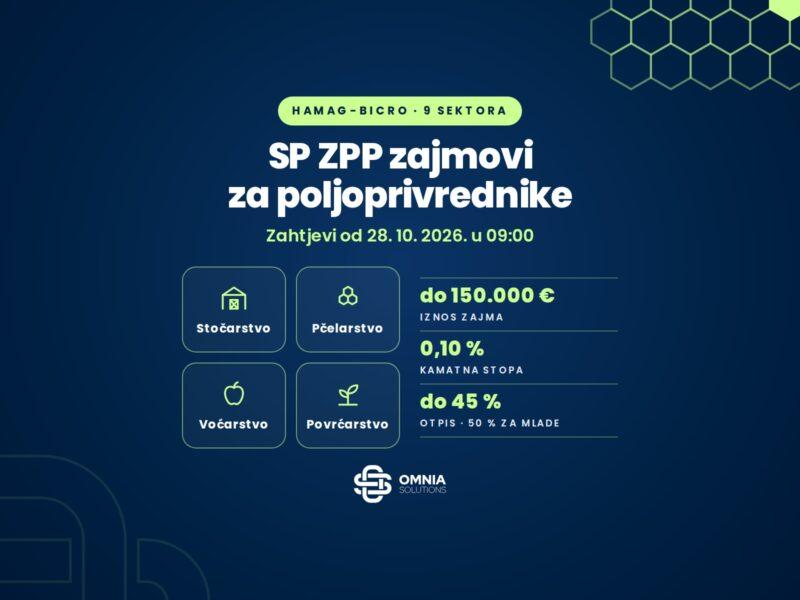
HAMAG-BICRO’s SP ZPP loans are intended for primary agricultural production, in amounts of EUR 1,000 to 150,000, at 0.10% interest and with a write-off of up to 45% (young farmers up to 50%). HBOR’s processing loans are intended for processors, in amounts of EUR 200,000 to 3,000,000, with a write-off of up to 40%.
Sources
- HBOR: Loans for Processing of Agricultural Products (lending programme, Annex 1 – Ineligible activities and loan beneficiaries, Annex 2 – Criteria for the capital rebate, documentation list of 14 October 2026)
- Ministry of Agriculture, Forestry and Fisheries: One step to a loan with a capital rebate (13 July 2026)
- Croatian Chamber of Agronomists: statements by authorised agronomists for HBOR
- HBOR: Frequently asked questions, general (Investment Notification)
The conditions are summarised from official sources as of 19 October 2026 and may change. Check the final availability and conditions in HBOR’s official documentation or with us. The decision on the loan and the capital rebate is made by HBOR.