SP ZPP Loans for Growth of Agricultural Production 2026: conditions by sector, principal write-off and application
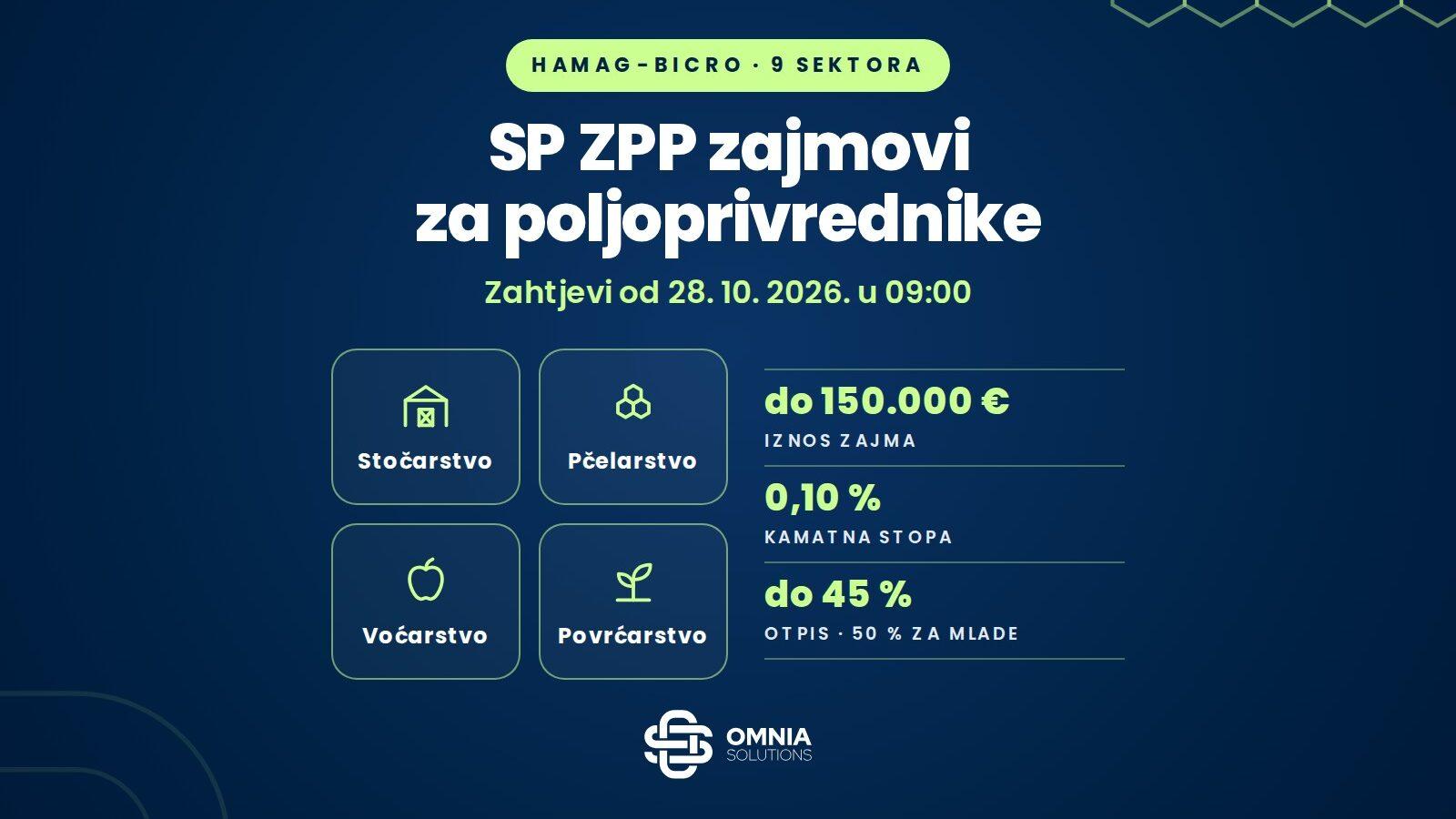
SP ZPP Loans for Growth of Agricultural Production in Sensitive Sectors (SP ZPP zajmovi za rast poljoprivredne proizvodnje u osjetljivim sektorima) are loans from HAMAG-BICRO (Croatian Agency for SMEs, Innovations and Investments) of EUR 1,000 to 150,000 at a fixed interest rate of 0.10% for farmers with the status of a small business entity (micro, small and medium-sized). They are intended for investments in nine livestock and crop production sectors, from dairy cattle farming and pig farming to beekeeping, fruit growing and vegetable growing. With regular repayment and the sector criteria met, up to 45% of the disbursed loan amount can be written off, and up to 50% for young farmers. Applications are accepted online from Wednesday, 28 October 2026 at 9:00, until the funds are used up.
Applications from 28 October 2026 · eligibility questionnaire
Check whether you qualify for an SP ZPP loan
The questionnaire on this page shows right away whether you meet the official programme terms of HAMAG-BICRO: the status and registration of the holding, the sector and farm profile, the eligible investment, experience in the sector, employees and contributions, financial discipline, the investment location and the loan amount. It has 15 questions and takes about four minutes. The check is free and without obligation.
Status on 28 October 2026. Receipt of applications has been open since Wednesday, 28 October 2026 at 9:00, via the online form on the HAMAG-BICRO website, and continues until the funds are used up.
This guide covers the loan conditions, eligible investments and write-off criteria for each sector, calculation examples, the required documents and the application steps. The information is summarised from the official programme conditions and the HAMAG-BICRO list of documents, as of 19 October 2026.
In brief
- Who provides the loan: HAMAG-BICRO, directly, without a bank as intermediary.
- Amount and interest: EUR 1,000 to 150,000 at a fixed interest rate of 0.10%, with no approval fee.
- Repayment: up to 8 years, and up to 10 years for young farmers, including a grace period of up to 12 months, in quarterly instalments.
- Principal write-off: up to 45% of the disbursed loan amount, or up to 50% for young farmers, with regular repayment and the sector criteria achieved.
- Sectors: dairy cattle farming, fattening of young cattle, cows in beef cattle farming, sheep and goat farming (milk and meat), pig farming, beekeeping, fruit growing and vegetable growing.
- Application: online from 28 October 2026 at 9:00, until the funds are used up. The programme is valid until 31 December 2029 at the latest.
- Limit: each entrepreneur can use only one loan of this kind.
- Eligibility check: 15-question questionnaire on this page, based on the official programme terms.
What SP ZPP Loans for Growth of Agricultural Production are
This is a financial instrument under the CAP Strategic Plan of the Republic of Croatia 2023–2027 (SP ZPP), co-financed by the European Agricultural Fund for Rural Development (EAFRD). It is implemented under intervention 73.10.FI, support for investments in primary agricultural production. HAMAG-BICRO approves the loans directly.
In practice, it is a HAMAG-BICRO loan for farmers and family farms (OPG) that can finance, for example, a milking parlour, a barn or farm equipment, anti-hail nets and irrigation in an orchard, or a new polytunnel for vegetables.
The aim is to make financing easier for farmers to access through greater availability of loans, a lower interest rate and less demanding collateral requirements. In addition, part of the principal can be written off if the investment achieves the results set for the sector.
The Ministry of Agriculture, Forestry and Fisheries announced “almost EUR 47 million” in total for HAMAG-BICRO SP ZPP loans and HBOR (Croatian Bank for Reconstruction and Development) loans with a capital rebate. How much of this is intended for this loan alone has not been published.
Conditions of SP ZPP loans
| Condition | Value |
|---|---|
| Lender | HAMAG-BICRO, directly |
| Source of funds | EAFRD, under the SP ZPP 2023–2027 |
| Loan amount | EUR 1,000 to 150,000 |
| Interest rate | 0.10%, fixed |
| Drawdown period | up to 6 months from disbursement, up to 12 months for fruit and vegetable growing |
| Grace period | up to 12 months, if repayment lasts at least 2 years |
| Repayment period | up to 8 years including the grace period, up to 10 years for young farmers |
| Repayment schedule | quarterly instalments |
| Collateral | promissory notes (zadužnice) of the borrower and the owners, and others according to HAMAG-BICRO’s risk assessment |
| Fee | no approval fee; changes to the conditions after the decision are charged according to the HAMAG-BICRO Ordinance on Fees (Pravilnik o naknadama) |
| Principal write-off | up to 45% of the disbursed loan amount, up to 50% for young farmers |
| Receipt of applications | from 28 October 2026 at 9:00, online only |
| Programme validity | until the funds are used up, 31 December 2029 at the latest |
The loan is intended for investments in tangible and intangible assets. The funds are paid into a special-purpose account, and HAMAG-BICRO checks whether they have been used for what they were approved for.
Which sectors SP ZPP loans are for
The programme covers nine sectors. For most of them, the profile of the farm the loan is intended for is also set, so the first step is to check whether your farm fits within those limits.
| Sector | Who it is intended for | What is financed |
|---|---|---|
| Dairy cattle farming | existing dairy cow farms | purchase, reconstruction and equipping of existing buildings for dairy cows; construction, reconstruction and equipping of milking parlours |
| Beef cattle farming, fattening of young cattle | farms that delivered up to 200 head for slaughter and/or export in the 12 months before the application | construction or purchase, reconstruction and equipping of buildings for fattening young cattle to expand capacity |
| Beef cattle farming, cows | farms with cows of beef and/or dual-purpose breeds | purchase, construction, reconstruction and equipping of buildings for cows to expand capacity |
| Sheep and goat farming, milk | dairy sheep and goat farms | construction or purchase, reconstruction and equipping of buildings for dairy sheep and goats, automation and digitalisation of feeding, microclimate management, milking parlours |
| Sheep and goat farming, meat | farms that delivered up to 200 head for slaughter and/or export in the 12 months before the application | purchase, construction, reconstruction and equipping of buildings for sheep and goats to expand capacity |
| Pig farming | farms that had an average of up to 35 sows in the 12 months before the application | purchase, construction, reconstruction and equipping of buildings for breeding sows to increase capacity or reduce dependence on human labour (automation and digitalisation of feeding, microclimate management) |
| Beekeeping | beekeepers with more than 100 hives | used trucks of category N2 and N3, trailers with a payload of more than 3,500 kg and semi-trailers; all vehicles no older than 10 years |
| Fruit growing | growers of apples, pears, peaches, nectarines, apricots, sweet cherries, sour cherries and plums, and strawberries in protected areas | systems and equipment for protection against adverse weather, irrigation, and new polytunnels and greenhouses |
| Vegetable growing | vegetable producers | new polytunnels and greenhouses, and irrigation systems and equipment |
In fruit and vegetable growing, irrigation is financed to increase the irrigated area, and the loan can be drawn down for up to one year, with a further year of grace period. In beekeeping, bees and hives cannot be purchased. We have described all the conditions for beekeepers, with a calculation example, in the guide SP ZPP loan for beekeepers.
How much principal can be written off by sector
The write-off is not automatic. It is granted when two conditions are met together: the loan is repaid regularly, and the investment has achieved the criteria set for that sector. The maximum write-off in all sectors is 45% of the disbursed loan amount, or 50% for young farmers.
| Sector | Basic criterion | Additional criterion or bonus | Maximum |
|---|---|---|---|
| Dairy cattle farming; sheep and goat farming, milk | 35% (40% for young farmers) for purchasing and putting into operation a building or equipment for automation and digitalisation of feeding, microclimate management or a milking parlour, and for cows also for automation, digitalisation and robotisation of milking | +5 percentage points for 1 to 5% higher milk deliveries, +10 for more than 5% | 45% (50%) |
| Pig farming | 35% (40% for young farmers) for a building or equipment for automation and digitalisation of feeding or microclimate management | +5 percentage points for 3 to 20% more sows, +10 for more than 20% | 45% (50%) |
| Beekeeping | 35% (40% for young farmers) for a vehicle put into operation and entered in the register of beekeeping vehicles | +5 percentage points for 1 to 5% more hives, +10 for more than 5% | 45% (50%) |
| Fattening of young cattle; sheep and goat farming, meat | 15% for 3 to 5.9% more head delivered for slaughter or export, 30% for 6 to 8.9%, 45% for 9% or more | young farmers receive 5 percentage points more | 45% (50%) |
| Cows in beef cattle farming | 15% for 3 to 5.9% more cows, 30% for 6 to 8.9%, 45% for 9% or more | young farmers receive 5 percentage points more | 45% (50%) |
| Fruit growing; vegetable growing | 45% (50% for young farmers) for the purchase, installation and putting into operation of new irrigation equipment, new polytunnels and greenhouses and, in fruit growing, equipment for protection against adverse weather | none | 45% (50%) |
The additional criterion applies only if the basic one has been checked and met. In sectors where the write-off is linked to production growth, growth is measured using data from the Single Register of Kept Animals (Jedinstveni registar držanih životinja, JRDŽ), for milk using data submitted under the Ordinance on the Mandatory Submission of Data in the Milk and Dairy Products Sector (Pravilnik o obveznoj dostavi podataka u sektoru mlijeka i mliječnih proizvoda), and for hives using the Register of Beekeepers and Apiaries (Evidencija pčelara i pčelinjaka).
In livestock farming, the baseline is determined for the 12 months preceding the month in which you requested the JRDŽ extract that you attach to the loan application. The situation after the investment is measured over 12 consecutive months, within a period of up to 18 months after the end of the loan drawdown period. In beekeeping, the number of hives in the Register of Beekeepers and Apiaries for the current year is compared with the number on the day you request the data. This is why production growth should be planned from the start, not after approval.
A written request for the write-off is submitted once during repayment, no later than 18 months after the end of the loan drawdown period. The part of the principal already repaid cannot be written off, and the total aid must remain within the aid intensity limits set by the SP ZPP.
Calculation examples
These fictitious examples show how the write-off is calculated. The write-off is always calculated from the disbursed loan amount.
| Example | Loan | What was achieved | Write-off |
|---|---|---|---|
| A fruit grower invests in an anti-hail net and an irrigation system on new areas | EUR 80,000 | new equipment installed and put into operation, the loan is repaid regularly | 45% or EUR 36,000 (young farmer 50% or EUR 40,000) |
| A young cattle fattening farm expands its building | EUR 100,000 | deliveries for slaughter rose from 150 to 160 head (6.7%) | 30% or EUR 30,000 (young farmer 35% or EUR 35,000) |
| A dairy farm introduces a milking robot | EUR 120,000 | equipment in operation, milk deliveries up by 4% | 40% or EUR 48,000 (young farmer 45% or EUR 54,000) |
Who can apply for an SP ZPP loan
The loan is intended for micro, small and medium-sized small business entities as defined in European Commission Recommendation 2003/361/EC: family farms (OPG), sole proprietorships (obrt), companies, producer organisations and other legal entities. The applicant must meet all of these conditions.
- Entry in a register. The Register of Farmers (Upisnik poljoprivrednika), the Register of Family Farms (Upisnik OPG-ova) or another appropriate register, registry or record of producers of primary agricultural products.
- Experience in the sector. A registered activity and operations in the sector related to the investment for at least 2 years before the application.
- Employees and contributions. Legal entities have at least one employee or hire one within 6 months of using the loan. The holder of the family farm or the owner of the sole proprietorship is entered in the Register of Taxpayers before the loan is approved and pays health and pension insurance contributions, except for pensioners.
- Financial discipline. The account is not blocked and has not been continuously blocked for more than 30 days in the last 6 months. No debts to the state, except under an agreed rescheduling, and existing liabilities are settled regularly.
- Seat in Croatia. A registered place of business and activity in the Republic of Croatia at the time of the investment and during repayment.
- Investment location. All of Croatia except the urban centres of Zagreb, Osijek, Rijeka and Split.
- Stability. The applicant is not an undertaking in difficulty.
Who is a young farmer
A young farmer receives a write-off 5 percentage points higher and up to 2 years longer repayment. This is a natural person older than 18 years, with an age limit of 40 years under the SP ZPP definition, who is the holder of an agricultural holding for the first time, for no more than 5 years at the time of the application, and who independently manages the holding with resources entered in the competent registers. In a company, the young farmer must be the responsible person and the owner of at least 50% of the share capital. The status is checked at the time the loan application is submitted.
What cannot be financed
- VAT, if you are entitled to recover it.
- Refinancing of existing liabilities, including repayment of loans or leases.
- Reimbursement of previously paid liabilities.
- Liabilities older than 3 months from the date HAMAG-BICRO receives the application.
- Investments for personal needs.
- Purchase of real estate and movable property from related parties.
- Working capital.
- Activities in restricted sectors, such as weapons or gambling.
Combining with other aid. For the same investment, you may not use grants (non-repayable funding) or other financial instruments co-financed by EU funds. Previous use of other SP ZPP instruments is not an obstacle, but each entrepreneur can receive only one loan of this kind.
Eligibility check: SP ZPP loan questionnaire
In about four minutes, this questionnaire checks the basic conditions of the SP ZPP loan for growth of agricultural production in sensitive sectors: the status and registration of the holding, the sector and farm profile, the eligible investment, experience in the sector, employees and contributions, financial discipline, the investment location and the loan amount. The questions are based on HAMAG-BICRO’s official programme terms.
Questionnaire · about four minutes
Do you meet the conditions for an SP ZPP loan?
Answer 15 questions for the holding that would request the loan. Your answers are not stored and are not sent anywhere unless you click the button to send the result.
Application documents
According to the HAMAG-BICRO list of documents, which applies from 28 October 2026, the following documents are attached to the application. The application must contain all documents and signed statements, otherwise it is considered incomplete.
- Business plan on the HAMAG-BICRO form, in xls format.
- Offers, pro forma invoices, bills of quantities or purchase contracts in line with the business plan.
- Signed and stamped HAMAG-BICRO forms: a statement on de minimis aid and state aid received, a combined statement on small business entity status, and a table of credit indebtedness as at the last day of the month, no older than 2 months.
- BON2 or SOL2 and a Tax Administration certificate on the debt status, no older than 30 days, and certificates of regular repayment of existing liabilities.
- A printout from the Agronet application from the Register of Farmers or the Register of Family Farms, with the tabs basic data, members, holdings, ARKOD, JRDŽ and payment entitlements, and a certificate of the economic size of the holding.
- For livestock farming and beekeeping: a JRDŽ extract issued by the Ministry of Agriculture, Forestry and Fisheries, no older than 30 days. It is requested by sending the form "SP ZPP Request for JRDŽ Data (before the investment)" (SP ZPP Zahtjev za podatke iz JRDŽ), published on the HAMAG-BICRO website, to oznacavanje@mps.hr.
- For livestock farming: a holding certificate with the farm address and the number and type of livestock, issued by the Croatian Agency for Agriculture and Food (HAPIH).
- For beekeeping: a certificate of entry in the Register of Beekeepers issued by the Croatian Beekeepers' Association (Hrvatski pčelarski savez).
- For fruit and vegetable growing: an extract from the Register of Farmers.
- For real estate investments: documentation on the legality of construction, for example a location or building permit, confirmation of the main design, a decision on construction conditions, or a design.
- Financial documentation according to tax status, mostly for the previous two years, and copies of the identity cards of persons in the ownership and management structure.
The JRDŽ extract, BON2 or SOL2, the Tax Administration certificate and, for income tax payers, form TO must not be older than 30 days on the day the application is received. Request them when the rest of the documentation is almost ready, so that they are valid on the day of submission.
How to apply, step by step
- Check the sector and the farm profile. Compare your farm with the sector table. Check in particular the limits of a maximum of 200 head delivered, a maximum of 35 sows or more than 100 hives, and 2 years of operations in the sector.
- Plan the investment according to the write-off criteria. Determine which criteria you can achieve and what production growth is realistic.
- Prepare the documents. The business plan, offers and, for construction, permits and designs. Request the certificates with a 30-day validity at the end.
- Submit the application online. Receipt of applications started on Wednesday, 28 October 2026 at 9:00 and continues until the funds are used up, exclusively via the HAMAG-BICRO online form.
- Carry out the investment. The funds are paid into a special-purpose account and are used within 6 months of disbursement, or within 12 months in fruit and vegetable growing.
- Achieve the criteria and request the write-off. The written request for the write-off is submitted once, no later than 18 months after the end of the loan drawdown period.
HAMAG-BICRO decides on each application according to its own methodology and discretionary assessment, so there is no entitlement to the loan in advance. The investment must be economically justified and have a closed financial structure.
Most common mistakes
- Investment in an urban centre. The investment location must not be in the urban centres of Zagreb, Osijek, Rijeka and Split.
- Too short a period of operations in the sector. At least 2 years of registered operations in the sector related to the investment are required.
- Farm outside the profile. Fattening of young cattle and sheep and goats for meat up to 200 head delivered, pig farming up to 35 sows, beekeeping more than 100 hives.
- Used equipment in fruit and vegetable growing. The write-off criterion requires the purchase and putting into operation of new equipment.
- Outdated certificates. Several certificates must not be older than 30 days on the day the application is received.
- Old invoices. Liabilities older than 3 months from the receipt of the application cannot be paid from the loan.
- Unrealistic growth plan. In livestock farming, part or all of the write-off depends on proven production growth, measured over the set period.
SP ZPP loan or HBOR loan
The HAMAG-BICRO SP ZPP loan is intended for primary agricultural production and investments of up to EUR 150,000. If you process agricultural products, for example in a slaughterhouse or a plant for processing cereals, fruit or vegetables, see the HBOR Loans for Processing of Agricultural Products, from EUR 200,000 to 3,000,000 with a write-off of up to 40% of the principal. HAMAG-BICRO also offers micro loans of up to EUR 50,000. We have compared all HAMAG loans, including working capital for farmers of up to EUR 25,000, in the guide HAMAG loans 2026.
How Omnia Solutions can help you
Omnia Solutions is a Zagreb consultancy specialising in EU funds and public sources of financing. We help farmers in this programme from the first check to the write-off request. Read more about how we work on the page HAMAG-BICRO loans: advice and application.
- Eligibility check of the farm and the investment against all programme conditions. The first check is free and without obligation.
- Calculation of the possible write-off and planning of the investment according to the criteria for your sector.
- Preparation of the business plan and documents, so that you can submit the application as early as possible, because applications are accepted until the funds are used up.
- Follow-up after approval, from the earmarked use of the loan to a timely write-off request.
Free introductory call
Not sure whether you meet the conditions for an SP ZPP loan?
Tell us your sector and what you plan to finance, and we will check whether you can apply. The introductory call is free. Email or call us.
Frequently asked questions about SP ZPP loans
What are SP ZPP Loans for Growth of Agricultural Production?
They are HAMAG-BICRO loans of EUR 1,000 to 150,000 at an interest rate of 0.10%, co-financed by the European Agricultural Fund for Rural Development under the SP ZPP 2023–2027. They are intended for investments in primary agricultural production in nine sensitive sectors, and up to 45% of the disbursed loan amount can be written off, or up to 50% for young farmers.
Who can apply for an SP ZPP loan?
Small business entities (family farm, sole proprietorship, company, producer organisation or other legal entity) that are entered in the Register of Farmers or another appropriate register and have been operating for at least 2 years in the sector related to the investment. The investment must not be in the urban centres of Zagreb, Osijek, Rijeka and Split, and the applicant must settle its liabilities regularly.
Which sectors are eligible?
Dairy cattle farming, fattening of young cattle, cows in beef cattle farming, sheep and goat farming for milk and meat production, pig farming (sows), beekeeping with more than 100 hives, fruit growing (apples, pears, peaches, nectarines, apricots, sweet cherries, sour cherries, plums and strawberries in protected areas) and vegetable growing.
How large is the loan, what is the interest rate and what is the repayment period?
The loan ranges from EUR 1,000 to 150,000 at a fixed interest rate of 0.10% with no approval fee. Repayment lasts up to 8 years, and up to 10 years for young farmers, including a grace period of up to 12 months, in quarterly instalments.
How much of the principal can be written off?
Up to 45% of the disbursed loan amount, or up to 50% for young farmers. The write-off is granted with regular repayment and the sector criteria met, for example putting equipment into operation or production growth. The part of the principal already repaid cannot be written off.
In which sectors does the full write-off not depend on production growth?
In fruit and vegetable growing. There, the write-off of 45%, or 50% for young farmers, is achieved through the purchase, installation and putting into operation of new irrigation equipment, new polytunnels and greenhouses and, in fruit growing, equipment for protection against adverse weather. In livestock farming and beekeeping, part or all of the write-off depends on proven production growth.
Since when are applications accepted and until when?
Receipt started on Wednesday, 28 October 2026 at 9:00, via the HAMAG-BICRO online form. The instrument is in force until the funds are used up, and until 31 December 2029 at the latest.
Which documents are required?
Among other things, the application must include a business plan on the HAMAG-BICRO form, offers or pro forma invoices, statements and a table of credit indebtedness on HAMAG-BICRO forms, BON2 or SOL2, a Tax Administration certificate, an Agronet printout, a certificate of the economic size of the holding and financial documentation. Depending on the sector, a JRDŽ extract, a HAPIH holding certificate, a certificate from the Croatian Beekeepers' Association or an extract from the Register of Farmers is also required.
Can an SP ZPP loan be combined with grants?
Not for the same investment. Combining it with grants or other financial instruments co-financed by EU funds for the same investment is not permitted. Previous use of other SP ZPP instruments is not an obstacle, but each entrepreneur can receive only one loan of this kind.
Who is a young farmer and what do they receive?
A natural person older than 18 years, with an age limit of 40 years, who is the holder of an agricultural holding for the first time, for no more than 5 years at the time of the application. A young farmer receives a write-off 5 percentage points higher, up to 50% of the principal, and repayment of up to 10 instead of up to 8 years.
How can I check whether I meet the conditions for an SP ZPP loan?
This page includes a 15-question questionnaire that checks the status and registration of the holding, the sector and farm profile, the eligible investment, two years of operation in the sector, employees and contributions, account blockades and debts, the investment location and the loan amount against HAMAG-BICRO's official programme terms. The result is for information only; HAMAG-BICRO decides on the loan and the write-off.
Planning an investment in a farm, orchard or polytunnel?
Applications are accepted from 28 October 2026 at 9:00, until the funds are used up. Check the conditions in good time, free and without obligation.
Sources
The information is summarised from the official programme conditions and the HAMAG-BICRO list of documents, and from announcements by the Ministry of Agriculture, Forestry and Fisheries.
- SP ZPP Loans for Growth of Agricultural Production in Sensitive Sectors, HAMAG-BICRO (programme conditions, PDF)
- List of required documents and forms, HAMAG-BICRO
- Announcement of the receipt of applications, Ministry of Agriculture, Forestry and Fisheries, 25 September 2026
- A step closer to a loan with a capital rebate: study the application conditions (Korak do zajma/kredita s kapitalnim rabatom: proučite uvjete za prijavu), Ministry of Agriculture, Forestry and Fisheries, 13 July 2026
The conditions are summarised from official sources as of 19 October 2026 and may change. Check the final conditions in the official HAMAG-BICRO documentation or with us. The decision on the loan and the principal write-off is made by HAMAG-BICRO.