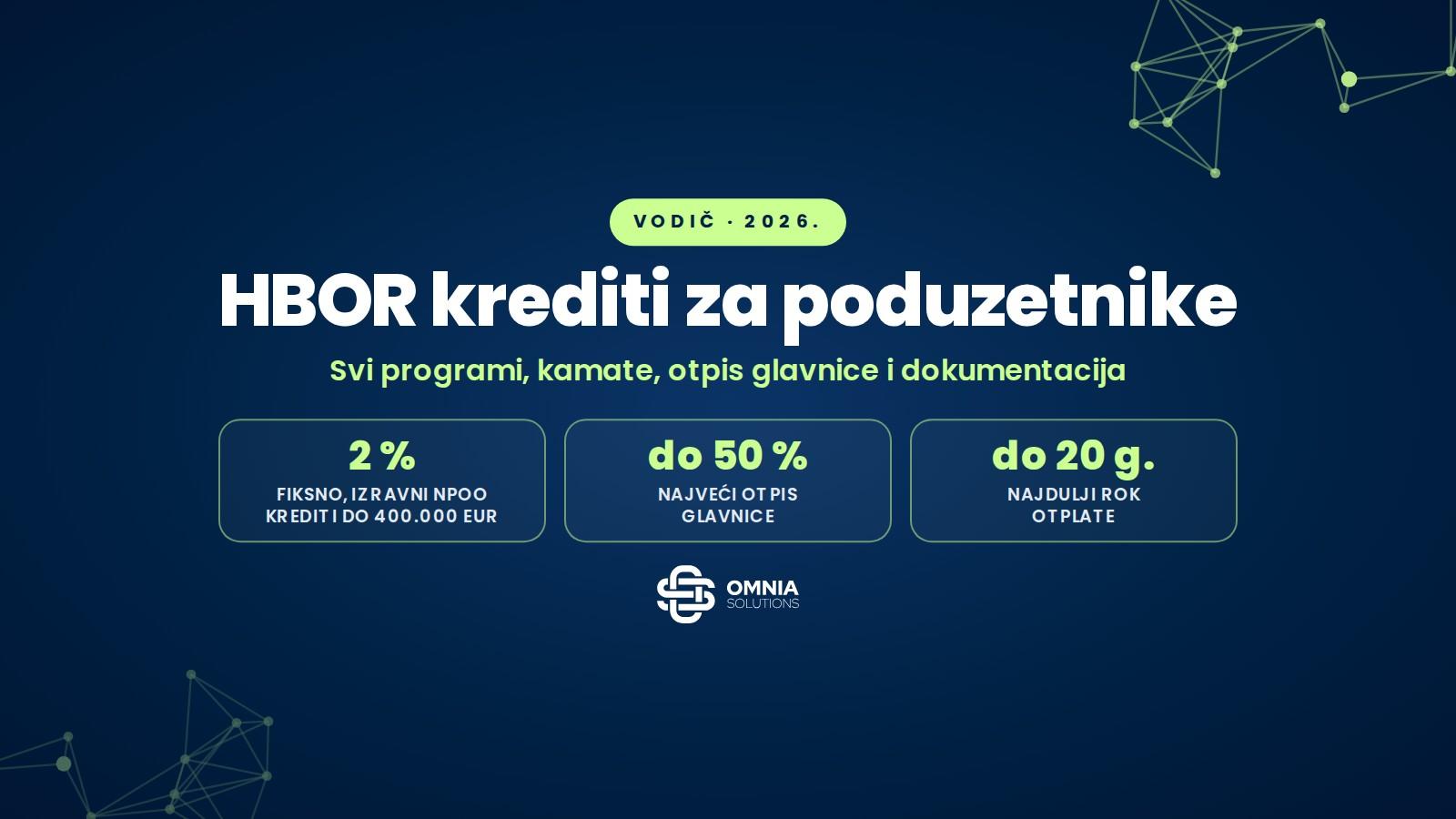
HBOR loans for entrepreneurs in 2026 include investment loans from HBOR (Croatian Bank for Reconstruction and Development) with a fixed interest rate of 2% to 3.90% for loans up to EUR 400,000 and repayment of up to 20 years, as well as four programmes with a partial principal write-off: for production modernisation, processing of agricultural products, sustainable tourism and energy efficiency. In these programmes the interest rate on half of the loan is 0%, and the write-off amounts to up to 40 or 50% of the principal. Since July 2026, HBOR has also offered three programmes from the National Recovery and Resilience Plan (NPOO), with a fixed interest rate of 2% for direct loans to the private sector of up to EUR 400,000.
This guide covers all HBOR programmes for entrepreneurs, their conditions, how to submit an application and the documentation required. To find out which programme fits your investment, contact us using the details near the end of the page. The information was checked on the HBOR website on 20 October 2026.
Free introductory call
Not sure which HBOR loan fits your investment?
Tell us what you plan to invest in and we will check which HBOR programmes you can apply for. The introductory call is free. Email or call us.
In brief: HBOR loans in 2026
- Classic investment loans: the Private Sector Investment programme (Investicije privatnog sektora), with a fixed interest rate of 3.40% or 3.90% for loans up to EUR 400,000 and repayment of up to 20 years.
- Young people, women, start-ups and assisted areas: loans up to EUR 400,000. Through a commercial bank, up to 100% of the investment excluding VAT can be financed, at an interest rate of up to 3%.
- Loans with principal write-off: production modernisation (up to 50%), processing of agricultural products (up to 40%), sustainable tourism (up to 50%, for loans above EUR 500,000) and energy efficiency (up to 50%).
- NPOO programmes: digital transition, green transition, and defence and security, at 2% fixed for direct loans to the private sector up to EUR 400,000.
- Minimum amount: as a rule, EUR 100,000 for a direct HBOR loan and EUR 50,000 for a loan through a commercial bank.
- Documentation: for direct loans up to EUR 400,000, a business plan on the HBOR template; for larger loans, business projections or an investment study.
Three lending channels
Before choosing a programme, you need to know where the application is submitted, because this determines the minimum loan amount and the collateral.
- Direct lending by HBOR: the application is submitted to HBOR. Loans below EUR 100,000 are, as a rule, not approved. HBOR determines the collateral in line with its internal rules, for example bills of exchange, promissory notes, a pledge on assets or a guarantee from HAMAG-BICRO (Croatian Agency for SMEs, Innovations and Investments). In the Private Sector Investment programme and similar programmes, family farms (OPG) outside the VAT system and associations are not eligible for a direct loan.
- Lending through a commercial bank: the application is submitted to the bank, which carries out the analysis, determines the collateral and sets the required documentation. The minimum amount is, as a rule, EUR 50,000. In the Private Sector Investment programme, HBOR works with 18 banks, including Zagrebačka banka, PBZ, Erste, OTP, Raiffeisenbank, HPB and Addiko.
- Risk-sharing model: the loan is approved jointly by HBOR and a commercial bank. HBOR’s share, as a rule, cannot be less than EUR 100,000.
Overview of HBOR programmes for entrepreneurs
| Programme | For whom | Loan amount | Interest rate | Repayment | Special feature |
|---|---|---|---|---|---|
| Private Sector Investment | private sector, all sizes | direct from EUR 100,000, through a bank from EUR 50,000; up to 75% of the investment | 3.40% or 3.90% fixed up to EUR 400,000; above that, a subsidy is possible | up to 20 years, grace period up to 3 | the broadest programme |
| Entrepreneurship of Young People, Women, Start-ups and Special Segments (Poduzetništvo mladih, žena, početnika i posebnih segmenata) | SMEs: young people, women, start-ups, assisted areas and hill and mountain areas, commercialisation of RDI | up to EUR 400,000; through a bank up to 100% of the investment excluding VAT | direct 3.90% fixed; through a bank up to 3.00% | up to 12 years, grace period up to 3 (exceptionally up to 14) | through a bank, possible without own contribution |
| Loans for Production Modernisation (Krediti za modernizaciju proizvodnje) | micro, small and medium-sized enterprises (SMEs) in manufacturing | EUR 100,000 to 3,000,000 | 0% on half of the loan (European Regional Development Fund, ERDF) | up to 15 years, grace period up to 3 | write-off of up to 50% of the principal |
| Loans for Processing of Agricultural Products (Krediti za preradu poljoprivrednih proizvoda) | SMEs: slaughterhouses, processing of cereals, fruit and vegetables | EUR 200,000 to 3,000,000 | 0% on half of the loan | up to 20 years, grace period up to 3 | write-off of up to 40%; applications from 28 October 2026 |
| Sustainable Tourism Loans (Krediti za održivi turizam) | SMEs: hotels and campsites | EUR 250,000 to 7,000,000 | 0% on half of the loan (ERDF) | up to 20 years, grace period up to 4 | write-off of up to 50% for loans above EUR 500,000 |
| Energy Efficiency Loans for Businesses (Krediti za energetsku učinkovitost poduzetnika) | all sizes; manufacturing, trade, hospitality and accommodation | up to EUR 3,000,000 | 0% on half of the loan (ERDF); the bank’s portion as set by the bank | up to 17 years, grace period up to 3 | write-off of up to 50%; through banks only |
| Investments in Digital Transition (Ulaganja u digitalnu tranziciju, NPOO) | all sizes | direct from EUR 100,000, through a bank from EUR 50,000 | 2.00% fixed up to EUR 400,000 (direct); through a bank at most 3.50% | up to 20 years, grace period up to 3 | strategic digital projects |
| Investments in Green Transition (Ulaganja u zelenu tranziciju, NPOO) | all sizes | from EUR 100,000 | 2.00% fixed up to EUR 400,000 | up to 20 years, grace period up to 3 | direct only |
| Investments in Defence and Security (Ulaganja za obranu i sigurnost, NPOO) | all sizes | from EUR 100,000 | 2.00% fixed up to EUR 400,000 | up to 20 years, grace period up to 3 | direct only |
| Working Capital (Obrtna sredstva) | private and public sector | through a bank from EUR 50,000; direct, exceptionally, from EUR 500,000 | 4.00% fixed up to EUR 400,000 | short-term up to 12 months; long-term up to 6 years | day-to-day operations |
| EU Projects (EU projekti) | grant beneficiaries | direct from EUR 100,000, through a bank from EUR 50,000 | at least 3.24% fixed up to EUR 400,000 | according to the project | own contribution and other project costs |
Loans with principal write-off of up to 50%
Four HBOR programmes are implemented as financial instruments. Half of the loan is financed from EU sources at 0% interest, and once predefined criteria are met, part of the principal from those sources is written off. This write-off is called a capital rebate and is granted as State aid. Only one loan per programme can be contracted with a single beneficiary. Read more about how the write-off works in the article Capital rebate.
Loans for Production Modernisation
They are intended for micro, small and medium-sized enterprises in manufacturing (section C of the National Classification of Economic Activities, NKD 2025). The loan ranges from EUR 100,000 to 3,000,000, repayment lasts up to 15 years with a grace period of up to 3 years, and the application is submitted directly to HBOR, electronically. The write-off of up to 50% of the principal is added up from Industry 4.0 solutions (10% for each solution costing at least 10% of the principal), digital solutions for business processes (2% for each) and alignment with the Smart Specialisation Strategy (5%).
Read all the conditions in the guide HBOR loan for production modernisation 2026, and the difference between Industry 4.0 and 5.0 in the article Industry 4.0, 5.0 and 6.0.
Loans for Processing of Agricultural Products
This new programme is intended for micro, small and medium-sized processors investing in slaughterhouses or facilities for processing cereals, fruit or vegetables, provided that the investment increases processing capacity by more than 5% or establishes new capacity. The loan ranges from EUR 200,000 to 3,000,000, the interest rate on half of the loan is 0%, and repayment lasts up to 20 years with a grace period of up to 3 years. The write-off of up to 40% of the principal depends on the increase in processing capacity and the origin of the raw material. Applications are submitted directly to HBOR from 28 October 2026. Read the details in the guide HBOR loans for processing of agricultural products.
Sustainable Tourism Loans
They are intended for micro, small and medium-sized enterprises registered for hotels and similar accommodation (NKD 55.1) or campsites (NKD 55.3). The programme finances the construction, reconstruction, refurbishment and equipping of accommodation facilities and additional amenities, if this results in greater accommodation capacity, a new optional amenity or classification into a type or category. Routine maintenance is not eligible. The loan ranges from EUR 250,000 to 7,000,000, repayment lasts up to 20 years with a grace period of up to 4 years, and the application is submitted directly to HBOR, electronically.
A principal write-off is possible only for loans above EUR 500,000. It is added up according to the criteria in Annex 2 of the programme: higher energy efficiency (up to 15%), investment in certain categories of the Tourism Development Index (up to 30%), a new decision on the classification or category of the facility (up to 20%) and an additional amenity in facilities with at least three stars (up to 20%). In total, it amounts to at most 50% of the disbursed principal.
Energy Efficiency Loans for Businesses
They are intended for entities of any legal form and size in manufacturing and in the commercial and service sector, including trade, hospitality and accommodation, that have been registered for the investment activity for at least one year before the application. The investment must reduce delivered energy consumption by at least 20% in production facilities, or by 30% in the commercial and service sector. For buildings serving a production facility, a reduction of at least 50% in energy consumption for heating and cooling is required. Activities not directly linked to energy savings can account for up to 30% of the loan.
Loans of up to EUR 3,000,000 are approved exclusively through selected commercial banks (Erste, HPB, OTP, PBZ and Raiffeisenbank). Half of the loan is financed by the ERDF at 0%, the other half by the bank, and repayment lasts up to 17 years with a grace period of up to 3 years. The write-off amounts to up to 50% of the principal.
NPOO programmes: digital transition, green transition, defence and security
Following the recapitalisation in June 2026, which increased HBOR’s share capital by EUR 980.7 million, of which EUR 410 million came from the National Recovery and Resilience Plan, HBOR has been implementing three new programmes since 1 July 2026. They are intended for businesses of all sizes and for the public sector.
- Investments in digital transition: strategic digital projects in intervention fields with a 100% digital coefficient under Annex VII to Regulation (EU) 2021/241. Implemented directly and through commercial banks.
- Investments in green transition: strategic green projects in intervention fields with a 100% climate coefficient under Annex VI to the same Regulation. Direct only.
- Investments in defence and security: for example protective structures and civil protection, dual-use infrastructure, cybersecurity, modernisation of companies and research in the military and security industry. Direct only.
For direct loans to the private sector up to EUR 400,000, the interest rate is 2.00% fixed. For larger loans, HBOR sets the rate individually, and with a subsidy it cannot be lower than 1.50%. For digital transition loans through commercial banks, the interest rate is at most 3.50%. Repayment lasts up to 20 years with a grace period of up to 3 years, working capital can account for up to 30% of the loan, and investments must comply with the “do no significant harm” (DNSH) principle. Read more in the article HBOR launches three new lending programmes.
Classic investment loans
Private Sector Investment
This is HBOR’s broadest programme, intended for companies, sole proprietorships (obrt), self-employed individuals, family farms, cooperatives and institutions of all sizes. It finances investments in tangible and intangible assets, for example modernisation, new technologies, greater capacity, research and development, environmental protection, energy efficiency, tourism capacity and defence activities, as well as working capital of up to 30% of the loan. For exporters, it can also finance the purchase of a stake in, or an investment in, a foreign company. Up to 75% of the investment value excluding VAT can be financed, and there is no maximum amount.
- Interest rate for loans up to EUR 400,000: 3.40% fixed for investments in special areas of the Republic of Croatia, agriculture, green projects, digitalisation, research, development and innovation (RDI), social infrastructure, defence activities or for exporters, and 3.90% fixed for other investments. A county, city or municipality can lower it further by up to 2 percentage points.
- Interest rate for larger loans: set by HBOR or the bank, and it can be subsidised. For micro, small and medium-sized enterprises, the subsidy is at most 3.00 percentage points for special areas of the Republic of Croatia, 2.50 for exporters, 2.00 for agriculture, digitalisation, green projects, research and development, social infrastructure and defence, and 1.50 for other investments. As a rule, the subsidy per loan is at most EUR 1,000,000.
- Repayment: up to 20 years, including a grace period of up to 3 years (exceptionally up to 5).
Entrepreneurship of Young People, Women, Start-ups and Other Special Segments
The programme is intended for micro, small and medium-sized enterprises that are young entrepreneurs, women entrepreneurs or start-up entrepreneurs, that invest in assisted areas of groups I to IV or in hill and mountain areas of group 1, or that invest in the commercialisation of research and development. The criteria for young people, women and start-ups are set out in HBOR’s General Eligibility Criteria (Opći kriteriji prihvatljivosti).
- Amount: at most EUR 400,000. A direct loan finances up to 85% of the investment excluding VAT, and a loan through a bank up to 100%.
- Interest rate: direct 3.90% fixed, through a bank up to 3.00% fixed. A county, city or municipality can lower it further by up to 2 percentage points.
- Repayment: up to 12 years with a grace period of up to 3 years; exceptionally up to 14 years for permanent crops, for investments in tourism or if the investment study shows the need for a longer period.
- The programme does not finance used equipment and machinery older than 10 years, or vehicles and vessels older than 5 years.
Working capital, EU projects and special measures
- Working capital: for the purchase of raw materials and supplies, salaries and other current costs. Loans are approved through a bank from EUR 50,000 and directly, exceptionally, from EUR 500,000. The interest rate for the private sector up to EUR 400,000 is 4.00% fixed. Short-term loans run for up to 12 months, and long-term loans for up to 6 years with a grace period of up to 2 years.
- EU projects: a loan for grant beneficiaries, for eligible and ineligible project costs. HBOR can accept up to 70% of the grant amount the beneficiary is due to receive as own contribution. The interest rate for the private sector up to EUR 400,000 is at least 3.24% fixed. An advance payment guarantee is also available.
- Measure for wood processing and furniture manufacturing: a temporary subsidy of the interest rate and the loan insurance premium for businesses in activities C16 and C31, under the Private Sector Investment and Working Capital programmes, until the funds are used up.
- Exports: buyer credit, supplier credit and export preparation. On 16 October 2026, HBOR announced the introduction of export receivables factoring.
- The Urban Development Fund (Urbani razvojni fond) is intended for the public sector (municipalities, cities, counties and their companies), not for private businesses.
Business plan, business projections or investment study?
According to HBOR’s general list of documentation for direct loans, the type of document depends on the loan amount, not on the value of the investment. For loans through a bank, the bank sets the documentation, and the programmes with principal write-off have their own lists (for production modernisation, an investment study is usually required for loans above EUR 400,000).
| Loan amount | What to attach |
|---|---|
| up to EUR 400,000 | business plan on the HBOR template (for investment loans or for working capital) |
| above EUR 400,000 and at most 20% of the total assets of the applicant or co-debtor for the previous year | business projections in Excel for the requested repayment period, with a description of the business, assumptions and investment, plus the client and investment tables |
| above EUR 400,000 and more than 20% of the total assets of the applicant or co-debtor for the previous year | investment study, plus the client and investment tables |
On its Investment study page, HBOR publishes the recommended content in 15 chapters, from information on the investor and market analysis to economic and financial analysis, the payback period method, net present value and internal rate of return, sensitivity analysis and the final assessment. The study must include the author’s name and contact details. For loans with principal write-off, the figures in the study must match the cost breakdown and the capital rebate documents.
Documentation for an HBOR loan
For loans through a commercial bank, the bank sets the documentation. For a direct loan, HBOR’s documentation list includes:
- HBOR forms: loan application, client eligibility statement, statement on related persons and statement on the use of real estate;
- investment documents: business plan, projections or investment study, investment tables, and quotations, pro forma invoices and cost breakdowns;
- financial documentation: annual financial statements for the previous two years and quarterly statements, as well as reports on indebtedness and repayment record and BON2/SOL2 solvency data, not older than 30 days. Start-ups without previous business activity do not submit financial statements;
- a Tax Administration certificate on the status of obligations to the State, not older than 30 days;
- anti-money laundering forms: a questionnaire for legal or natural persons, data on beneficial owners and, for politically exposed persons, a separate questionnaire;
- environmental questionnaires: a self-assessment questionnaire on climate, environmental and social risks for all NPOO loans and loans with an NPOO subsidy, and for other loans above EUR 400,000;
- documents for collateral, for example a property valuation report and a land registry extract;
- additional documents per programme, for example a Digital Transformation Plan and a statement from a court expert for production modernisation, or a technological project and a statement from a certified agronomist for processing loans.
When can the investment start?
In programmes with State aid, the investment must not start too early. For loans for production modernisation, processing and sustainable tourism, only costs incurred after submission of the Investment Notice (Najava ulaganja) (or, if no Investment Notice was submitted, after submission of the loan application) and paid after the loan decision are reimbursed. For energy efficiency loans, only costs incurred after submission of the application and paid after the decision are reimbursed. The Investment Notice or the application should therefore be submitted before ordering equipment, signing a contract with a contractor or paying an advance.
Most common mistakes
- The investment started before the Investment Notice or the application. For loans for production modernisation and processing, an investment started or completed before the Investment Notice or application is not eligible, and in other programmes with aid such costs are, as a rule, not included in the loan.
- The wrong programme. For example, a manufacturing company chooses a classic loan, while the investment would meet the criteria for a principal write-off.
- The wrong investment document. For loans above EUR 400,000, check whether business projections or an investment study is required.
- Inconsistent amounts. The amounts in the cost breakdown, investment tables, study and application must match.
- DNSH overlooked. In programmes funded from EU sources and the NPOO, compliance with the “do no significant harm” principle is proven with documents.
- Ineligible purpose. Refinancing existing loans is, as a rule, not eligible, and in programmes with a write-off neither are investments that have already been completed.
Combining HBOR loans and grants
It depends on the programme. For projects with grants, there is a separate EU Projects programme. Loans for production modernisation and for processing of agricultural products must not be used for co-financing or pre-financing grants, and grants cannot be used to compensate for the aid from these loans. The energy efficiency loan must not be used for pre-financing grants either. In any case, the same cost item must not be financed twice, and total aid must remain within the State aid rules, so the funding sources should be planned before the first application.
In addition to an HBOR loan, an investment can also use tax incentives under the Investment Promotion Act (Zakon o poticanju ulaganja), provided that the total of all aid for the same costs stays within the maximum aid intensity for the region. Read the guide Tax incentives for investment 2026.
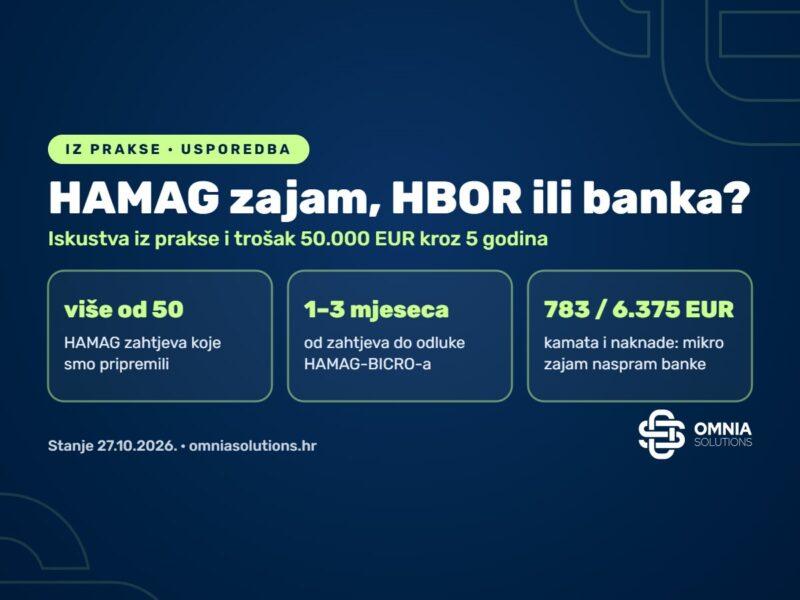
How an HBOR loan for young people, women and start-ups compares with HAMAG-BICRO loans and a bank loan on an example of EUR 50,000, and how long approval takes in practice, is shown in the article HAMAG loan in practice: experience and comparison with HBOR and a bank.
Which programme is right for you?
- A manufacturing SME investing in automation or new machinery: check the Loans for Production Modernisation first, because of the write-off of up to 50%.
- A slaughterhouse, mill or fruit and vegetable processing plant increasing its capacity: the Loans for Processing of Agricultural Products.
- A small or medium-sized hotel or campsite with a loan of at least EUR 250,000: the Sustainable Tourism Loans, with a principal write-off for loans above EUR 500,000.
- An investment that reduces energy consumption by 20 or 30%: an energy efficiency loan through a bank or the green transition programme.
- A young entrepreneur, woman entrepreneur or start-up with a loan of up to EUR 400,000: the programme for special segments, which through a bank can finance up to 100% of the investment excluding VAT.
- An investment below EUR 50,000: HBOR as a rule does not approve such small loans, so check the HAMAG-BICRO micro loan. An overview of all programmes is in the guide HAMAG loan 2026.
Free introductory call
Which HBOR programme should you apply for?
Send us a short description of your company, the investment and the loan amount, and we will check the conditions with you. The introductory call is free. Email or call us.
How Omnia Solutions can help you
Omnia Solutions is a Zagreb-based consultancy specialising in EU funds and favourable loans with principal write-off. For HBOR loans, we prepare the application and documentation on a turnkey basis. Read more on the page HBOR loans: advisory services and application preparation.
- Choosing the programme and lending model and estimating the possible principal write-off or interest subsidy.
- Structuring the financing: the ratio of loan, own funds and grants, in line with the aid rules.
- The Investment Notice before contracting with suppliers.
- The business plan, projections or investment study and all statements, questionnaires and DNSH documentation.
- Submitting the application and managing the procedure until the loan is disbursed and, for financial instruments, until the capital rebate claim.
A practical example is PG Orehovec (case study). Omnia Solutions prepared the application for a Loan for Production Modernisation for this farm. According to the post on our website (6 May 2026), the investment in expanding capacity and automating the slaughterhouse is worth almost EUR 2 million, the loan is about EUR 1.45 million, and the expected capital rebate of 50% is approximately EUR 730,000. The capital rebate is realised once the criteria have been proven.
Frequently asked questions about HBOR loans
Which HBOR loans are available for entrepreneurs in 2026?
Private Sector Investment, Entrepreneurship of Young People, Women, Start-ups and Other Special Segments, Loans for Production Modernisation, Loans for Processing of Agricultural Products, Sustainable Tourism Loans, Energy Efficiency Loans for Businesses, three NPOO programmes (digital transition, green transition, defence and security), Working Capital, EU Projects and export loans.
What is the interest rate on HBOR loans?
For loans up to EUR 400,000: 3.40% or 3.90% fixed in the Private Sector Investment programme, 3.90% for direct loans for young people, women and start-ups (up to 3.00% through a bank), 2.00% for direct loans from the NPOO programmes and 4.00% for working capital. For loans with principal write-off, the interest rate on half of the loan is 0%.
What is the minimum HBOR loan amount?
As a rule, EUR 100,000 for a direct HBOR loan and EUR 50,000 for a loan through a commercial bank. Loans for Processing of Agricultural Products start at EUR 200,000, and Sustainable Tourism Loans at EUR 250,000. For smaller amounts, a HAMAG-BICRO micro loan of up to EUR 50,000 can be considered.
Which HBOR loans have a principal write-off?
Loans for Production Modernisation (up to 50%), Loans for Processing of Agricultural Products (up to 40%), Sustainable Tourism Loans (up to 50%, for loans above EUR 500,000) and Energy Efficiency Loans for Businesses (up to 50%). The write-off is granted once the criteria set out in the programme are met.
When is an investment study required?
For loans above EUR 400,000 that exceed 20% of the applicant’s total assets for the previous year. For other loans above EUR 400,000, business projections are attached, and for loans up to EUR 400,000, a business plan on the HBOR template.
What share of the investment does HBOR finance?
In the Private Sector Investment programme, up to 75% of the investment value excluding VAT. In the programme for young people, women and start-ups, up to 85% for a direct loan and up to 100% through a bank. For Loans for Production Modernisation and Sustainable Tourism Loans, as a rule up to 85%, or up to 75% if regional aid is granted, and for processing loans, as a rule up to 85%.
Can a sole proprietorship or a family farm apply for an HBOR loan?
Yes. Most programmes are open to companies, sole proprietors, self-employed individuals, family farms, cooperatives and institutions. In the Private Sector Investment programme, family farms outside the VAT system can apply for a loan only through a commercial bank. For Loans for Processing of Agricultural Products, the application is submitted directly to HBOR.
Can a large company apply for an HBOR loan?
Yes, for example in the Private Sector Investment programme, the Energy Efficiency Loans for Businesses and the NPOO programmes. The loans with principal write-off for manufacturing, processing and tourism, and the programme for young people, women and start-ups, are intended only for micro, small and medium-sized enterprises.
Can I start the investment before the loan is approved?
In programmes with aid, costs are recognised only from the submission of the Investment Notice or the loan application, and for energy efficiency from the submission of the application. Only costs paid after the loan decision are reimbursed. Orders, contracts or advance payments should therefore be planned after that.
Can an HBOR loan be used to refinance an existing loan?
Not for loans with principal write-off, because they finance only new investments. The Working Capital programme can finance the settlement of short-term liabilities, and for other programmes the purpose is set by the programme text.
Can an HBOR loan be combined with grants?
It depends on the programme. For projects with grants, there is the EU Projects programme. Loans for production modernisation and for processing must not be used for co-financing or pre-financing grants. The same cost item must not be financed twice, and aid must remain within the State aid rules.
How can I check which HBOR loan fits my investment?
Send us a short description of your company and the investment by email, or call us, and we will tell you which programmes might fit. You can check the conditions with us free of charge.
Is there an HBOR loan for women entrepreneurs, young people and start-ups?
Yes. The Entrepreneurship of Young People, Women, Start-ups and Other Special Segments programme is intended for micro, small and medium-sized enterprises that are young entrepreneurs, women entrepreneurs or start-up entrepreneurs, as well as for investments in assisted areas and hill and mountain areas. The loan amounts to up to EUR 400,000, directly at a fixed interest rate of 3.90% and up to 85% of the investment, and through a commercial bank at an interest rate of up to 3.00% and up to 100% of the investment excluding VAT. Repayment lasts up to 12 years with a grace period of up to 3 years. The criteria for young people, women and start-ups are set out in HBOR’s General Eligibility Criteria.
Is there an HBOR loan for tourism?
Yes. Sustainable Tourism Loans are intended for micro, small and medium-sized hotels and campsites, from EUR 250,000 to 7,000,000, with 0% interest on half of the loan, repayment of up to 20 years and a write-off of up to 50% of the principal for loans above EUR 500,000. Investments in tourism capacity can also be financed under the Private Sector Investment programme, and in the programme for young people, women and start-ups, repayment for tourism can last up to 14 years with a grace period of up to 4 years.
What is an HBOR loan and how does it differ from a commercial bank loan?
An HBOR loan is approved by the Croatian Bank for Reconstruction and Development, the development and export bank of the Republic of Croatia, either directly or through commercial banks. The conditions are set by the programmes. The interest rate is fixed (for investment loans up to EUR 400,000, from 2% to 3.90%), repayment lasts up to 20 years with a grace period, and in four programmes half of the loan carries 0% interest and a write-off of up to 40 or 50% of the principal is possible. For loans through a commercial bank, the bank carries out the analysis and determines the collateral.
Planning an investment in 2026 or 2027?
The choice of programme determines the interest rate, the possible principal write-off and the documentation required. Check in good time which programme fits your investment, free of charge and with no obligation.
Sources
- HBOR: Private Sector Investment (the programme applies from 10 August 2026)
- HBOR: Entrepreneurship of Young People, Women, Start-ups and Other Special Segments
- HBOR: Loans for Production Modernisation
- HBOR: Loans for Processing of Agricultural Products
- HBOR: Sustainable Tourism Loans and Annex 2, Criteria for the capital rebate
- HBOR: Energy Efficiency Loans for Businesses
- HBOR: Investments in Digital Transition (NPOO), Investments in Green Transition (NPOO) and Investments in Defence and Security (NPOO)
- HBOR: Working Capital and EU Projects
- HBOR: Measure for businesses in wood processing and furniture manufacturing
- HBOR: Urban Development Fund
- HBOR: recommended content of the investment study and List of documentation and commercial banks
- tportal: HBOR launches new lending programmes (6 July 2026)
The conditions are summarised from official sources as of 20 October 2026 and may change. The applicable programme text on hbor.hr prevails. Our programme suggestion is for information only and is based on the information you provide. The loan decision is made by HBOR or the commercial bank.