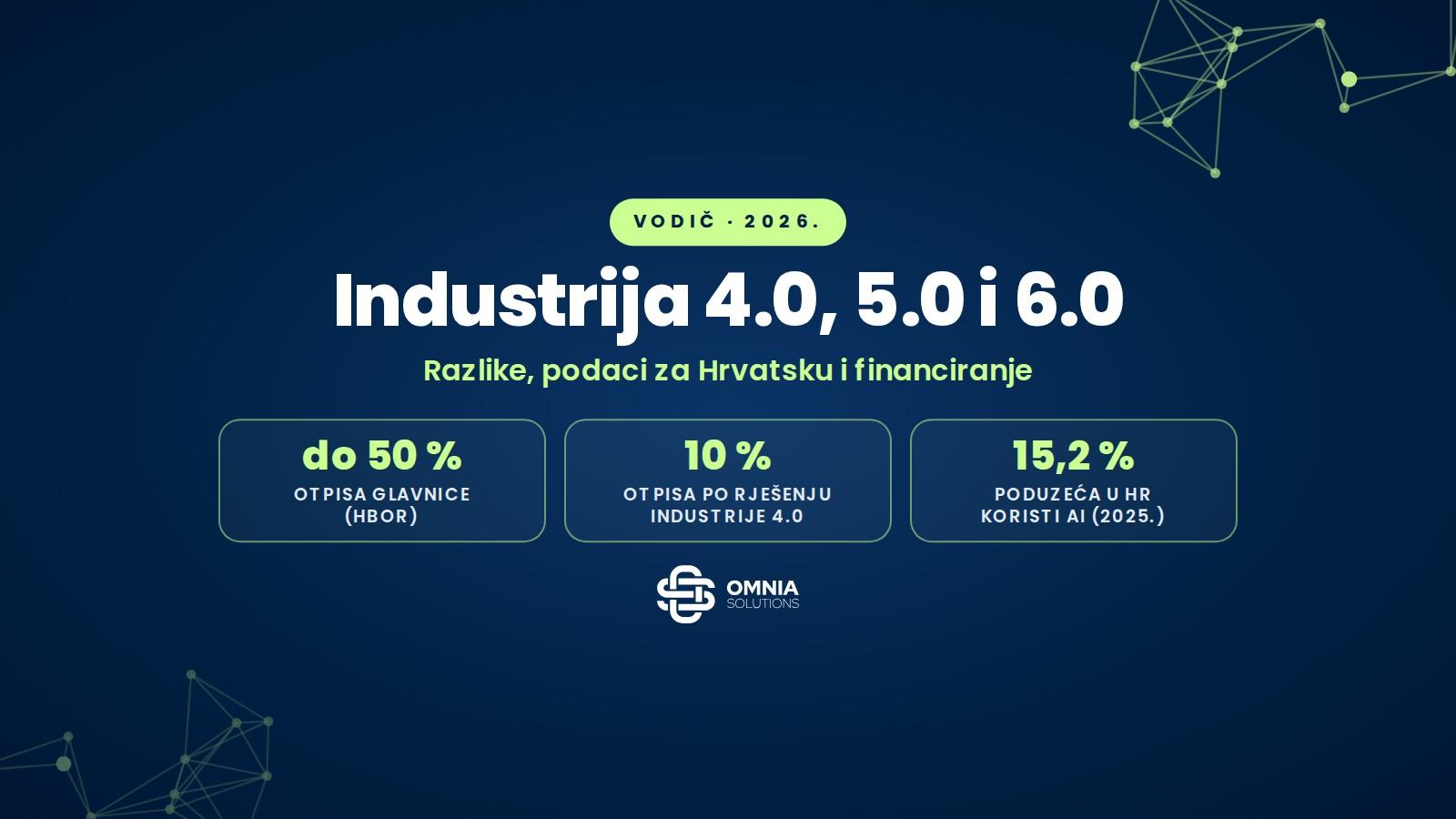
Industry 4.0 connects machines, products and information systems into production that makes decisions based on real-time data. The term originated in Germany in 2011. Industry 5.0 is a concept that the European Commission presented in 2021 and that complements Industry 4.0 with three goals: human-centricity, sustainability and resilience. Industry 6.0 so far exists only in scientific and professional literature. For Croatian manufacturers, Industry 4.0 also has a direct financial value. Under the Loans for Production Modernisation (Krediti za modernizaciju proizvodnje) of HBOR (Croatian Bank for Reconstruction and Development), each recognised Industry 4.0 solution brings a 10% principal write-off, and the total write-off can reach 50%.
The article contains definitions with sources, a comparison table, the latest data on the digitalisation of Croatian companies and the sources of investment financing. Data checked on 20 October 2026.
Automation · digitalisation · Industry 4.0
Free assessment of how to finance your investment
Tell us what you are planning in production. We will assess which funding source fits the investment and how large the principal write-off could be under HBOR’s criteria for Industry 4.0 solutions. The first assessment is free and without obligation.
In brief
- Industry 4.0: a technological paradigm that emerged in Germany in 2011. It is based on cyber-physical systems, the internet of things, automation and connected data.
- Industry 5.0: a concept presented by the European Commission in January 2021. It complements Industry 4.0 with human-centricity, sustainability and resilience.
- Industry 6.0: a term from scientific and professional literature (a white paper from 2021), with no official European Commission document and no criteria in funding programmes.
- Croatia: 15.2% of enterprises with 10 or more employees use artificial intelligence (EU 20.0%), and 21.9% use an ERP system (EU 46.5%), according to Eurostat data for 2025.
- Financing: HBOR’s loan for production modernisation (EUR 100,000 to 3,000,000, 0% interest on half of the loan) allows a write-off of up to 50% of the principal, depending on Industry 4.0 and digitalisation solutions.
- Digital projects: HBOR’s Investments in Digital Transition (Ulaganja u digitalnu tranziciju) programme offers a fixed interest rate of 2% for direct loans to the private sector of up to EUR 400,000 and repayment of up to 20 years.
What is Industry 4.0?
Industry 4.0 is a way of organising production in which machines, products and information systems are connected through cyber-physical systems and the internet of things, and decisions are made on the basis of data collected in real time.
On 1 April 2011, Henning Kagermann (acatech), Wolf-Dieter Lukas (German Federal Ministry of Education and Research) and Wolfgang Wahlster (DFKI) published the article “Industrie 4.0: Mit dem Internet der Dinge auf dem Weg zur 4. industriellen Revolution” in the newspaper VDI nachrichten. Wahlster presented the term publicly on 3 April 2011 at the opening of the Hannover Messe trade fair. On 8 April 2013, also at the fair in Hannover, a working group led by Siegfried Dais (Robert Bosch GmbH) and Henning Kagermann handed Chancellor Angela Merkel its final report with recommendations for implementing the Industrie 4.0 strategic initiative.
Industry 4.0 therefore began as a German industrial initiative that then became a global term.
The technological core of Industry 4.0 consists of:
- cyber-physical systems and the industrial internet of things (IIoT);
- sensors and real-time data collection;
- automation and robotisation of production and logistics processes;
- manufacturing information systems (MES), ERP and data integration between systems;
- predictive maintenance and machine learning;
- additive manufacturing (3D printing);
- cloud computing, edge computing and industrial cybersecurity.
Integration is at the heart of Industry 4.0. A robot delivers its full value when it sends data about its operation to a system that uses the data for production planning and monitoring. For HBOR’s loan for production modernisation, Industry 4.0 solutions are defined in Annex 2 of the programme and confirmed by a certified court expert.
What is Industry 5.0?
Industry 5.0 is a concept of European industrial policy that complements Industry 4.0 with three goals: human-centricity, sustainability and resilience.
In January 2021, the European Commission’s Directorate-General for Research and Innovation published the document “Industry 5.0 – Towards a sustainable, human-centric and resilient European industry” (authors Maija Breque, Lars De Nul and Athanasios Petridis). In it, the Commission states that Industry 5.0 complements the existing Industry 4.0 paradigm and shifts the focus from shareholder value to value for all stakeholders. It places worker well-being at the centre of the production process, while respecting planetary boundaries.
In January 2022, the Commission also published the ESIR expert group’s document “Industry 5.0, a transformative vision for Europe”, which sets out how to manage the transition towards a sustainable industry.
At a workshop with European technology experts in 2020, the Commission identified six groups of technologies that enable Industry 5.0 (Müller, 2020):
- individualised human-machine interaction technologies;
- bio-inspired technologies and smart materials;
- digital twins and simulation;
- technologies for data transmission, storage and analysis;
- artificial intelligence;
- technologies for energy efficiency, renewables, energy storage and energy autonomy.
The list largely overlaps with Industry 4.0 technologies. What is new in Industry 5.0 is the criterion by which these tools are assessed, that is, how the investment affects people, the environment and the resilience of the company.
What is the key difference between Industry 4.0 and 5.0?
A concise distinction was given by Xun Xu, Yuqian Lu, Birgit Vogel-Heuser and Lihui Wang in a paper published in 2021 in the Journal of Manufacturing Systems. According to them, Industry 4.0 is technology-driven and Industry 5.0 is value-driven. Industry 5.0 is therefore more accurately understood as a value framework that determines what Industry 4.0 technology serves.
In 2023, Dmitry Ivanov proposed a framework in the International Journal of Production Research that links resilience, sustainability and human-centricity through viability, that is, the ability of a company to survive in the long term. For company management this is a useful formulation, because it translates value-based goals into the language of risk.
Does Industry 6.0 exist?
It does, but only in scientific and professional literature. Industry 6.0 has no official European Commission document and no criterion in funding programmes.
The term appears in 2021 in the white paper “From Industry X to Industry 6.0: Antifragile Manufacturing for People, Planet, and Profit with Passion”, prepared by researchers in the Allied ICT Finland network and published by Business Finland. There, Industry 6.0 is described as ubiquitous, customer-driven, virtualised and antifragile manufacturing. Papers by Duggal et al. (IET Communications, 2022) and Chourasia et al. (MAPAN, 2022) followed.
In these papers, the following are mentioned in connection with Industry 6.0:
- generative artificial intelligence that runs the production process autonomously;
- groups (swarms) of different autonomous robots that work together;
- virtualised production driven by customer needs;
- antifragility, that is, systems that come out of disruptions stronger.
The first experimental demonstrations also exist. Researchers from Skoltech (Lykov et al., 2024) presented a system in which the user describes a product in plain language and artificial intelligence manages design, fabrication, logistics and assembly using robotic arms, drones and 3D printers. In their experiment, production was about 4.4 times faster than with experts.
The status of the three concepts nevertheless differs considerably. Industry 4.0 is backed by a German government initiative, and Industry 5.0 by European Commission documents and by topics in earlier Horizon Europe work programmes that mention it explicitly. Industry 6.0 so far has only scientific and professional papers behind it. For an entrepreneur preparing an investment, this means that Industry 6.0 is neither an eligibility criterion nor a source of points, and it does not belong in the project documentation.
Comparison table: Industry 4.0, 5.0 and 6.0
| Dimension | Industry 4.0 | Industry 5.0 | Industry 6.0 |
|---|---|---|---|
| Origin | Germany, 2011 (Hannover Messe) | European Commission, January 2021 | professional and scientific literature, since 2021 |
| Status | national and EU policy | European Commission documents, topics of earlier Horizon Europe calls | no official status |
| Driver | technology | values | autonomy and antifragility |
| Main goal | efficiency and productivity | worker well-being, sustainability, resilience | self-organising production systems |
| Role of people | supervise the automated system | collaborator and centre of the process | direct autonomous systems |
| Typical technologies | IIoT, cyber-physical systems, MES and ERP, robotisation | cobots, digital twins, artificial intelligence, energy efficiency | generative artificial intelligence, robot swarms |
| Measure of success | shareholder value | value for all stakeholders | resilience and adaptability of the system |
| Relevance for financing in Croatia | direct: criterion for the principal write-off at HBOR | indirect: framework for justifying the project | none |
Where Croatia stands: data on company digitalisation
| Indicator (2025) | Croatia | EU | Source |
|---|---|---|---|
| Enterprises with 10 or more employees using at least one artificial intelligence technology | 15.2% | 20.0% | Eurostat |
| Enterprises with 10 or more employees using an ERP system | 21.9% | 46.5% | Eurostat |
| SMEs with at least a basic level of digital intensity (EU target for 2030: more than 90%) | 57.1% | 71.4% | European Commission, Digital Decade 2026 |
| Enterprises using sophisticated or intermediate cloud services | 43.3% | 46.7% | European Commission, Digital Decade 2026 |
| Enterprises using data analytics | 41.9% | 39.9% | European Commission, Digital Decade 2026 |
Artificial intelligence. The share of enterprises using artificial intelligence in Croatia rose from 11.8% in 2024 to 15.2% in 2025, and in the EU from 13.5% to 20.0%. Denmark (42.0%), Finland (37.8%) and Sweden (35.0%) lead, while Romania (5.2%) and Poland (8.4%) have the lowest shares.
Business information systems. This is where the gap is largest. In 2025, 21.9% of Croatian enterprises use an ERP system, less than half of the EU average (46.5%), while in Denmark the share is 66.3%. Without ERP and connected data, there is no Industry 4.0 in the full sense.
Robotisation. According to the International Federation of Robotics (IFR), in 2024 the EU had 231 industrial robots per 10,000 employees in manufacturing, and Western Europe a record 267. The global average was 132. The IFR does not publish a figure for Croatia.
European Commission assessment. In its Digital Decade report for Croatia (2026), the Commission states that the digital intensity of SMEs remains one of the key weaknesses and that the use of cloud and artificial intelligence is below the EU average. It recommends faster adoption of artificial intelligence and other advanced technologies, especially in SMEs and micro-enterprises.
Our assessment is that Croatian manufacturing is not choosing between Industry 4.0, 5.0 and 6.0. Many companies are only now introducing basic Industry 4.0 systems, while funding programmes increasingly also require a justification in the spirit of Industry 5.0, that is, effects on employees, the environment and resilience. With the HBOR loan, the write-off depends on the criteria in Annex 2 (Industry 4.0 solutions, digital solutions and S3), and the “do no significant harm” (DNSH) principle is an eligibility condition. In calls for grants, the justification of effects on people, the environment and resilience can affect the score.
How to finance an Industry 4.0 investment in Croatia
Two HBOR programmes are particularly interesting for Industry 4.0 investments. The first links the principal write-off directly to Industry 4.0 solutions, and the second offers a favourable interest rate for strategic digital projects.
HBOR loan for production modernisation: principal write-off for Industry 4.0 solutions
Loans for Production Modernisation are intended for micro, small and medium-sized enterprises in manufacturing (section C of NKD 2025). The loan amounts to EUR 100,000 to 3,000,000 and is financed half from the European Regional Development Fund (ERDF), at 0% interest on that portion, and half from HBOR’s own funds. Repayment lasts up to 15 years, including a grace period of up to 3 years. The application is submitted directly to HBOR, electronically.
The most important feature is the capital rebate, that is, a write-off of up to 50% of the total disbursed principal. The percentage is added up according to three criteria in Annex 2 of the programme:
| Criterion | Write-off | Condition |
|---|---|---|
| A. Industry 4.0 solutions (smart factory) | 10% for each solution | the cost of each solution must be at least 10% of the total loan principal |
| B. Digital solutions for business processes (e.g. ERP, CRM, document management) | 2% for each solution | the solution must be included in the Digital Transformation Plan and the List of Planned Products and Solutions |
| C. Alignment with the Smart Specialisation Strategy (S3) until 2029 | 5% | the result of the investment belongs to one of the S3 thematic areas |
| Total | up to 50% | the criteria can be combined |
According to Annex 2, Industry 4.0 solutions are:
- automation and robotisation of processes and of management and control;
- the internet of things (IoT) and sensors;
- machines controlled by artificial intelligence;
- manufacturing information systems for data exchange during and after production.
Several products can form one solution if they work as a unit in the production process. That is why it is important to decide in advance how the equipment will be grouped, because each solution must reach 10% of the loan principal. A certified court expert confirms the solutions before the loan is approved, on the basis of the Digital Transformation Plan, and again after the investment.
Hypothetical example. With a loan of EUR 1,000,000, an Industry 4.0 solution is recognised if it costs at least EUR 100,000. A robotic cell, a sensor system for machine monitoring and a MES, each above that threshold, bring 30%. An ERP and a document management system add 4%, and a product in an S3 area another 5%. With the loan fully disbursed, the total write-off would be 39%, or EUR 390,000. The actual write-off depends on HBOR’s assessment and must stay within the permitted aid intensity.
All conditions, documentation and the procedure are described in the guide HBOR loan for production modernisation 2026, and how the write-off works in the article Capital rebate. An example from practice is the PG Orehovec case study. Omnia Solutions prepared the application for this loan for PG Orehovec. According to the post on our website (6 May 2026), the investment in capacity expansion and automation of the slaughterhouse is worth almost EUR 2 million, the loan amounts to around EUR 1.45 million, and the projected capital rebate of 50% is approximately EUR 730,000. The capital rebate is realised once the criteria have been proven.
HBOR programme Investments in Digital Transition
The programme has applied since 1 July 2026 and is funded from the National Recovery and Resilience Plan (NPOO). It is intended for businesses of all sizes and legal forms and for the public sector (local and regional self-government units only for economic activities). It finances strategic digital projects, that is, investments in intervention fields to which Regulation (EU) 2021/241 assigned a digital coefficient of 100%, as well as working capital of up to 30% of the loan amount.
- Interest rate for the private sector: for direct HBOR loans of up to EUR 400,000, a fixed 2.00% per year; for larger loans HBOR sets it individually, and with the subsidy it cannot be lower than 1.50%. For loans through commercial banks, the interest rate is up to 3.50%.
- Amount: direct loans from EUR 100,000, and through banks from EUR 50,000.
- Repayment: up to 20 years, with a grace period of up to 3 years.
- Principal write-off: the programme does not provide for one.
Read more about the programme and two other new programmes in the article HBOR launches three new lending programmes.
Which HBOR programme should you choose?
| Loans for Production Modernisation | Investments in Digital Transition | |
|---|---|---|
| For whom | micro, small and medium-sized enterprises in manufacturing | businesses of all sizes and the public sector |
| Amount | EUR 100,000 to 3,000,000 | direct from EUR 100,000, through a bank from EUR 50,000 |
| Interest rate | 0% on half of the loan (ERDF); HBOR’s portion based on risk assessment | 2.00% fixed up to EUR 400,000 (direct, private sector) |
| Principal write-off | up to 50%, depending on Industry 4.0 solutions, digitalisation and S3 | none |
| Repayment | up to 15 years, grace period up to 3 | up to 20 years, grace period up to 3 |
| Best suited for | production investments with automation, sensors, robots and MES | strategic digital projects, also outside manufacturing |
An overview of all HBOR programmes is in the article HBOR loans for entrepreneurs 2026.
A manufacturing company that invests at least EUR 500,000 in automation, robotisation or digitalisation can also benefit from profit tax that is lower by 50, 75 or 100% for up to 10 years, with no obligation to create new jobs. Read more in the guide Tax incentives for investment 2026.
Grants and Horizon Europe
We regularly follow current national calls for grants, including calls for innovation and digitalisation, in the article Current EU funding opportunities in 2026. HBOR’s loan for production modernisation must not be used to co-finance or pre-finance grants, so the funding source should be chosen before the investment starts.
For companies that develop new technologies in international consortia, the Horizon Europe programme is relevant. The work programme for 2026 and 2027 includes the horizontal call “R&I in Support of the Clean Industrial Deal” worth EUR 540 million, funded by Clusters 4 (Digital, Industry and Space) and 5 (Climate, Energy and Mobility). Earlier Cluster 4 calls explicitly mentioned Industry 5.0, for example a 2023 topic on the drivers of progress towards Industry 5.0. Horizon Europe mainly funds research and innovation projects of consortia.
How to prepare an Industry 4.0 investment for financing
- Start from processes and data, not from equipment. Describe which data the machines collect, where they send them and how they are used in production planning and monitoring.
- Prepare a Digital Transformation Plan. List in it every Industry 4.0 and digitalisation solution, with the equipment and software that make it up.
- Group the equipment into solutions. With the HBOR loan, each solution must reach at least 10% of the loan principal to bring a 10% write-off.
- Explain the effects on people, the environment and resilience. For example, describe how ergonomics and occupational safety, energy consumption, the amount of scrap and dependence on individual suppliers change.
- Link the result to the Smart Specialisation Strategy. With the HBOR loan, this brings an additional 5% write-off.
- Prepare DNSH and climate resilience early. Documentation on the “do no significant harm” principle is mandatory in both HBOR programmes.
- Do not start the investment too early. With the loan for production modernisation, the investment must not start before the Investment Notification (Najava ulaganja) or the loan application is submitted.
Criticism and open questions
- Inflation of paradigms. The first three industrial revolutions were decades apart. Industry 4.0 and 5.0 are a decade apart, and Industry 6.0 is being written about before the effects of Industry 5.0 have even been measured.
- Shift in goals. Industry 4.0 describes a technological change, and Industry 5.0 describes public policy goals. That is why Industry 5.0 brings no new tools, but it matters for justifying projects.
- Measurability. Efficiency and productivity are easy to measure, while worker well-being and resilience are much harder to measure. Without clear indicators, Industry 5.0 can easily remain at the level of a declaration.
- The actual situation in companies. A large part of European SMEs, and Croatian SMEs in particular, has not yet introduced even the basic Industry 4.0 systems, as the ERP data also show.
For an entrepreneur, this means that Industry 5.0 mainly changes the way an investment is justified. In calls for grants, points may depend on it, while with the HBOR loan the write-off depends on Industry 4.0 solutions, digitalisation and S3.
How Omnia Solutions can help you
Omnia Solutions is a Zagreb-based consultancy specialising in EU funds and favourable loans with a principal write-off. We help manufacturing companies from the investment idea to loan approval and proving the criteria after the investment. Read more on the pages HBOR loans: advice and application preparation and EU projects: preparation and implementation.
- Choosing the funding source according to the type, size and location of the investment.
- Structuring the investment into Industry 4.0 and digitalisation solutions and estimating the possible write-off.
- Preparing the Digital Transformation Plan, business plan or investment study.
- Coordination with the court expert and designers on DNSH and climate resilience, submission of the application and communication with HBOR.
Free introductory call
Not sure how to finance your Industry 4.0 investment?
Tell us what you plan to automate or digitalise and we will check which funding source fits your investment. The introductory call is free. Email or call us.
Frequently asked questions about Industry 4.0, 5.0 and 6.0
What is the difference between Industry 4.0 and Industry 5.0?
Industry 4.0 focuses on technology and efficiency, that is, on connecting machines, data and systems. Industry 5.0 adds human-centricity, sustainability and resilience. In the literature, Industry 4.0 is described as technology-driven and Industry 5.0 as value-driven (Xu et al., 2021).
Does Industry 5.0 replace Industry 4.0?
No. In its document of January 2021, the European Commission states that Industry 5.0 complements the existing Industry 4.0 paradigm.
Does Industry 6.0 exist?
Only in scientific and professional literature, starting with a white paper from 2021. It describes Industry 6.0 as ubiquitous, customer-driven, virtualised and antifragile manufacturing. There is no official European Commission document and no criterion in funding programmes that refers to it.
Who coined the term Industry 4.0?
Henning Kagermann, Wolf-Dieter Lukas and Wolfgang Wahlster, in an article published on 1 April 2011 in the newspaper VDI nachrichten. The term was presented publicly on 3 April 2011 at the opening of the Hannover Messe trade fair.
What are the three pillars of Industry 5.0?
Human-centricity, sustainability and resilience, according to the European Commission document of January 2021.
What counts as an Industry 4.0 solution for HBOR’s loan for production modernisation?
According to Annex 2 of the programme, these are automation and robotisation of processes and of management and control, the internet of things and sensors, machines controlled by artificial intelligence, and manufacturing information systems for data exchange during and after production. The solutions are confirmed by a certified court expert.
How large a principal write-off do Industry 4.0 solutions bring?
With HBOR’s loan for production modernisation, each Industry 4.0 solution whose cost is at least 10% of the loan principal brings a 10% write-off. Each digital solution for business processes brings 2%, and alignment with the Smart Specialisation Strategy 5%. The total is up to 50% of the disbursed principal.
How many Croatian companies use artificial intelligence?
According to Eurostat, in 2025 artificial intelligence was used by 15.2% of Croatian enterprises with 10 or more employees, while the EU average was 20.0%.
Which loans finance the digitalisation of production in Croatia?
HBOR’s loan for production modernisation (EUR 100,000 to 3,000,000, 0% interest on half of the loan, principal write-off of up to 50%) for SMEs in manufacturing. For strategic digital projects there is also HBOR’s Investments in Digital Transition programme, with a fixed interest rate of 2% for direct loans to the private sector of up to EUR 400,000 and repayment of up to 20 years, if the investment falls within intervention fields with a digital coefficient of 100%.
Is Industry 6.0 relevant for a call application?
No. No funding programme in Croatia or in the EU uses Industry 6.0 as an eligibility or scoring criterion. What matters for financing are Industry 4.0 solutions and a justification of the effects in the spirit of Industry 5.0.
Planning robotisation, sensors or a new production system?
The principal write-off depends on how the investment is structured and described before the application is submitted. Check your options in good time, free of charge and without obligation.
Sources
- DFKI: Ten Years of Industrie 4.0 (interview with W. Wahlster); Kagermann, H., Lukas, W.-D., Wahlster, W. (2011), Industrie 4.0, VDI nachrichten, 1 April 2011.
- acatech: Industrie 4.0, final report of the working group (2013)
- Breque, M., De Nul, L., Petridis, A. (2021), Industry 5.0 – Towards a sustainable, human-centric and resilient European industry, European Commission
- Dixson-Declève, S. et al. (2022), Industry 5.0, a transformative vision for Europe, ESIR Policy Brief No. 3, European Commission
- Müller, J. (2020), Enabling Technologies for Industry 5.0, European Commission
- Xu, X., Lu, Y., Vogel-Heuser, B., Wang, L. (2021), Industry 4.0 and Industry 5.0 – Inception, conception and perception, Journal of Manufacturing Systems 61
- Ivanov, D. (2023), The Industry 5.0 framework, International Journal of Production Research 61(5)
- Annanperä, E. et al. (2021), From Industry X to Industry 6.0, Business Finland
- Duggal, A. S. et al. (2022), A sequential roadmap to Industry 6.0: Exploring future manufacturing trends, IET Communications 16(5)
- Lykov, A. et al. (2024), Industry 6.0: New Generation of Industry driven by Generative AI and Swarm of Heterogeneous Robots, arXiv:2409.10106
- Eurostat: Use of artificial intelligence in enterprises (2025 data)
- Eurostat: E-business integration (2025 data)
- European Commission: State of the Digital Decade 2026 and the country report for Croatia
- IFR: Robot density surges in Europe, Asia and Americas (8 April 2026)
- HBOR: Loans for Production Modernisation (programme and Annex 2, Criteria for the Capital Rebate)
- HBOR: Investments in Digital Transition lending programme (NPOO), applicable from 1 July 2026
- European Commission: Horizon Europe, Work Programme 2026–2027, General Introduction
Data checked on 20 October 2026. The conditions of funding programmes may change, so check them in the official documentation or with us before making a decision. HBOR decides on the loan and the capital rebate.