For a client, Omnia Solutions has successfully carried out one of the most complex procedures for financing a production investment through the loan for production modernisation (Krediti za modernizaciju proizvodnje) from HBOR (Croatian Bank for Reconstruction and Development).
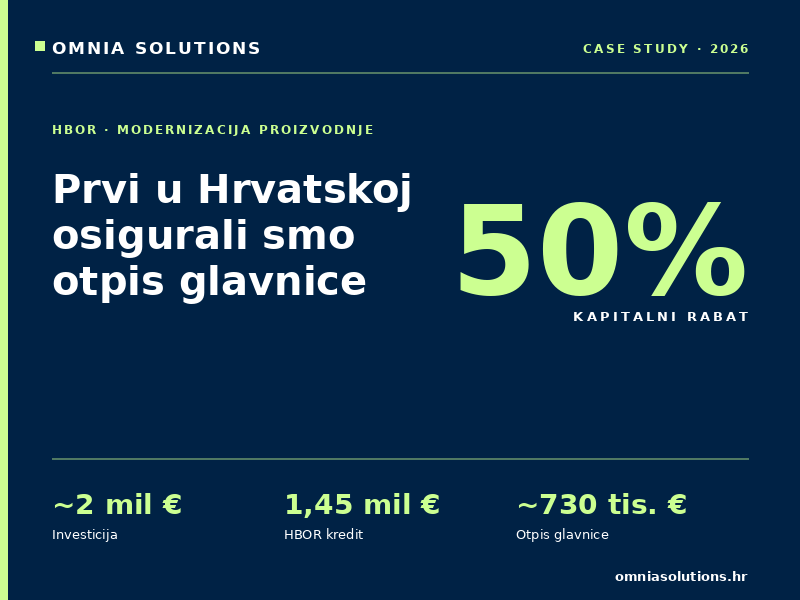
The project in figures:
- almost EUR 2 million in total investment,
- around EUR 1.45 million in HBOR loan financing,
- approximately EUR 730,000 in principal write-off,
- the maximum capital rebate of 50%,
- more favourable financing terms for the remaining part of the loan compared with regular bank credit lines,
- digital transformation of production carried out through investment in new equipment, automation and Industry 4.0 technologies.
Omnia Solutions submitted one of the first applications in Croatia for this HBOR credit line, and the client was approved the maximum principal write-off of 50% on the HBOR loan for production modernisation.

What is the HBOR loan for production modernisation?
The HBOR loan for production modernisation is a financial instrument intended for entrepreneurs who invest in the modernisation, digitalisation and automation of production processes and in making them more competitive.
This credit line is particularly important for micro, small and medium-sized enterprises in manufacturing, because it makes it possible to finance investments in modern production equipment, Industry 4.0 technologies, digital transformation and greater business efficiency.
The biggest advantage of this line is the possibility of a capital rebate, that is, a write-off of part of the loan principal. If the prescribed criteria are met, the principal write-off can amount to up to 50% of the total disbursed loan principal.
You can read more about the credit line on our page:
HBOR loans for production modernisation
HBOR’s official page is available here:
HBOR: Loans for Production Modernisation
Why is this credit line complex?
The HBOR loan for production modernisation is not a standard loan application. In addition to the usual financial documentation, the applicant must prove that the investment contributes to the modernisation of production, digital transformation, higher productivity and compliance with environmental criteria.
A successful application requires preparing and coordinating several levels of documentation, including:
- an investment study,
- financial projections,
- the Digital Transformation Plan,
- a technical description of the investment,
- forms proving eligibility,
- DNSH documentation,
- climate resilience documentation,
- evidence that the investment does not harm environmental objectives,
- documentation for the review and confirmation of the effects of the investment after implementation.
This is exactly why this credit line is administratively and technically demanding. It requires an understanding of the technological, digital, environmental and implementation criteria as well as the financial conditions.
The role of Omnia Solutions in the project
Our work as consultants went beyond preparing the documentation. The key value that Omnia Solutions brought was that we recognised in time that the client’s project was an ideal candidate for the HBOR loan for production modernisation.
Instead of the client applying for the regular credit lines of commercial banks, we identified in time the possibility of applying for this specific HBOR line, which offered a considerably more favourable financial structure and the possibility of a principal write-off.
In the project, Omnia Solutions was in charge of:
- the analysis of the eligibility of the investment,
- structuring the project according to HBOR’s conditions,
- preparing the investment study,
- drafting the Digital Transformation Plan,
- preparing the application forms,
- coordinating the DNSH documentation,
- coordinating external experts for climate resilience and environmental criteria,
- communication with the client and the stakeholders involved,
- support during the implementation of the investment,
- coordination towards the final proof of the conditions for the capital rebate.
In this way, we significantly reduced the client’s administrative burden and allowed the client to focus on implementing the investment and on day-to-day operations.
The client’s project: modernisation of production at PG Orehovec
The project was carried out for the client PG Orehovec, a producer and processor of poultry meat from Veliki Bukovec.
PG Orehovec is developing its business in poultry farming and processing, with an emphasis on product quality, animal welfare, controlled food origin and the development of its own production. More about the client is available on its official website: PG Orehovec
The investment concerned the expansion of capacity and the automation of the slaughterhouse through the purchase of modern technological equipment for processing and packaging poultry meat.
The project included the introduction of advanced solutions for:
- cutting,
- rehanging,
- carcass weighing,
- filleting,
- packaging,
- automated data collection,
- quality monitoring,
- real-time monitoring of production and stock,
- integration of production data with the ERP system.
The aim of the project was to transform the existing production processes, which relied largely on manual work and manual records, into a more modern, more efficient and digitalised production system.
In the Digital Transformation Plan, the project was defined as an investment in expanding capacity and automating the slaughterhouse by introducing technological equipment for processing and packaging poultry meat, including Industry 4.0+ solutions, ERP integration and real-time production monitoring.
Why was the Digital Transformation Plan decisive?
For the HBOR loan for production modernisation, it is not enough to show that the entrepreneur is buying new equipment. It must be proven that the investment creates a real digital transformation of the business.
That is why the Digital Transformation Plan was one of the key documents in the application.
In this project, the Digital Transformation Plan showed how the investment would improve production through:
- fewer manual entries,
- digitalisation of weighing and records,
- automation of production lines,
- fewer operational errors,
- better control of shrinkage and stock,
- faster data-based decision-making,
- integration of machines and production processes with the ERP system,
- real-time monitoring of key production indicators.
This was particularly important because the existing production system involved a significant share of manual measurements, manual data recording and subsequent entry into spreadsheets and the ERP. The modernisation raises production to a considerably higher level of efficiency, control and transparency.
DNSH forms and proof of the environmental acceptability of the investment
One of the more demanding parts of the application concerned the DNSH documentation.
DNSH stands for “Do No Significant Harm”, the principle under which an investment must not significantly harm environmental objectives. For this credit line, it had to be proven that the investment does not endanger environmental objectives and that the project complies with climate resilience criteria.
In this part, Omnia Solutions coordinated the work of external experts, the collection of the necessary data, the preparation of the forms and the alignment of the documentation with the rest of the application.
This mattered for the client because DNSH and climate documentation require specific technical knowledge, and any error in preparation can slow down processing or jeopardise the success of the application.
One of the first applications in Croatia for the HBOR loan for production modernisation
Omnia Solutions submitted one of the first applications in Croatia for this credit line.
Since the line was new and the documentation extremely complex, processing took somewhat longer than expected. In practice, the approach to administrative processing, the interpretation of the criteria and the proof of the conditions for the capital rebate were being developed at the same time.
Yet it was precisely the early reaction that was decisive.
Recognising the opportunity in time allowed the client to choose, instead of a regular investment loan, a financial instrument that could bring a considerably greater financial benefit.
One of the most important tasks of a good consultant is to recognise the best source of financing before the client decides to take on debt.

Maximum principal write-off of 50% approved
After the investment was carried out, the equipment installed, the machines put into operation and detailed inspections by the certified court expert completed, the maximum capital rebate was approved for the client, that is, a write-off of 50% of the HBOR loan principal.
Financial result of the project:
- total investment: almost EUR 2 million,
- HBOR loan: around EUR 1.45 million,
- approved principal write-off: approximately EUR 730,000,
- write-off level: 50% of the loan principal.
This result confirms that a well-prepared application and precisely managed implementation can have a direct, measurable and very significant financial effect for an entrepreneur.
What does this result mean for manufacturing companies?
If a company is planning an investment in production, equipment, automation, digitalisation or ERP integration, the HBOR loan for production modernisation can be one of the most favourable financing options on the market.
However, the possibility of a principal write-off does not mean that every project will automatically obtain the capital rebate. It must be proven that the investment meets the prescribed criteria and contributes to a real modernisation of the production process.
Entrepreneurs should consider this line if they are planning investments in:
- production machinery,
- automation lines,
- digitalisation of production,
- ERP systems,
- Industry 4.0,
- robotisation,
- capacity expansion,
- quality control,
- reducing shrinkage and operating costs,
- more efficient management of stock and production.
Timely preparation can make the difference between a standard loan and financing that includes a significant principal write-off.
Frequently asked questions about the HBOR loan for production modernisation
What is the HBOR loan for production modernisation?
The HBOR loan for production modernisation is a credit line intended to finance investments in the modernisation, digitalisation and automation of manufacturing companies and in making them more competitive.
What is a capital rebate?
A capital rebate is a write-off of part of the loan principal. For the HBOR loan for production modernisation, the capital rebate can amount to up to 50% of the total disbursed loan principal if the prescribed criteria are met.
Can a 50% principal write-off be obtained?
Yes, a principal write-off of up to 50% is possible, but only if the project meets the conditions of the credit line and if, after the investment has been implemented, it is proven that the prescribed criteria have been achieved.
What is the Digital Transformation Plan?
The Digital Transformation Plan is a document that presents the company’s current level of digitalisation, the planned investments, the expected effects and the way in which the project contributes to the digital transformation of the business.
Why are DNSH forms important?
DNSH forms are used to prove that the investment does not harm environmental objectives. For this credit line, they are an important part of the documentation, especially for investments in equipment, production and technological processes.
Why hire a consultant for the HBOR loan for production modernisation?
A consultant helps with assessing the eligibility of the investment, structuring the project, preparing the documentation, drafting the Digital Transformation Plan, coordinating the DNSH documentation and proving the conditions for the principal write-off.
The right source of financing can change the economics of an investment
This project shows how important it is to recognise the right source of financing in time.
Had the client applied for a regular credit line, it would not have obtained the same level of financial benefit. Through the HBOR loan for production modernisation, with a properly structured project and well-managed implementation, a principal write-off of approximately EUR 730,000 was approved.
In this project, Omnia Solutions demonstrated its expertise in preparing and implementing one of the most demanding credit lines on the market.
If you are planning an investment in production, automation, digitalisation, an ERP system or Industry 4.0, now is the right time to check whether your project can qualify for the HBOR loan for production modernisation and a capital rebate of up to 50%.
Find out more at: HBOR loans for production modernisation or contact us at +385 97 796 96 79 or mvlahovski@omniasolutions.hr so that we can check the eligibility of your project together.
Guide: HBOR loans for entrepreneurs 2026
- HBOR loans for entrepreneurs 2026. All programmes, interest rates, principal write-off of up to 50%, repayment of up to 20 years and documentation.
- HBOR loan for production modernisation 2026. From EUR 100,000 to 3,000,000, half at 0% interest, and a write-off of up to 50% of the principal.
- HBOR loans: advice and application preparation. What you need for the application and how we work.