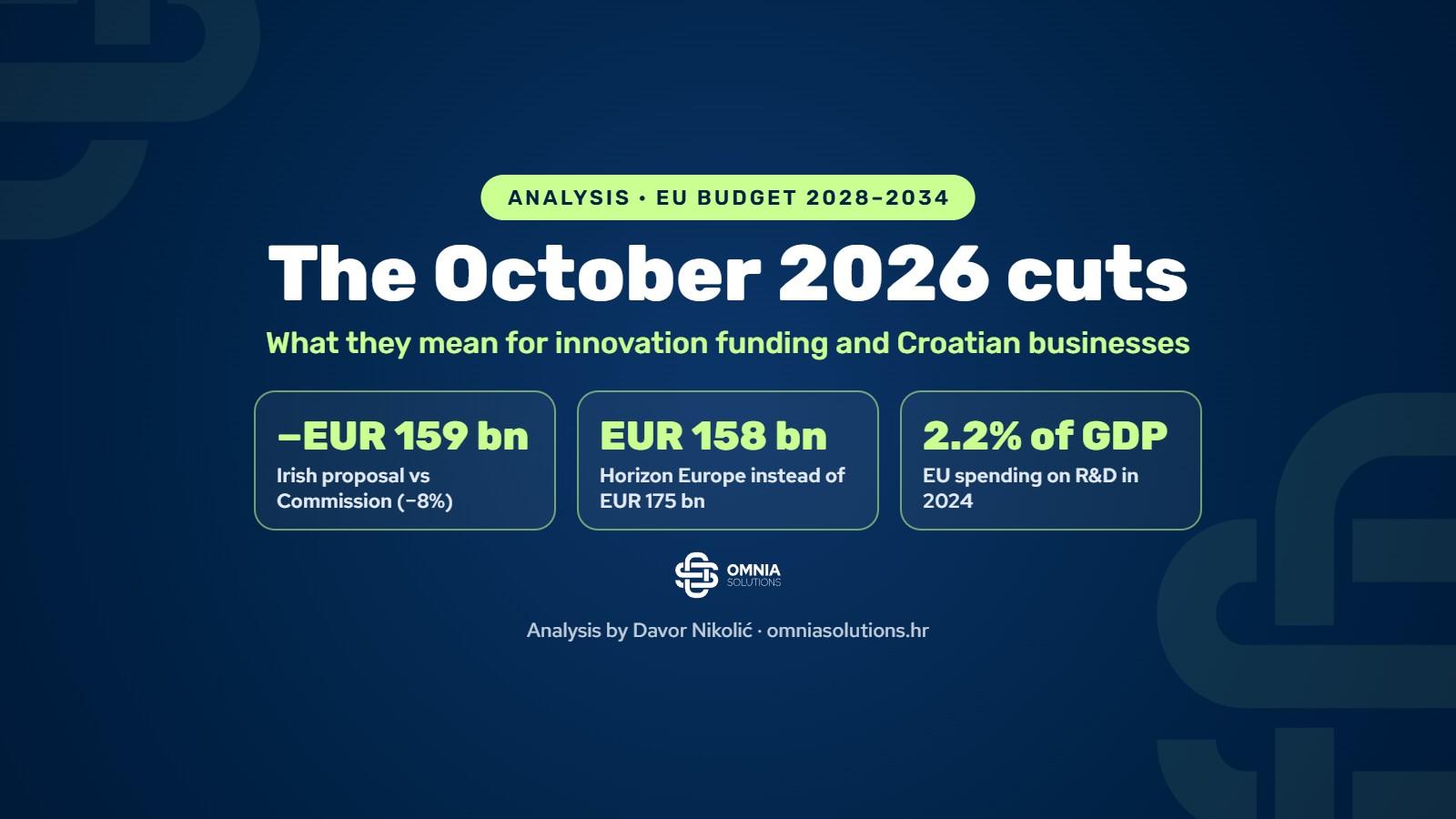
Negotiations on the European Union’s multiannual financial framework (MFF) for 2028–2034 have entered the decisive phase. On 10 October 2026, the Irish Presidency of the Council of the EU proposed a budget of EUR 1,825 billion, EUR 159 billion (8%) less than the European Commission’s proposal, with the deepest cuts to competitiveness, defence and external action. Horizon Europe, the main EU programme for research and innovation, would fall from EUR 175 billion to EUR 158 billion. EU heads of state or government discussed the budget for the first time on 15 and 16 October and kept the goal of an agreement by the end of 2026, while European Council President António Costa announced his own proposal with figures by the end of November, ahead of the European Council meeting dedicated to the budget on 26 and 27 November 2026.
This analysis covers the three budget proposals and their figures, the European Council conclusions, the Council’s position on Horizon Europe, the implementation of the Draghi recommendations one year on, and what all of this means for businesses in Croatia planning projects for 2027 and 2028. It follows our June 2026 analysis. Figures are based on official sources and on reports by Agence Europe, Euronews, EUA and EPRS as of 28 October 2026.
At a glance
EU budget 2028–2034: from the Commission proposal to the Irish negotiating box
Amounts in current prices. Sources: Agence Europe, Euronews, EUA, October 2026.
Three proposals, three figures: where the negotiations stand
The European Commission presented its budget proposal of almost EUR 2 trillion on 16 July 2025. Cyprus, holding the Council Presidency, tabled the first negotiating box with figures in June 2026, and Ireland presented the second on 10 October 2026, with deeper cuts. National envelopes for cohesion and agriculture were left untouched, so the burden of the cuts falls on programmes managed at EU level.
| Item | Commission (July 2025) | Cypriot negotiating box (June 2026) | Irish negotiating box (October 2026) |
|---|---|---|---|
| Total MFF 2028–2034 | EUR 1,985 bn | cut of EUR 32.8 bn (−2%) | EUR 1,825 bn (−EUR 159 bn, −8%) |
| Heading 1: cohesion, agriculture, national and regional partnership plans | EUR 1,062 bn | – | EUR 1,026 bn (−3%), national envelopes untouched |
| Heading 2: competitiveness, research, defence | EUR 590 bn | – | EUR 515 bn (−13%) |
| European Competitiveness Fund | EUR 409 bn | not published | EUR 362 bn |
| Horizon Europe (FP10) | EUR 175 bn | EUR 167.9 bn | EUR 158.2 bn (−9.6% compared with the Commission) |
| Resilience, security, defence industry and space | EUR 130 bn | – | EUR 113 bn (−13%) |
| Global Europe (external action) | EUR 215 bn | – | EUR 177 bn (−17%) |
Interactive chart
Where the cuts fall: Commission proposal vs Irish negotiating box by item
Heading 1: cohesion, agriculture, partnership plans
Heading 2: competitiveness, research, defence
European Competitiveness Fund
Global Europe (external action)
Horizon Europe (FP10)
Resilience, security, defence industry and space
Hover over or tap a bar for details. The items partly overlap because smaller programmes sit inside larger headings, so the amounts do not add up.
Amounts in EUR billion, current prices. Sources: Agence Europe and Euronews (10 October 2026), EUA (13 October 2026).
Two camps stand behind the figures. Six "frugal" countries led by Germany want the Commission's proposal cut by several hundred billion, while seventeen "friends of cohesion" led by Italy defend funding for agriculture and less developed regions. Sweden called the Irish negotiating box unreasonable and said the sides were not even close to an agreement. The revenue side is also open: the package of new own resources is estimated at EUR 55 billion a year, and three proposals from the European Parliament (digital services, online gambling, crypto-assets) were not included in the Irish negotiating box.
The European Parliament, whose consent the MFF requires, is moving in the opposite direction to the Council. In an interim report adopted on 28 April 2026 (370 votes in favour, 201 against, 84 abstentions), it calls for a budget of 1.27% of gross national income, or EUR 1,789 billion in constant 2025 prices, plus an additional EUR 149.3 billion for repaying NextGenerationEU debt above the ceilings. By Parliament's calculation, that is around EUR 175 billion (10%) more than the Commission's proposal. It also calls for a basket of new own resources worth at least EUR 60 billion a year. The rapporteurs are Siegfried Mureșan (EPP) and Carla Tavares (S&D). Parliament's figures are in constant prices and are not directly comparable with the current prices in the table, but the direction is clear: the Council is cutting, Parliament wants more, and the gap between them runs to several hundred billion euro.
What EU leaders concluded on 16 October 2026
The European Council discussed the budget for the first time at the level of heads of state or government, on the basis of the Irish negotiating box. In its conclusions, it tasked the President of the European Council with steering the negotiations towards a timely agreement, noting that an agreement before the end of 2026 would allow the legislative acts to be adopted in 2027 and beneficiaries to be funded without interruption from January 2028. According to Agence Europe, the draft conclusions no longer treated an agreement by the end of the year as essential, which diplomats read as preparation for the negotiations being settled in 2027. Irish Taoiseach Micheál Martin and European Council President António Costa defended the end-2026 deadline, because implementing a more complex framework will take longer than before.
The next step is Costa's. According to Agence Europe, on 21 October in Strasbourg he confirmed that he would present his own negotiating box with figures by the end of November, with three aims: keeping national contributions at a reasonable level, agreeing an ambitious package of own resources and strengthening flexibility instruments for future crises. Leaders will discuss it at the European Council meeting dedicated to the MFF on 26 and 27 November 2026 in Brussels; the informal meeting in Dublin on 13 November will focus on artificial intelligence, not the budget.
The calendar does not help. Spain holds early elections on 29 November 2026, and several member states go to the polls in 2027, so the window for a compromise is narrow. In the same conclusions, leaders asked for the simplification packages on digital, environmental and automotive legislation to be completed in 2026, and for the Commission to propose faster permitting, avoidance of national "gold-plating" and fewer reporting obligations, especially for small and medium-sized enterprises.
Horizon Europe: less money, same structure
On 26 June 2026, the Council adopted a partial position on Horizon Europe for 2028–2034, without figures, which remain part of the negotiations on the MFF as a whole. The programme keeps four pillars: excellent science, competitiveness and society, innovation, and the European Research Area. It remains a stand-alone, excellence-driven programme but is more closely linked to the European Competitiveness Fund, to shorten the path from research to investment. The European Innovation Council (EIC) gets a bigger role in funding deep-tech and high-risk projects, support for dual use is built into the second pillar together with a research security framework, and member states get a clearer role in setting priorities, particularly in European partnerships.
For beneficiaries, the most important measures are the simplifications the Council supports: wider use of lump sums, less reporting and unit costs for personnel. At the same time, the Irish negotiating box gives Horizon Europe EUR 158.2 billion, EUR 16.8 billion less than the Commission's proposal. The European University Association (EUA) is calling for at least EUR 200 billion, the amount the Draghi report proposed as a doubling of the programme. For Croatian participants, universities and companies alike, this means the same competition for less money, with one piece of good news: lump sums reduce the administrative burden that most discouraged small businesses from applying.
Horizon Europe 2028–2034
How the Horizon Europe amount shrinks through the negotiations
Commission proposal, July 2025
Cypriot negotiating box, June 2026
Irish negotiating box, October 2026
European University Association (EUA) demand
The dashed bar is the EUA demand, not a proposal on the table. The final amount depends on the deal on the whole MFF.
Amounts in EUR billion, current prices. Sources: Agence Europe, EUA (13 October 2026).
One year after Draghi: right diagnosis, slow implementation
The Draghi report on EU competitiveness was published in September 2024 with 383 recommendations. According to the implementation index run by the think tank EPIC, 41.3% of the recommendations had been fully or partially implemented by July 2026, up from 38.9% in January 2026. The pace has slowed to a third of its earlier rate: only 34 recommendations progressed between February and June 2026. At its "one year on" conference in September 2025, the Commission presented a more favourable picture, with more than half of the flagship initiatives of the Competitiveness Compass delivered and more than EUR 1 trillion of investment mobilised, but EPIC's index measures how many recommendations have become binding EU law, so its figures are lower.
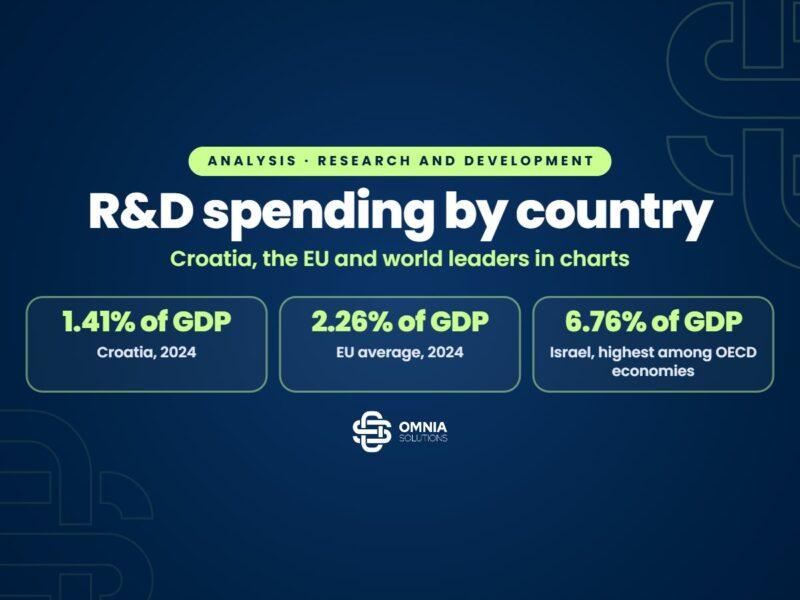
Figures on research and development investment confirm this. According to the Eurostat database (updated 29 September 2026), the EU spent EUR 408.4 billion on research and development in 2024, 4.9% more than in 2023, and its share of GDP was 2.26%, only 0.17 percentage points higher than in 2014. The target of 3% of GDP, set back in 2002, is exceeded by six countries: Sweden (3.53%), Austria (3.34%), Belgium (3.25%), Finland (3.22%), Denmark (3.15%) and Germany (3.12%). The business sector performs two thirds of R&D. Croatia raised its share from 0.77% to 1.41% between 2014 and 2024, but remains well below the EU average (more in our analysis of R&D spending by country). Against this background, the cut to Horizon Europe runs counter to the diagnosis that the member states themselves accepted.
Investment in research and development
R&D expenditure in 2024 (% of GDP)
Sweden
Austria
Belgium
Finland
Denmark
Germany
EU average
Croatia
Six countries exceed the 3% target. The EU average is 2.26%, and Croatia raised its share from 0.77% to 1.41% between 2014 and 2024 but remains well below the EU average.
Source: Eurostat, rd_e_gerdtot (updated 29 September 2026). Total EU R&D expenditure in 2024: EUR 408.4 billion.
What this means for businesses in Croatia
- Timing. If no agreement is reached by the end of 2026, the legislative acts will slip into 2027 and the first calls of the new period will move further into 2028 or 2029. In the current period, the Competitiveness and Cohesion Programme 2021–2027 was approved only at the end of 2022, and calls for businesses followed after that. Anyone planning an investment for 2028 should not count on the new budget as their first source.
- National and regional partnership plan. Instead of several operational programmes, Croatia will have one plan combining cohesion, agriculture and other funds under shared management. National envelopes were not touched in the Irish negotiating box, but the priorities within the plan are set in Zagreb in 2026 and 2027. This is the moment for sector associations and chambers to say clearly which measures for businesses they want to see.
- European Competitiveness Fund. The fund of EUR 362 billion (according to the Irish negotiating box) is under the Commission's direct management, with competition at EU level. Croatian companies succeed there with projects at a higher technology readiness level and in consortia with partners from other countries, and a smaller fund means tougher competition.
- Until 2028, current sources apply. Calls under the Competitiveness and Cohesion Programme 2021–2027 are published until the funds are used up, and costs are eligible until the end of 2029. Alongside them are HBOR loans with principal write-off and HAMAG-BICRO loans, which do not depend on the MFF. We track what is open, with the date of each update, in our guides Grants and EU funds for businesses 2026, HBOR loans 2026 and HAMAG-BICRO loans 2026.
- Simplification. The Commission's proposal introduces a single rulebook for all funds, and the Council supports lump sums and less reporting. Whether this survives the negotiations will become clear in the 2027 legislative acts. Until then, the yardstick is simple: can a business in 2028 submit an application in one system, under one set of rules, with a report that does not require an external consultant?
What to watch until the end of the year
- António Costa's negotiating box with figures, announced for the end of November, and the General Affairs Council meetings that precede it.
- The European Council meeting dedicated to the MFF on 26 and 27 November 2026, and the regular December meeting as the last chance for a political agreement in 2026.
- Negotiations between the Council and the European Parliament on own resources and on Parliament's role in directly managed programmes, where positions are furthest apart.
- Preparation of Croatia's national and regional partnership plan and the public consultations on it.
Interactive timeline
MFF 2028–2034 negotiations: what has happened and what comes next
The labels update automatically based on today's date.
Sources: Council of the EU, European Council, Agence Europe, EPRS. Status as of 28 October 2026.
Frequently asked questions
How big is the proposed EU budget for 2028–2034?
On 16 July 2025, the European Commission proposed a budget of EUR 1,985 billion in current prices, almost EUR 2 trillion. On 10 October 2026, the Irish Presidency of the Council proposed a negotiating box of EUR 1,825 billion, EUR 159 billion (8%) less, with the deepest cuts to competitiveness, defence and external action.
Will Horizon Europe have less money in the next period?
Under the Irish negotiating box, yes: EUR 158.2 billion instead of the EUR 175 billion in the Commission's proposal, or 9.6% less. The final amount depends on the agreement on the MFF as a whole. On 26 June 2026, the Council adopted a partial position on the programme without figures, keeping the four pillars and expanding the role of the European Innovation Council.
When will the 2028–2034 budget be agreed?
The European Council aims for an agreement by the end of 2026, so that the legislative acts can be adopted in 2027 and funding can start in January 2028. The conclusions of 16 October 2026 refer to a timely agreement, and diplomats do not rule out the negotiations being settled in 2027. The President of the European Council has announced his own proposal with figures by the end of November, and a European Council meeting dedicated to the budget is scheduled for 26 and 27 November 2026.
What are national and regional partnership plans?
A new way of implementing funds under shared management: each member state will have one plan combining cohesion, agriculture and other funds, instead of several operational programmes. National envelopes were left untouched in the Irish negotiating box, and each member state sets the priorities within its plan.
What can businesses in Croatia do until 2028?
Use the current sources: calls under the Competitiveness and Cohesion Programme 2021–2027 and the CAP Strategic Plan, HBOR loans with principal write-off and HAMAG-BICRO loans. It is worth preparing projects for the new period now, at a higher technology readiness level and with partners, because competition for the European Competitiveness Fund will be at European level.
Planning a project for 2027 or 2028?
Until the new budget arrives, current calls and loans apply
We keep track of what is open for businesses, with the date of each update, in our guides. If you want to check which funding your project can apply for before 2028, get in touch; the first conversation is free of charge.
Sources
- Council of the EU: timeline of the MFF 2028–2034 negotiations and overview of the long-term budget
- European Council: conclusions of 16 October 2026 on competitiveness, the MFF and enlargement
- Council of the EU: position on Horizon Europe 2028–2034 (26 June 2026)
- Agence Europe: Irish Council Presidency bets on cuts mainly affecting EU competitiveness, defence and external action (10 October 2026), European Council no longer appears to rule out agreement after end of 2026 and António Costa confirms he will present his proposal with figures ahead of late November summit (21 October 2026)
- EPRS: European Parliament adopts interim report on the MFF 2028–2034 (6 May 2026)
- Euronews: Ireland pitches €141bn cuts to appease the frugals (10 October 2026)
- EUA: Horizon Europe hit by additional proposed cuts (13 October 2026)
- EU Insider / EPIC: Draghi Implementation Index, July 2026 and European Commission: The Draghi report, one year on (16 September 2025)
- Eurostat: gross domestic expenditure on R&D (rd_e_gerdtot), updated 29 September 2026 and the news item of 4 December 2025 with first data for 2024
Figures and dates according to the sources listed, as of 28 October 2026. Negotiating boxes change during the negotiations, and the final amounts will be known once the European Council and the European Parliament reach agreement.