The European Union’s next Multiannual Financial Framework (MFF) for 2028–2034 will be the largest budget in EU history. It again comes with a promise of simpler procedures. The key question is whether this time the simplification will be real and measurable for those the funds are intended for, the beneficiaries and the taxpayers.
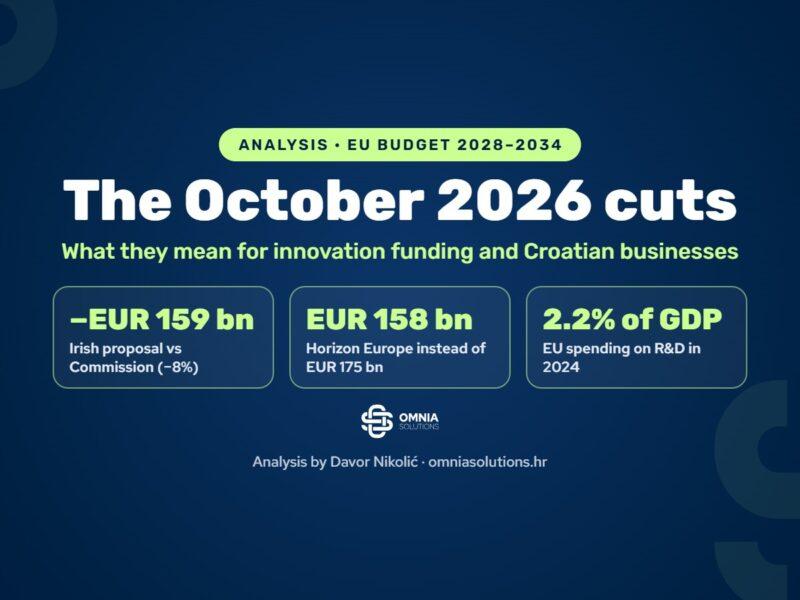
Follow-up analysis (October 2026): EU budget 2028–2034: the October 2026 cuts and what they mean for innovation funding and Croatian businesses
“Simplification is promised in every budget cycle. The benchmark for 2028 will be whether an entrepreneur can submit an application in one system, under one set of rules.” – Davor Nikolić, EAIC panel, Zagreb, 9 June 2026
This topic was at the centre of the panel “The Future of EU Innovation Funding: Priorities for the Next MFF” at the annual meeting of the European Association of Innovation Consultants (EAIC), held in Zagreb on 9 June 2026. Davor Nikolić, co-founder of Omnia Solutions, a company specialising in EU funding, took part as one of the panellists. Below we present the key insights from the discussion and the data showing why reform of EU innovation funding is more urgent today than ever.

The largest EU budget in history, with (yet another) promise of simplification
The next MFF will be a record in size and, as in previous cycles, it comes with announcements of simpler and faster procedures. Experience from previous programming periods shows that such announcements too often remain mere declarations.
The key message is therefore simple, but demanding to implement. Simplification must not remain just another announcement. Rules, procedures and processes at all levels, from European to national and regional, must become significantly faster and easier for end beneficiaries to understand. Only then can a larger budget deliver a larger real impact, instead of the additional funds being spent on administration and complex access.
The Draghi report: the most systematic diagnosis, but slow implementation
Mario Draghi’s report of September 2024 presented the most systematic diagnosis of European competitiveness in recent decades. It identified 383 specific recommendations to boost growth, innovation and the industrial renewal of the EU.
The problem, however, lies in implementation rather than in the diagnosis. According to the Draghi Observatory initiative, by January 2026 only about 15% of these recommendations had been fully implemented, with roughly another 24% partially implemented. In other words, a year and a half after publication, more than half of the recommendations are still “in progress” or unrealised. Progress has been greatest in critical raw materials and transport, and weakest in energy and digitalisation.
The slowness of the reform response becomes even clearer when European results are placed in the wider, global context of investment in research and development.
The EU has lagged behind in R&D investment for decades
According to Eurostat, investment in research and development (R&D) in the EU amounted to 2.24% of GDP in 2024. This is stagnation compared with 2.26% a year earlier, and still far below the target of 3% of GDP that the EU set back in 2002 under the Lisbon Strategy.
This gap is neither a new phenomenon nor the result of a single crisis. It is a structural problem that has lasted more than two decades. Although the absolute amount of R&D investment has grown (exceeding EUR 403 billion in 2024), investment intensity measured as a share of GDP remains practically unchanged and far from the target.
Global context: where the EU stands against its competitors
A comparison with global competitors clearly shows the scale of the challenge. According to comparable data, R&D investment intensity is as follows:
- South Korea: 4.96% of GDP
- USA: 3.45% of GDP
- Japan: 3.44% of GDP
- China: 2.58% of GDP, already above the EU average
- EU: 2.24% of GDP
Within the Union itself, the picture is uneven. Only six Member States reach or exceed the target of 3% of GDP: Sweden (3.6%), Belgium (3.4%), Austria (3.3%), Finland (3.2%), Germany (3.1%) and Denmark (3.0%). The conclusion is unambiguous. The EU is behind in implementing the Draghi recommendations, and for decades it has also been behind in the basic stimulation of its own innovation base. This is exactly what must change in the implementation of the next budget.
What this means for the next EU budget and for beneficiaries
The next MFF 2028–2034 is an opportunity to start systematically closing these two gaps, in reform implementation and in the level of investment. This depends above all on execution rather than ambition, that is, on how future programmes are designed (including the successor to Horizon Europe), how simple access to funding will be and how quickly capital will be directed into research, development and innovation.
For companies, research institutions and public bodies, this means that competitiveness in future calls will increasingly depend on the ability to turn innovation potential into high-quality, well-structured applications aligned with the priorities of the new programming period.
How Omnia Solutions supports beneficiaries of EU funding
Omnia Solutions acts as an expert intermediary between beneficiaries and complex EU funding systems. We help companies and institutions identify relevant calls, prepare competitive applications and build partnerships, including Horizon Europe consortia, and stay compliant with EU rules and priorities throughout the process.
At a time when the largest budget in the Union’s history is being announced, timely and expert preparation becomes a decisive advantage. Learn more about our services in EU funding or contact us to discuss your project.
Frequently asked questions (FAQ)
What is the Multiannual Financial Framework (MFF)?
The Multiannual Financial Framework (MFF) is the long-term budget of the European Union that sets ceilings on EU spending by area for a period of at least five years. It determines how much the EU can spend and on which priorities.
Which period does the next MFF cover?
The next Multiannual Financial Framework covers the period 2028–2034 and will be the largest budget in EU history to date.
What is the Draghi report?
It is the report on the future of European competitiveness that Mario Draghi presented in September 2024. It contains 383 recommendations to boost growth, innovation and industrial renewal, and is considered the most systematic diagnosis of EU competitiveness in recent decades.
How much does the EU invest in research and development?
In 2024, the EU invested 2.24% of GDP in research and development, still well below the target of 3% of GDP set in 2002.
Which EU Member States reach the target of 3% of GDP for R&D?
Six Member States reach or exceed the 3% target: Sweden, Belgium, Austria, Finland, Germany and Denmark.
About the panel
The panel “The Future of EU Innovation Funding: Priorities for the Next MFF” was held as part of the annual meeting of the EAIC (European Association of Innovation Consultants) in Zagreb. Alongside Davor Nikolić (Omnia Solutions), the panellists were Danijel Bertović (Sensum d.o.o.), Mirjana Puljić Dožan (FER), Raluca Prelucă (fonduri-structurale) and Todor Milchevski (World Bank), and the discussion was moderated by Paul Walsh.
About the author
Davor Nikolić is co-founder and director of Omnia Solutions, a Zagreb-based consultancy specialising in EU funding. He is an expert in the preparation and implementation of EU-funded projects, with many years of experience and an extensive portfolio of completed projects. As an external member of the Croatian Parliament’s Committee on European Affairs, he actively follows European policies and innovation funding issues.