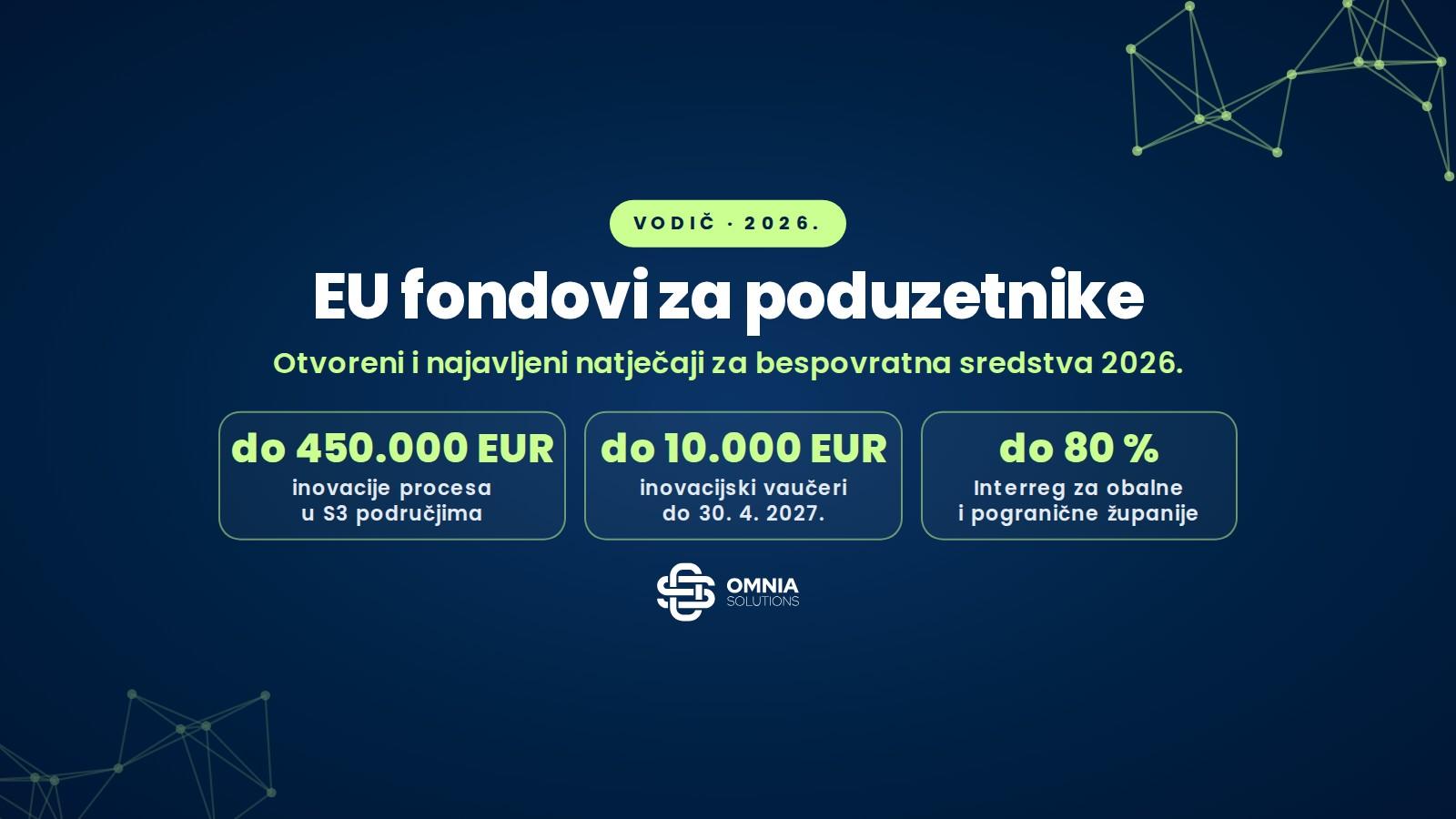
In October 2026, businesses in Croatia can apply to several calls for grants: Process Innovation in S3 Areas (Inovacije procesa u S3 područjima), with EUR 150,000 to 450,000 for SMEs in manufacturing, no later than 31 December 2026; Innovation Vouchers for SMEs (Inovacijski vaučeri za MSP-ove), with EUR 2,000 to 10,000, until 30 April 2027; two Interreg calls for border counties; and calls for investment in agricultural holdings. From 9 November 2026, a Modernisation Fund call for solar power plants in agriculture and processing also opens. There are no more new grant calls for companies from the National Recovery and Resilience Plan (NPOO), so the main source is the Competitiveness and Cohesion Programme 2021–2027.
This guide covers open, announced and recently closed calls for businesses, the rules that apply to most calls and the steps of the application. To check which call fits your project, contact us. The information was checked on the official websites of the ministries, eufondovi.gov.hr, HAMAG-BICRO (Croatian Agency for SMEs, Innovations and Investments) and the Environmental Protection and Energy Efficiency Fund (FZOEU) on 20 and 21 October 2026.
If, in addition to grants, you are also looking for loans or tax incentives, we have put all incentives with their amounts and deadlines together in the overview Business incentives 2026.
Free introductory call
Not sure which call fits your project?
Tell us what you plan to invest in and we will check which calls you can apply for and what to watch out for. The introductory call is free. Email or call us.
In brief: EU funds for businesses at the end of 2026
- Open to SMEs in manufacturing: Process Innovation in S3 Areas, EUR 150,000 to 450,000, until the funds are used up and no later than 31 December 2026 at 11:00.
- Open to most SMEs with at least one employee: Innovation Vouchers, EUR 2,000 to 10,000 for testing services and technical expertise, until 30 April 2027.
- Coastal and border counties: SEAS (Interreg Italy-Croatia, first deadline 9 November 2026) and B Light 2 (Interreg Hungary-Croatia, until 23 November 2026), with a mandatory partnership with a foreign business.
- Agriculture: calls for investment in primary agricultural production are open to farms with an economic size of up to EUR 250,000 until 12 November and 1 December 2026, and applications for solar power plants in agriculture and processing can be submitted from 9 November 2026.
- Reopens on 17 November 2026 at 11:00: Integrator (EUR 300,000 to 820,000), suspended since 3 July 2026 due to high demand.
- In preparation: STEP SPIN for strategic partnerships, digital vouchers, the second Proof of Concept (Dokazivanje inovativnog koncepta) call and the call for the processing of agricultural products.
- NPOO: the implementation deadline was 31 August 2026, and there are no new calls for grants to companies.
Open and published calls for businesses: status as of 21 October 2026
| Call | Who it is for | Aid amount | Deadline |
|---|---|---|---|
| Process Innovation in S3 Areas (PK.1.3.11) | micro, small and medium-sized enterprises in manufacturing | EUR 150,000 to 450,000 | until the funds are used up, no later than 31 December 2026 at 11:00 |
| Innovation Vouchers for SMEs (PK.1.1.06) | SMEs with at least one employee | EUR 2,000 to 10,000 | until the funds are used up, no later than 30 April 2027 at 11:00 |
| SEAS (Interreg Italy-Croatia) | SMEs and start-ups from the 8 counties of the programme area (the coastal counties and Karlovac County), with an Italian partner | EUR 80,000 to 125,000 per project, up to 80% | first deadline 9 November 2026 |
| B Light 2 (Interreg Hungary-Croatia) | SMEs from 8 border counties, with a Hungarian partner | EUR 60,000 to 300,000 of EU support, up to 80% | 23 November 2026 |
| Aid for investment in primary agricultural production (73.10) | farmers entered in the Farm Register (Upisnik poljoprivrednika), with a farm of an economic size of up to EUR 250,000 | EUR 15,000 to 500,000 per project | until 12 November 2026 (laying hens) and 1 December 2026 (fruit, wine, vegetables, milk) |
| Renewable Energy Sources in Agriculture and Processing (Obnovljivi izvori energije u poljoprivredi i preradi, MF-2026-6-1) | businesses in primary agriculture and in the processing of agricultural products | up to EUR 5,000,000 per applicant | from 9 November 2026 at 10:00 to 31 January 2027 at 12:00, or until the funds are used up |
| Development of Small and Medium-sized Entrepreneurship and Crafts in Areas Inhabited by Members of National Minorities (Razvoj malog i srednjeg poduzetništva i obrta na područjima naseljenim pripadnicima nacionalnih manjina), 2026 | sole proprietorships, companies and cooperatives from the specified municipalities and towns, registered for at least 3 years, with an average of at least three employees, majority-owned by members of a national minority or with at least one employee who is a member of a minority | EUR 7,000 to 20,000 | 30 October 2026 |
| Restoration of agricultural potential (73.02) | farmers affected by a natural disaster | EUR 1,000 to 1,000,000, up to 100% | from 2 November 2026 to 4 January 2027 |
Process Innovation in S3 Areas
- Who it is for: micro, small and medium-sized enterprises from section C (manufacturing).
- What is financed: the introduction of process or organisational innovation together with the commercialisation of a product that is new to the market, in a thematic area of the Smart Specialisation Strategy. The product must reach technology readiness level TRL 7 or higher, and the project must include at least one process innovation related to digitalisation or the green transition.
- Amount: EUR 150,000 to 450,000 of aid, with the intensity depending on the type of activity. A total of EUR 17,188,524.40 has been allocated.
- Deadline: applications are accepted from 1 September 2026 until the funds are used up, no later than 31 December 2026 at 11:00. The similar Integrator call was suspended two months after it opened, so it is not advisable to wait for the deadline.
We described the conditions, costs and examples in the article Process Innovation in S3 Areas: up to EUR 450,000 for manufacturing.
Innovation Vouchers for SMEs
- Who it is for: micro, small and medium-sized enterprises with at least one employee, except for financial and insurance activities, real estate, legal and accounting activities, and gambling.
- What is financed: testing, inspection, demonstration and technical expertise services for the development of products, services or processes, purchased from research organisations, testing infrastructure or innovation clusters.
- Amount: EUR 2,000 to 10,000, up to 50% of costs, and up to 85% for innovation advisory and support services.
- Deadline: a permanent call open until the funds are used up. An amendment of 15 October 2026 extended the deadline from 31 December 2026 to 30 April 2027 at 11:00.
Interreg: SEAS and B Light 2
- SEAS: for SMEs and start-ups from Istria, Primorje-Gorski Kotar, Karlovac, Lika-Senj, Zadar, Šibenik-Knin, Split-Dalmatia and Dubrovnik-Neretva counties, in partnership with an Italian business. It finances innovation in the blue economy, for example fish processing and aquaculture, maritime technologies, sustainable maritime transport and coastal tourism. The first deadline is 9 November 2026.
- B Light 2: for SMEs from Međimurje, Varaždin, Koprivnica-Križevci, Bjelovar-Bilogora, Virovitica-Podravina, Požega-Slavonia, Osijek-Baranja and Vukovar-Syrmia counties, with at least one Hungarian SME. It finances joint innovation, new products, equipment and entry into new markets. At least 20% of costs are financed from own funds or a loan, and the deadline is 23 November 2026.
Agriculture and renewable energy sources
- Investment in primary agricultural production (73.10): as of 21 October 2026, only the windows for farms with an economic size of up to EUR 250,000 are open, with aid of EUR 15,000 to 500,000 and an intensity of 45%. The intensity increases by 15 percentage points for young farmers or for farms whose holder has been a woman for at least three consecutive years, and the increases are not cumulative. For fruit growing, viticulture and vegetable growing, applications can be submitted until 1 December 2026, for laying hens until 12 November 2026, and in the third call for milk from 21 October to 1 December 2026. The windows for larger farms closed on 30 September and 19 October 2026.
- Solar power plants in agriculture and processing (Modernisation Fund): photovoltaic plants for own consumption and battery storage, up to EUR 5,000,000 per applicant, EUR 30,000,000 in total. Applicants are businesses and producer organisations, and the call specifies whether family farms (OPG) without business status can apply. Applications are sent by registered mail to the Environmental Protection and Energy Efficiency Fund from 9 November 2026.
- Loans for farmers: from 28 October 2026, HAMAG-BICRO is accepting applications for CAP Strategic Plan (SP ZPP) loans for growth in nine sensitive sectors, with a principal write-off of up to 45% (up to 50% for young farmers). The programme sets the rules for combining them with grants; read more in the guide HAMAG-BICRO loans 2026.
Suspended and announced calls
Apart from Integrator, which was suspended and reopens on 17 November 2026, the following calls for businesses had not been published as of 21 October 2026. The deadlines are indicative and may change.
- Integrator: receipt of applications was suspended on 3 July 2026, and the call reopens on 17 November 2026 at 11:00, according to the notice of 27 October 2026. The call provides EUR 300,000 to 820,000 to consortia of SMEs (an applicant in partnership with at least two partners) that become suppliers to medium-sized and large companies.
- STEP SPIN: a call for strategic partnerships of companies in digital, clean, biotech and defence technologies in Pannonian, Northern and Adriatic Croatia. According to the draft guidelines from the public consultation (14 September to 14 October 2026), the allocation is EUR 145 million, with EUR 3 to 10 million in grants per project, for a consortium of at least two businesses. The publication date of the call is not yet known.
- Digital vouchers: for introducing artificial intelligence solutions, cybersecurity diagnostics and complex digital solutions. According to the plan from December 2025, applications were to open in September 2026, but the call has not yet been published.
- Proof of Concept, second call: the first call (EUR 26,500 to 70,000) closed on 15 September 2026, and according to the plan from December 2025 the second is planned for autumn 2026.
- Start-up/Spin-off Companies of Young Researchers (Start-up/spin-off poduzeća mladih istraživača): for newly established companies of young researchers, EUR 66,000 to 200,000 according to the draft guidelines from September 2026. The call has not yet been published.
- Agriculture and rural development: calls for the processing of agricultural products (73.11, EUR 80,000,000), diversification into non-agricultural activities (75.02), business development in rural areas (73.14) and non-productive investments (73.01) are planned for the fourth quarter of 2026. The call for the setting up of young farmers (75.01) was planned for the third quarter.
- Second Chance for SMEs (Druga šansa za MSP-ove): the Ministry of Economy and the SENTOR Senior Entrepreneurs Club (Klub poduzetnika seniora SENTOR) are implementing a project (direct award, published on 16 October 2026) that sets up an early warning system and non-financial and financial support for SMEs, so that they can avoid bankruptcy or restart their business. The conditions of the financial support for businesses have not yet been published.
- Croatian Employment Service (HZZ): the conditions of self-employment aid for 2027 have not yet been published. More in the guide Grants and loans for young people, women and start-up entrepreneurs 2026.
Recently closed calls (2026)
- Increasing the Development of New Products and Services from Research and Development (Povećanje razvoja novih proizvoda i usluga iz istraživanja i razvoja, PK.1.1.12), EUR 200,000 to 2,000,000: receipt of applications suspended on 5 November 2025, call closed on 7 January 2026.
- Support for SME Internationalisation (Potpora MSP-ovima za internacionalizaciju, PK.1.3.10), EUR 6,000 to 120,000: receipt of applications suspended on 29 August 2025, call closed on 7 January 2026. A call for internationalisation through business support organisations (chambers, clusters and associations) is open, in which SMEs take part in joint appearances and the organisation submits the application.
- Support for Product Certification and Introduction of Management Systems (Potpora za certifikaciju proizvoda i uvođenje sustava upravljanja, PK.1.3.04), EUR 3,000 to 150,000: receipt of applications suspended on 3 September 2025, call closed on 7 January 2026.
- Proof of Concept (PK.1.1.17): closed on 15 September 2026.
- Green and Digital Transition of Tourism Businesses (Zelena i digitalna tranzicija poduzetnika u turizmu), Ministry of Tourism and Sport: closed on 30 July and 31 August 2026.
- HZZ self-employment aid: applications for 2026 were accepted until 30 September 2026.
What about the NPOO?
The measures of the National Recovery and Resilience Plan were to be implemented by 31 August 2026. On the Ministry of Economy website, all NPOO calls for companies are closed, and there are no new NPOO grant calls for companies. Until the end of 2026, only the remaining instruments are available: Skill Up non-financial advisory support (until 31 December 2026), internationalisation vouchers for start-ups that are already beneficiaries of HAMAG-BICRO’s Acceleration Programme (until 1 December 2026) and NPOO loans from HBOR (Croatian Bank for Reconstruction and Development). For new company projects, the main sources are the Competitiveness and Cohesion Programme, the Integrated Territorial Programme (Integrirani teritorijalni program), the CAP Strategic Plan, the Modernisation Fund and Interreg.
Which funds grants for businesses come from
- Competitiveness and Cohesion Programme 2021–2027 (European Regional Development Fund): the main source of grants for companies, for research and development, innovation, digitalisation and SME competitiveness.
- Integrated Territorial Programme: calls for the industrial transition of Pannonian, Northern and Adriatic Croatia, for example STEP SPIN.
- Efficient Human Resources Programme (Učinkoviti ljudski potencijali, European Social Fund Plus): employment, education and social inclusion. For start-up entrepreneurs, it most often comes through HZZ self-employment aid and the HAMAG-BICRO micro loan.
- CAP Strategic Plan: calls for agriculture, processing and rural development.
- Modernisation Fund: calls for the energy transition, such as solar power plants in agriculture and processing.
- Interreg: cross-border cooperation with businesses from neighbouring countries.
- National Recovery and Resilience Plan: finished for new company projects.
How grants work
- Co-financing: in most calls, the aid covers part of the eligible costs, and the business finances the rest from its own funds or a loan. The percentage, i.e. the aid intensity, is set by the call and depends on the size of the company and the type of activity.
- Do not start before applying: for most types of aid, the project must not start before the project proposal is submitted, otherwise the aid has no incentive effect and the project may be ineligible. The exact rule, for example whether a quote may be signed before applying, is set by the call.
- Award model: in permanent calls, open until the funds are used up, applications are processed in the order received, while in calls with a deadline they are scored and ranked after the deadline. Calls such as Integrator and the call for developing products from research and development were suspended months before the deadline due to high demand.
- Payment: in most EU-funded calls, funds are paid after the business has paid the costs and proved them with a payment claim. Some types of aid, for example HZZ self-employment aid, are paid in a lump sum after the contract is signed. The call sets whether an advance payment is possible and how much it is.
- State aid rules: aid to companies is most often granted under EU state aid rules or as de minimis aid. The total aid for the same eligible costs is limited, and de minimis aid also has a ceiling per business over a three-year period. Calls under the CAP Strategic Plan have their own rules.
- Obligations after the project: the results must be maintained for the period set by the call, and the competent body checks this.
How to prepare for the application
- Project idea and alignment with the call: check whether the project falls within the eligible activities and objectives of the call, for example the thematic areas of the Smart Specialisation Strategy.
- Quotes and budget: collect quotes for equipment and services and draw up a budget with eligible and ineligible costs.
- Financial structure: secure your own contribution and liquidity until payment, if necessary with an HBOR loan or a HAMAG-BICRO guarantee.
- Documentation: statements, financial statements, proof of employees and permits, depending on the call. The call sets the submission method: for calls under the Competitiveness and Cohesion Programme the application is as a rule submitted in the eKohezija system, for Interreg calls through the programme platforms, and for the Modernisation Fund call by registered mail.
- Timing: in calls open until the funds are used up, a complete application submitted as soon as the call opens has the advantage.
Which source is right for you
- A manufacturing SME introducing automation or the green transition along with a new product: Process Innovation in S3 Areas. For your own contribution, check HBOR’s EU Projects (EU projekti) programme, and for investments outside the project also HBOR’s Loans for Production Modernisation (Krediti za modernizaciju proizvodnje) with a principal write-off of up to 50%.
- An SME that needs product testing or inspection: an innovation voucher of up to EUR 10,000.
- A company from a coastal or border county with a foreign partner: SEAS or B Light 2.
- A farmer: calls for investment in primary production, solar power plants from the Modernisation Fund and SP ZPP loans.
- An investment from EUR 150,000 (micro enterprises from EUR 50,000) with new jobs: tax incentives for investment, even when no call is open.
- Starting a business: grants and loans for young people, women and start-ups.
Free introductory call
Which call can you apply for with your project?
Send us your activity, company size, county and the planned project value, and we will check the open and upcoming calls with you. The introductory call is free. Email or call us.
How Omnia Solutions can help you
Omnia Solutions is a Zagreb consultancy specialising in EU funds and favourable loans with principal write-off. Our experts have almost 15 years of experience and more than 130 projects financed from national and EU sources. We prepare project applications on a turnkey basis and guide projects through to payment. Read more on the page EU projects: preparation and implementation. We regularly publish an overview of new calls in the article Current EU funding opportunities in 2026.
- Choosing the call and checking the eligibility of the project, the costs and the financial structure.
- Project proposal: project description, budget, indicators and all required documentation.
- Combining sources: grants, HBOR loans, HAMAG-BICRO loans and guarantees, and tax incentives, within the limits of state aid rules.
- Implementation: procurement, payment claims and reporting.
Frequently asked questions about grants
Which EU calls for businesses are open in 2026?
As of 21 October 2026, the open calls are Process Innovation in S3 Areas (EUR 150,000 to 450,000 for manufacturing, no later than 31 December 2026), Innovation Vouchers for SMEs (EUR 2,000 to 10,000, until 30 April 2027), SEAS and B Light 2 from the Interreg programme for border counties, and calls for investment in primary agricultural production. From 9 November 2026, applications for solar power plants in agriculture and processing from the Modernisation Fund will be accepted.
Are there still grants from the NPOO?
Not for new company projects. The NPOO measures were to be implemented by 31 August 2026, and all NPOO calls for grants to companies are closed. Until the end of 2026, the Skill Up advisory support, internationalisation vouchers for existing beneficiaries of HAMAG-BICRO’s Acceleration Programme and HBOR’s NPOO loans remain available.
How much grant funding can a business apply for?
It depends on the call: EUR 2,000 to 10,000 for innovation vouchers, up to EUR 450,000 for Process Innovation in S3 Areas, and even more in agriculture and renewable energy. In most calls, the aid covers only part of the eligible costs, and the business finances the rest itself or with a loan.
Can I apply for grants to start a business?
EU calls are rarely intended for starting a business. The main source for unemployed people is HZZ self-employment aid, whose conditions for 2027 have not yet been published. The HAMAG-BICRO micro loan is also available to young companies, but not in the first year of using the HZZ aid, and there is also aid from cities and counties.
Can I start investing before applying to a call?
As a rule, no. For most types of aid, the project must not start before the project proposal is submitted, because the aid must have an incentive effect. The call defines what counts as the start of the project.
When are grants paid out?
In most EU-funded calls, after the business has paid the costs and proved them with a payment claim, so the investment needs to be financed from own funds or a loan until the funds are paid. Each call sets whether an advance payment is possible and how much it is, and some types of aid, for example HZZ self-employment aid, are paid in a lump sum after the contract is signed.
Which calls are expected at the end of 2026 and in 2027?
The announced calls are STEP SPIN for strategic partnerships in Pannonian, Northern and Adriatic Croatia, digital vouchers, the second Proof of Concept call, Start-up/Spin-off Companies of Young Researchers, and calls for the processing of agricultural products, diversification and business development in rural areas. Integrator reopens on 17 November 2026 at 11:00.
Can I combine grants with a loan?
Yes, a loan is often used for the own contribution and liquidity until payment. The same cost item must not be financed twice, the total aid must stay within the limits of state aid rules, and some loans with principal write-off and SP ZPP loans must not be combined with grants for the same investment.
Are there grants for tourism?
The Ministry of Tourism and Sport’s call for the green and digital transition of tourism businesses closed in July and August 2026. Small and medium-sized hotels and campsites can check HBOR’s Sustainable Tourism Loans, with a principal write-off of up to 50% for loans above EUR 500,000. Businesses from the coastal counties and Karlovac County can also check the SEAS call, which covers coastal tourism in the blue economy, with a mandatory partnership with an Italian business.
Who can apply for EU calls?
It depends on the call. Most often these are micro, small and medium-sized enterprises, and some calls are also open to large companies, family farms (OPG), cooperatives, research organisations or local government units. The conditions relate to the applicant’s size, activity, location and financial position.
How long does it take to prepare a project application?
A good application usually takes 4 to 12 weeks to prepare, depending on the complexity of the project and the permits and quotes needed. For calls open until the funds are used up, preparation should start before the call opens.
Do I need a consultant to apply for an EU call?
No, you can submit the application yourself. A consultant helps make the application complete and compliant with the conditions of the call, because formal errors and incomplete documentation can lead to the rejection of even a good project.
What are the most common reasons for rejecting applications?
Incomplete documentation, a project that is not aligned with the objectives of the call, an unrealistic budget or financial structure, insufficient implementation capacity, and starting the project before the application is submitted.
How do I apply for an EU call?
The call sets the submission method. For calls under the Competitiveness and Cohesion Programme, the application is as a rule submitted electronically in the eKohezija system, for Interreg calls through the programme platforms, and for the Modernisation Fund call by registered mail. Before applying, check the eligibility of the company, the project and the costs, secure your own contribution and do not start the project before submission.
Prepare your project before the call opens
Many calls accept applications until the funds are used up and close before the deadline. Check in good time which call fits your project and what needs to be prepared, free of charge and with no obligation.
Sources
- eufondovi.gov.hr: Process Innovation in S3 Areas and Ministry of Economy: open calls
- Guidelines for Applicants: Innovation Vouchers for SMEs
- Ministry of Economy: Integrator and closed calls
- eufondovi.gov.hr: SEAS and HAMAG-BICRO: B Light 2
- Second call 73.10, third call 73.10 for milk, call 73.02 and indicative plan of SP ZPP calls
- FZOEU: MF-2026-6-1 Renewable Energy Sources in Agriculture and Processing
- Ministry of Economy: programme for areas inhabited by national minorities 2026 and open national calls
- eufondovi.gov.hr: Internationalisation through business support organisations and Second Chance for SMEs
- eufondovi.gov.hr: consultation on the STEP SPIN call and indicative annual plan of calls
- Ministry of Science, Education and Youth (MZOM): Proof of Concept, first call
- Ministry of Tourism and Sport: public calls and Ministry of Economy: closed NPOO calls
- HZZ: Self-employment aid 2026 and HAMAG-BICRO: Eurostars-3
The overview is summarised from official sources as of 21 October 2026, and the status of the Integrator call as of 27 October 2026. Calls may be amended, suspended or closed before the deadline, so the call texts in force prevail. The decision on awarding funds is made by the competent body.