Start-up/Spin-off Companies of Young Researchers: up to EUR 200,000, conditions and eligibility check
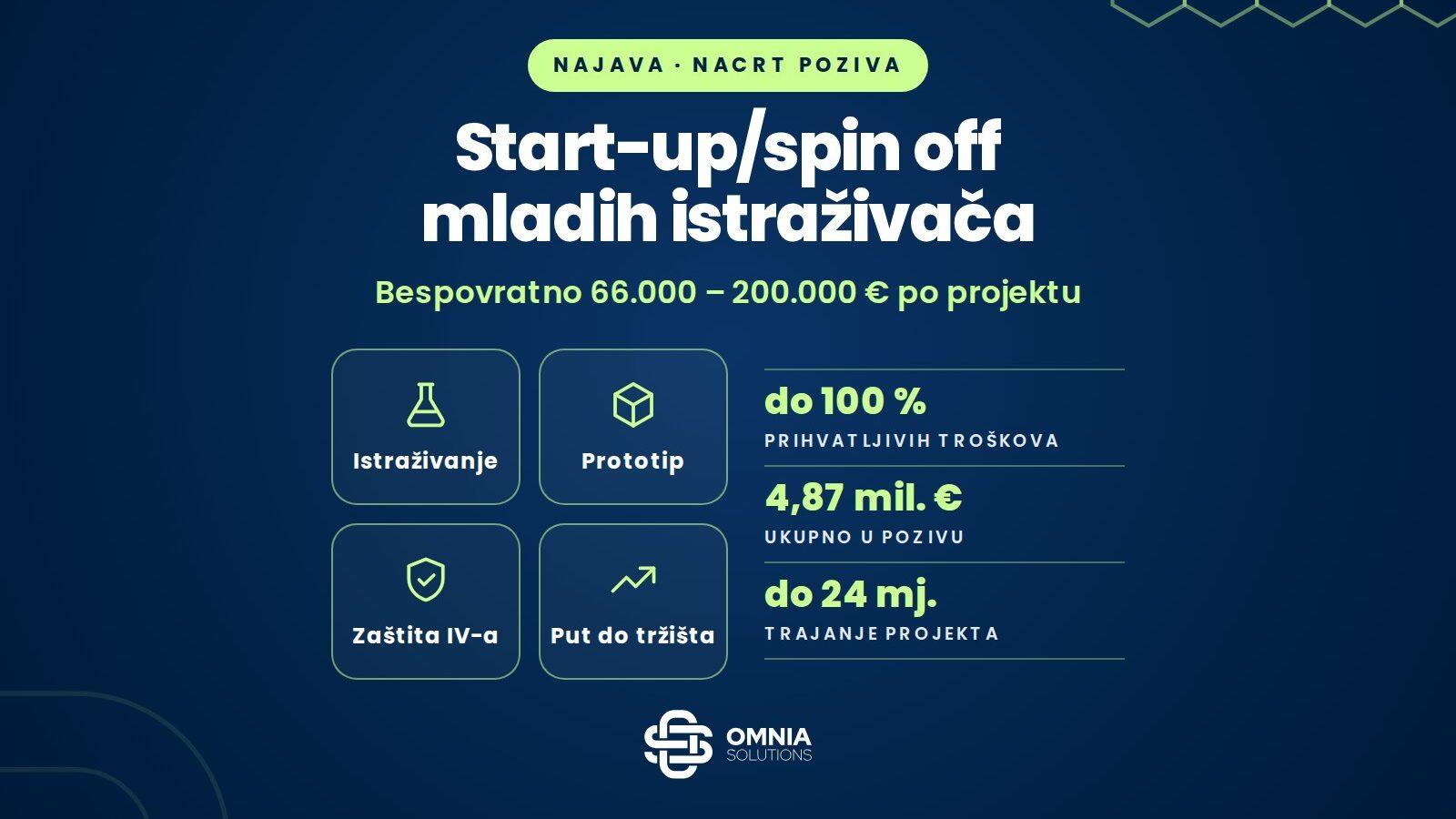
The Ministry of Science, Education and Youth is preparing a new call, Start-up/Spin-off Companies of Young Researchers (Start-up/spin off poduzeća mladih istraživača), under the Competitiveness and Cohesion Programme 2021–2027. According to the draft Guidelines for Applicants, newly established micro and small enterprises (co-)owned by young researchers will be able to apply for EUR 66,000 to 200,000 in grants, with an aid intensity of up to 100% of eligible costs, for research and for preparing the commercialisation of their results. EUR 4,874,214 is planned for the call. The draft was in public consultation from 15 September to 15 October 2026, and the call had not been published as of 28 October 2026.
This guide sets out the conditions from the draft: who can apply, which activities and costs are funded, how projects are selected and what to prepare now. The information is taken from the draft Guidelines for Applicants (September 2026), as of 28 October 2026. It may change in the final call. You can check right away whether you are an eligible applicant with the questionnaire on this page.
Call announced · eligibility questionnaire
Check whether you are an eligible applicant
The questionnaire on this page shows immediately whether you meet the applicant conditions in the draft Guidelines for Applicants: the size and age of the company, the young researcher’s share and status, employment and the intellectual property agreement. The check is free and without obligation.
In brief
- What it is: a grant call for start-up and spin-off companies of young researchers, co-financed by the European Regional Development Fund (ERDF).
- Amount: EUR 66,000 to 200,000 per project, with an aid intensity of up to 100% of eligible costs. A total of EUR 4,874,214 is planned.
- For whom: micro and small enterprises established no more than five years before the application, in which a young researcher employed at a research organisation in Croatia holds a share of at least 10%.
- Project duration: up to 24 months.
- Selection: projects are scored and ranked, and innovativeness carries the largest weight in the assessment (30%).
- Who implements it: the Ministry of Science, Education and Youth runs the award procedure, and HAMAG-BICRO (Croatian Agency for SMEs, Innovations and Investments) checks whether projects are implemented in line with the contract.
- Status: the draft was in consultation until 15 October 2026, and the call had not been published on the EU funds portal as of 28 October 2026.
- Eligibility check: the questionnaire on this page shows immediately whether you meet the applicant conditions.
What the Start-up/Spin-off Companies of Young Researchers call is
The call encourages young researchers to build their own company on the results of their research. For the purposes of the call, a start-up or spin-off is a company no older than five years whose business is based on original research or technologies developed at a research organisation, for example a faculty or an institute.
The funds are intended for the phase before commercialisation: further development of the technological solution, performance verification, intellectual property protection and business validation. The specific objectives of the call are greater market readiness of research and development results and stronger research, development and innovation capacity in companies.
The call is implemented under Priority 1 and Specific Objective 1.1 of the Competitiveness and Cohesion Programme, and aid is granted under Article 22 of Commission Regulation (EU) No 651/2014 as aid for start-ups. In 2023 the Ministry published a similar call with the same name under the National Recovery and Resilience Plan (NPOO), with a total of EUR 5,043,466.72 and the same range of EUR 66,000 to 200,000 per project.
We give an overview of other announced and open calls for entrepreneurs in the article Current EU funding opportunities in 2026.
Who can apply
The applicant is a company that must meet all of the following conditions from the draft.
- Size: a micro or small enterprise according to Annex I to Regulation (EU) 651/2014.
- Age: not listed on a stock exchange and established no more than five years and no less than 30 days before the project proposal is submitted.
- Ownership: at least one young researcher holds a share of at least 10% and, at the time of submission, is employed at a research organisation in Croatia under an employment contract.
- Intellectual property: the company has an agreement with the research organisation that sets out the terms of use of intellectual property for the technology or solution in the project.
- Activity: scientific research and development is a registered activity.
- Company history: it has not taken over the activity of another company, has not distributed profits, has not acquired another company and was not formed through a merger.
- Single applicant: partnership is not allowed, and each applicant may submit one project proposal.
Medium-sized and large enterprises, sole proprietorships (obrt), associations and undertakings in difficulty cannot apply.
Who is a young researcher
According to the draft, young researchers are doctoral students and researchers up to seven years after obtaining their doctorate, regardless of their position and the source of their salary funding. The seven-year period can be extended, for example by up to 18 months for each child due to maternity or parental leave, or by a period of long-term sick leave, if this is documented.
Agreement on the use of intellectual property
The agreement is signed by the company and the research organisation where the young researcher is employed. Its content is not prescribed, but the agreement must set out all essential terms of use of the intellectual property and comply with Article 22 of Regulation 651/2014 and with the research organisation’s technology transfer rules or another internal act. Agreeing the terms can take time, so it is a good idea to start talking to the technology transfer office right away.
Check whether you are an eligible applicant
The questionnaire checks the applicant conditions from the draft Guidelines for Applicants: the legal form, size and age of the company, the young researcher’s share and status, employment at a research organisation, the intellectual property agreement, the registered activity and the company’s history. The answer appears immediately, and your answers are not sent anywhere unless you choose to send them.
Questionnaire · about two minutes
Are you an eligible applicant?
Answer the questions about the company and the young researcher. If you have not set up the company yet, answer according to your plans.
Which activities are funded
| Activity | Mandatory | What it includes |
|---|---|---|
| 1. Carrying out research | yes | industrial research linked to the areas of the Smart Specialisation Strategy until 2029 (Strategija pametne specijalizacije do 2029.): development and validation of the technology concept, proof of concept, laboratory prototype, new algorithms or models |
| 2. Researcher training | no | visits to Croatian and foreign institutions for training and exchange of experience |
| 3. Business validation, verification and protection of intellectual property | yes | patent search, intellectual property protection, assessment of commercial potential, commercialisation plan, business model, analysis of regulatory requirements |
| 4. Dissemination | yes | attending professional conferences and organising at least one event for technology transfer and networking with the business sector |
| 5. Project management | yes | reporting, payment claims, procurement procedures |
| 6. Promotion and visibility | yes | for example a website, promotional materials or a closing event |
| 7. Horizontal activities | yes | non-discrimination, gender equality, accessibility and sustainable development |
Research activities must be linked to one or more thematic priority areas of the Smart Specialisation Strategy until 2029 (S3), and the project must not start before the project proposal is submitted.
Eligible costs and limits
| Cost type | Limit |
|---|---|
| Research staff employed by the applicant and new hires (gross 2 salary, i.e. including employer contributions, standard scale of unit costs) | no specific limit |
| External research and development services | up to 15% of eligible costs |
| Materials and small inventory for research | no specific limit |
| Knowledge and patents, including specialised software and licences | up to 10% |
| Rental, use or purchase of research and development equipment | up to 30% |
| Depreciation of instruments and equipment, for the period of use in the project | no specific limit |
| Rental of business premises | up to 10% |
| Official fees for intellectual property protection (DZIV, EPO, WIPO) | up to 20% |
| External advisory services: market analysis, commercialisation plan, intellectual property, business model, regulation | no specific limit |
| Researcher training, and attending and organising events | no specific limit |
| Indirect costs (visibility, project management, administration) | up to 15% of staff costs |
VAT is eligible only if the applicant cannot recover it. Among other things, the call does not fund construction, the purchase of land and motor vehicles, costs incurred before the application is submitted, advertising and sales, investment in production or sales capacity, or interest.
How projects are selected
The award procedure is run by the Ministry of Science, Education and Youth in a single phase: administrative check, eligibility check, quality assessment and cost verification. A project must reach the minimum score, and funds go to the highest-ranked projects until the available amount is used up. The procedure usually takes no longer than 120 days from the closing of the call.
| Selection criterion | Weight in the assessment |
|---|---|
| Innovativeness | 30% |
| Value for money | 20% |
| Implementation capacity | 20% |
| Project design and maturity | 15% |
| Financial sustainability | 10% |
| Equal opportunities and social inclusion | 3% |
| Sustainable development and green transition | 2% |
The beneficiary may request an advance payment of up to 30% of the approved funds, and after the project ends it must ensure the project's sustainability for three years.
Indicators to plan
In the application, the applicant sets target values for the indicators and is responsible for achieving them. If the average achievement of the mandatory indicators in Table 1 and the R indicators falls below 75%, financial corrections of 5 to 20% of the funds paid are applied.
- At least one commercialisation document must be prepared, for example a market analysis or a commercialisation plan.
- At least one product or process innovation indicator is chosen, to be achieved within three years of the end of the project.
- At least one indicator of private investment in research or of new researchers is chosen, along with at least one indicator of technology transfer or intellectual property applications.
- Newly established companies younger than three years must also track the indicators RCO05 (newly established enterprise receiving support) and RCR17 (survival on the market for at least one year after the project).
Application documents
The application is submitted to the Ministry through the eKohezija system. According to the draft, the following documents are attached to the application form.
- The additional information form, the applicant's statement, the joint statement on enterprise size and the form on the (non-)recoverability of VAT.
- CVs of the employed members of the research team, mandatory also for the young researchers who are co-owners.
- The young researcher's employment contract with the research organisation (a service contract is not sufficient).
- The agreement with the research organisation on the terms of use of intellectual property.
- Documents for calculating salary costs and the unit cost calculation methodology in Excel.
- The annual financial report or, for companies without an approved report, a business forecast.
- An extract from the register of beneficial owners, not older than 10 days.
- A completed baseline survey for the company and for each young researcher who is a co-owner.
How to prepare now
- Check the young researcher status and the employment at the research organisation under an employment contract.
- Establish the company in time, at least 30 days before the application is submitted, with scientific research and development as a registered activity and a young researcher share of at least 10%.
- Agree the intellectual property agreement with your institution's technology transfer office.
- Link the research to an S3 area and describe clearly what is new compared with existing solutions, because innovativeness carries 30% of the points.
- Plan the team and the budget within the cost limits, including the calculation of the staff unit cost.
- Do not start the project before the application is submitted, because costs incurred before then are not eligible.
Most common mistakes
- The company was established too late. The company must exist at least 30 days before the application is submitted.
- The researcher has no employment contract. Engagement at the research organisation under a service contract is not eligible.
- The share is too small. The young researcher must hold a share of at least 10%.
- The intellectual property agreement is missing or does not comply with the institution's rules.
- Cost limits are exceeded, for example for equipment (30%) or external research services (15%).
- A sole proprietorship instead of a company. Sole proprietorships cannot apply.
How Omnia Solutions can help you
Omnia Solutions is a Zagreb consultancy specialising in EU funds and public sources of financing. We help young researchers and their companies from the first check to the submission of the application. Read more about how we work on the page EU projects: preparation and implementation.
- Eligibility check of the company, the ownership structure and the young researcher status. The first check is free and without obligation.
- Structuring the project according to the call activities and linking it to S3 areas.
- Budget and indicators within the cost limits, including the calculation of the staff unit cost.
- Preparing the application in the eKohezija system and all supporting documents.
Free introductory call
Not sure whether your company can apply for this call?
Tell us about your company, its ownership and the young researcher's status, and we will check them against the conditions in the draft guidelines. The introductory call is free. Email or call us.
Frequently asked questions about the Start-up/Spin-off Companies of Young Researchers call
What is the Start-up/Spin-off Companies of Young Researchers call?
It is a grant call of the Ministry of Science, Education and Youth under the Competitiveness and Cohesion Programme 2021–2027. It is intended for newly established micro and small enterprises (co-)owned by young researchers, for research and for preparing the commercialisation of results developed at a research organisation.
How much grant funding is available per project?
According to the draft, EUR 66,000 to 200,000 per project, with an aid intensity of up to 100% of eligible costs. EUR 4,874,214 is planned for the whole call.
Who is considered a young researcher?
Doctoral students and researchers up to seven years after obtaining their doctorate, regardless of their position and the source of their salary funding. The period can be extended, for example due to maternity or parental leave or long-term sick leave, if this is documented.
How can I check whether I am an eligible applicant?
Fill in the questionnaire on this page. Ten questions on the legal form, size and age of the company, the young researcher's share and status, employment, the intellectual property agreement, the registered activity and the company's history give an answer immediately, based on the conditions in the draft Guidelines for Applicants.
Can a company that has not yet been established apply?
No. According to the draft, the company must be established at least 30 days and no more than five years before the application is submitted. That is why it needs to be established in time.
Does the young researcher have to be employed at a faculty or institute?
The young researcher must be employed at a research organisation in Croatia, for example a faculty or an institute. At the time the application is submitted, the young researcher with a share of at least 10% in the company must work there under an employment contract. A service contract is not sufficient.
What is the Agreement on the use of intellectual property?
An agreement between the company and the research organisation where the young researcher is employed, setting out the terms of use of intellectual property for the technology or solution in the project. It must comply with Article 22 of Regulation 651/2014 and with the institution's technology transfer rules or another internal act.
Can a sole proprietorship, an association or a partnership apply?
No. Medium-sized and large enterprises, sole proprietorships, associations and undertakings in difficulty are not eligible, and partnership is not allowed. The applicant submits one project proposal on its own.
Which costs does the call fund?
Research staff, external research services up to 15%, materials, knowledge and patents up to 10%, equipment up to 30%, depreciation of equipment, rental of premises up to 10%, advisory services for commercialisation and intellectual property protection, protection fees up to 20%, training, events and indirect costs up to 15% of staff costs.
When does the call open?
The call had not been published as of 28 October 2026, so the opening dates are not yet known. The draft Guidelines for Applicants were in public consultation from 15 September to 15 October 2026. Applications will be submitted through the eKohezija system.
How are projects selected?
Projects are scored against seven criteria, of which innovativeness carries the most weight (30%), followed by value for money and implementation capacity (20% each). A project must reach the minimum score, and funds go to the highest-ranked projects.
Do you have a spin-off or are you just setting one up?
Preparing the application takes time, especially the intellectual property agreement with the research organisation. Check the conditions in good time, free of charge and without obligation.
Sources
The information is summarised from the draft Guidelines for Applicants that was in public consultation and from announcements by the Ministry of Science, Education and Youth.
- Call for grant applications: Guidelines for Applicants “Start-up/Spin-off Companies of Young Researchers”, draft (September 2026), public consultation on the e-Savjetovanja portal from 15 September to 15 October 2026.
- Competitiveness and Cohesion Programme 2021–2027, Ministry of Science, Education and Youth
- Third amendment to the Programme for granting State aid for start-up/spin-off companies of young researchers, Ministry of Science, Education and Youth, 23 December 2025
- Previous Start-up/Spin-off Companies of Young Researchers call (NPOO.C3.2.R2-I1.04), fondovieu.gov.hr
This is an announcement based on the draft documentation, as of 28 October 2026. The conditions, amounts and deadlines in the final call may change. The funding decision is made by the Ministry of Science, Education and Youth.