STEP SPIN call 2026: EUR 145 million for consortia, conditions from the draft guidelines
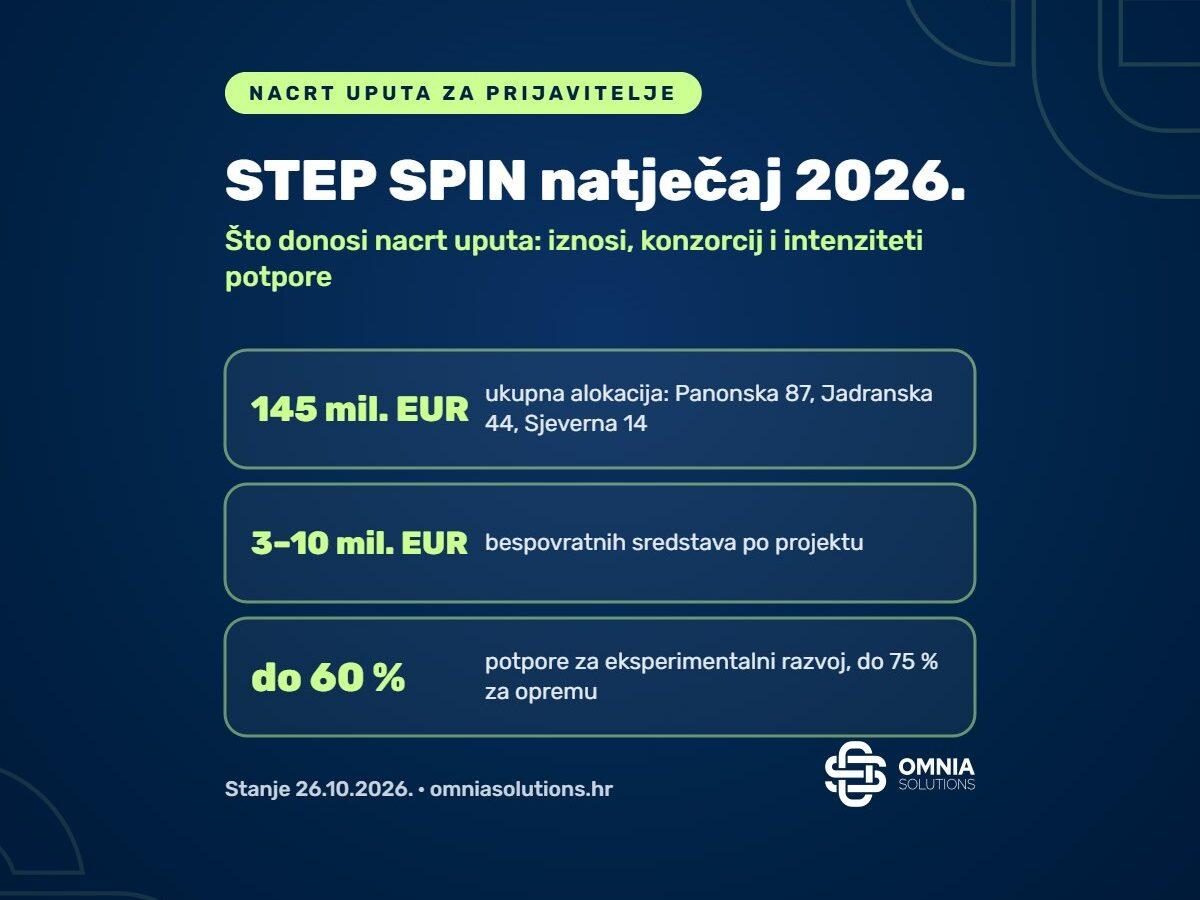
Updated on 28 October 2026 based on the draft Guidelines for Applicants that the Ministry of Regional Development and EU Funds (MRRFEU) published for public consultation from 14 September to 14 October 2026. The draft sets a total allocation of EUR 145 million (instead of the 130 million announced earlier), grants of EUR 3 to 10 million per project, a consortium of at least two unrelated enterprises of which at least one is an SME, and aid intensities of up to 60% for experimental development and up to 75% for investment in equipment. The call publication date and the application deadline are not filled in in the draft. The final conditions may differ from the draft.
Check right away whether your company can be the applicant: the STEP SPIN eligibility questionnaire on this page has 21 questions, takes about five minutes and is based on the draft Guidelines for Applicants.
STEP SPIN (full name: Strengthening STEP Strategic Partnerships for Innovation in the Industrial Transition Process (Jačanje STEP strateških partnerstva za inovacije u procesu industrijske tranzicije)) is a call under the Integrated Territorial Programme 2021–2027 (Integrirani teritorijalni program 2021.–2027.) for consortia of enterprises from Pannonian, Adriatic and Northern Croatia that develop products and services in the sectors of the Strategic Technologies for Europe Platform (STEP). Based on the draft guidelines, the sections below set out the conditions for applicants and partners, eligible activities and costs, amounts and intensities by region, how projects are evaluated, and what is worth preparing before the call is published. We track other open and announced calls in the guide Grants and EU funds for entrepreneurs 2026.
In brief: STEP SPIN according to the draft guidelines
- Allocation: EUR 145,000,000 in three regional envelopes: Pannonian Croatia EUR 87 million, Adriatic Croatia EUR 44 million, Northern Croatia EUR 14 million. A project is financed from the envelope of the applicant’s region.
- Amount per project: EUR 3,000,000 to 10,000,000 in grants.
- Who applies: the lead of the STEP SPIN consortium, that is, a micro, small, medium-sized or large enterprise or a small mid-cap company (up to 499 employees), with its registered office or a branch in Pannonian, Adriatic or Northern Croatia.
- Consortium: at least two enterprises that are not linked enterprises, at least one of which is an SME; partners do not have to be from the same region. Research and knowledge-dissemination organisations (OIŠZ) may be partners but are not mandatory. Large enterprises are eligible only if they cooperate with SMEs.
- Eligibility check: 21-question questionnaire on this page, based on the draft Guidelines for Applicants.
- What is funded: experimental development (TRL 5–8) is mandatory, with a feasibility study where needed; research and development may be combined with investment in equipment and intangible assets (regional aid for these may be at most 60% of the project value) and employee training.
- Aid intensity: experimental development up to 60% (small), 50% (medium-sized), 40% (large enterprise); research organisations up to 100%; regional investment aid up to 75% in Pannonian and Northern Croatia, up to 70% in Adriatic Croatia.
- Implementation period: up to 24 months; implementation must not start before the application is submitted.
- Evaluation: eight criteria, 110 points in total, threshold 75; the first phase is carried out by HAMAG-BICRO (Croatian Agency for SMEs, Innovations and Investments), and MRRFEU makes the funding decision.
- Application: through the eKohezija system, in Croatian; one applicant and one group of linked enterprises may submit only one project proposal.
- Deadline: the opening and closing dates are not filled in in the draft; the call is an open procedure in the time-limited modality, which means that applications are ranked after the deadline.
What STEP SPIN is and how it differs from the 2024 SPIN call
STEP SPIN is the follow-up to the SPIN call (Strengthening Strategic Partnerships for Innovation in the Industrial Transition Process (Jačanje strateških partnerstva za inovacije u procesu industrijske tranzicije)) under the Integrated Territorial Programme. According to an MRRFEU presentation from December 2025, the first SPIN call was published on 28 December 2023, applications were accepted from 1 February to 13 June 2024, and 110 projects with a total value of EUR 326.4 million were contracted, of which EUR 195.9 million in grants. According to the same presentation, the second call is financed from funds that the mid-term review of the programme moved to the new specific objective RSO 1.6, dedicated to the Strategic Technologies for Europe Platform (STEP).
The difference from the first call lies in the subject of the project. In addition to innovativeness and a fit with a regional value chain (RVC) and a priority niche from the Industrial Transition Plan (Plan za industrijsku tranziciju), the project must belong to one of the four STEP sectors and meet the criticality criterion. According to Regulation (EU) 2024/795 and its amendment of December 2025, the sectors are:
- digital technologies and deep-tech innovation,
- clean and resource-efficient technologies, including net-zero technologies,
- biotechnologies, including medicinal products on the Union list of critical medicines,
- defence technologies, including technologies with potential dual use (the regulation was amended in December 2025 to encourage defence investment as part of the ReArm Europe plan).
A technology is considered critical if it brings to the internal market an innovative, novel and cutting-edge element with significant economic potential, or if it contributes to reducing or preventing the Union’s strategic dependencies. One of these two conditions is sufficient; the application must justify it according to the Commission’s STEP guidance, which is annexed to the guidelines.
What has changed compared with earlier announcements
The draft guidelines of September 2026 differ from the announcements that MRRFEU made during 2025, which we covered in an earlier version of this article. The most important changes are:
| Condition | Announcement (December 2025) | Draft guidelines (September 2026) |
|---|---|---|
| Total allocation | EUR 130 million | EUR 145 million (Pannonian 87, Adriatic 44, Northern 14) |
| Amount per project | not announced | EUR 3 to 10 million |
| Consortium composition | at least three enterprises, of which at least two SMEs | at least two unrelated enterprises, of which at least one SME |
| Partners’ region | partners from the same region | partners do not have to be from the same region as the applicant, but all enterprises need a registered office or branch in one of the three regions |
| Aid intensity | up to 50% | experimental development up to 60%, feasibility study up to 70%, regional investment aid up to 75%, training up to 70% |
| Call publication | first quarter of 2026 | dates not filled in in the draft; consultation ended on 14 October 2026 |
Who can apply: applicant, partners and consortium
The application is submitted by the lead of the STEP SPIN consortium, whom the partners appoint in the Consortium Agreement. The lead may be a micro, small, medium-sized or large enterprise or a small mid-cap company (not an SME, with up to 499 employees, annual turnover of up to EUR 100 million or a balance sheet total of up to EUR 86 million). Large enterprises are eligible only if the project includes cooperation with SMEs in research and innovation activities. Partnership outside the consortium is not allowed, and the applicant is responsible for implementing the whole project regardless of the partners.
Conditions every enterprise in the consortium must meet
- Registered office or branch in Pannonian, Adriatic or Northern Croatia. An enterprise that does not have one at the time of application declares in the application that it will register one no later than the date on which it becomes entitled to payment. A partner does not have to be from the same region as the applicant, but must operate in the field of one of the regional value chains of these regions.
- Registration of activity: at least three years for the applicant and at least one year for a partner before the application is submitted. Lump-sum taxed sole proprietorships (paušalni obrt), associations, and charitable and religious organisations are not eligible.
- Employees in the year before the application is submitted (according to the GFI-POD annual financial statements): at least 5 for the applicant, at least 2 for each enterprise partner.
- Operating revenue: the applicant and each enterprise partner must individually have operating revenue of at least 40% of the total aid requested in each of the last two approved accounting periods.
- EBITDA: must not be negative in the two years before the application is submitted (operating revenue − operating expenses + depreciation); income tax payers must instead not show a loss on their DOH income tax returns for those two years.
- Not an undertaking in difficulty under the General Block Exemption Regulation (GBER), no outstanding tax liabilities and not subject to exclusion procedures (bankruptcy, liquidation, final court judgments, recovery of funds from earlier projects).
- One application: one applicant may submit one project proposal, and within a group of linked enterprises aid may be granted only once, either as applicant or as partner. If the group submits several applications, all of them are excluded.
- Share in the project: no partner may hold a predominant share (more than 50%) of the total project value.
Research organisations (OIŠZ) as partners
The consortium may include one or more research and knowledge-dissemination organisations registered in Croatia (universities, institutes and similar entities that meet the criteria of the Community Framework for State aid for research and development and innovation). A research organisation receives support that is not State aid, up to 100% of eligible costs, but only for research and development activities. Eligible costs are the salaries of newly employed research and technical staff, indirect costs at a flat rate of up to 15% of direct staff costs, and depreciation of equipment up to 50% of that partner’s costs. Salaries of existing employees financed from the state budget are not eligible, and a research organisation cannot use regional aid or training aid. The same organisation may be a partner in several projects. For a research organisation, the statute or another document proving its research organisation status is submitted with the application.
Associates who contribute to the project’s mission may also join the consortium, but they cannot claim grants.
Eligibility check: STEP SPIN questionnaire
In about five minutes, this questionnaire checks the basic conditions of the STEP SPIN call under the draft Guidelines for Applicants from the public consultation: company size, seat and age, employees, revenue, EBITDA, consortium composition, STEP area, RVC niches, place of implementation and the requested amount. The call has not been published yet, so the questionnaire will be aligned with the final Guidelines as soon as they are published.
Questionnaire · about five minutes
Can your company be the STEP SPIN applicant?
Answer 21 questions for the company that would be the applicant and STEP SPIN consortium leader. Your answers are not stored and are not sent anywhere unless you click the button to send the result.
What is funded: activities and technology readiness levels
Every project must include experimental development activities, that is, work at technology readiness levels TRL 5 to 8: from technology validation in a relevant environment, through prototype and demonstration, to a qualified system. The project may also include a feasibility study that precedes or follows experimental development. Fundamental research (TRL 1), industrial research (TRL 2–4) and TRL 9 are not eligible, nor is investment for routine mass production of finished products.
- Research and development (Article 25 of the GBER): the consortium members' own activities, contract research and collaborative research. Mandatory for every project.
- Investment in tangible and intangible assets (regional aid, Article 14): initial investment in equipment, instruments, laboratory and testing equipment, pilot lines and demonstration facilities, production equipment for the first industrial application of the developed technology, adaptation of premises needed to install the equipment, software, patents and licences. The assets must be new. This activity is allowed only together with research and development, is not available to research organisations, and the requested amount of regional aid may be at most 60% of the total project value.
- Employee training (Article 31): skills needed to develop and manufacture key technologies in the STEP sectors. Also allowed only together with research and development and only for enterprises; training to meet legal obligations is not eligible.
Amounts and aid intensities by region
The allocation is drawn from the envelope of the region in which the applicant has its registered office or branch. Each project may request EUR 3 to 10 million in grants, and the applicant covers the difference up to the total project value, including ineligible costs and VAT, from its own funds (which include the partners' funds) or with a bank loan. Combining grants with financial instruments from the ESI Funds is not allowed. Aid is considered granted on the date of the funding decision, and a written aid application for all consortium members must be submitted before implementation starts (incentive effect).
| Type of aid | Small enterprise | Medium-sized enterprise | Large enterprise | Research organisation (partner) |
|---|---|---|---|---|
| Experimental development (project in Pannonian, Adriatic or Northern Croatia) | 60% | 50% | 40% | 100% |
| Feasibility study | 70% | 60% | 50% | – |
| Regional investment aid: Pannonian and Northern Croatia | 75% | 70% | 60% | – |
| Regional investment aid: Adriatic Croatia | 70% | 60% | 50% | – |
| Regional investment aid: Sisak-Moslavina County | 75% | 75% | 75% | – |
| Employee training | 70% | 60% | 50% | – |
The regional aid intensity is calculated according to the location of the investment, not the registered office. A beneficiary of regional aid must provide a contribution of at least 25% of eligible costs from its own resources or through external financing, free of any State aid. For large enterprises, intangible assets may account for at most 50% of the initial investment costs, while for SMEs they are eligible in full. Initial investments started by the same group in the same region within three years are added together and must not exceed the maximum intensities and amounts set by the GBER.
Eligible costs and limits
For research and development activities, the applicant and the enterprise partners may claim:
- salaries of research and technical staff for hours worked on the project, according to a standard scale of unit costs (the gross 2 salary, that is, gross salary plus employer contributions, divided by 155 hours per month for full-time work); the unit cost does not change during implementation,
- depreciation of instruments and equipment for the period and extent of their use on the project, up to 50% of the item's initial value; not eligible for equipment acquired through regional aid,
- contract research, knowledge and patents bought or licensed at market conditions, up to 10% of total eligible costs; they must not be the only cost of any enterprise,
- consultancy and equivalent services used exclusively for the project; fees to intellectual property offices are not eligible,
- additional overheads and materials incurred directly as a result of the project, up to 20% of eligible research and development costs,
- indirect costs at a flat rate of up to 15% of direct staff costs (office space, visibility, horizontal principles),
- a feasibility study linked to experimental development in the same project,
- VAT that the beneficiary cannot recover, with a statement on the basis for this.
Costs must be incurred during the implementation period, paid and documented, and comply with the procurement rules for entities not subject to the Public Procurement Act (Zakon o javnoj nabavi), which are annexed to the guidelines. Procurement procedures cannot be concluded before the implementation period starts, and subcontracting a linked company is not allowed.
Financing plan: bank loan or own funds
The draft requires a closed financing plan already in the application, on Form 12, in one of two ways that cannot be combined:
- Bank loan: a binding letter of intent from a bank, for at least the total project value minus the grants requested, is submitted with the application. During contracting, the loan agreement is submitted within 15 calendar days of the end of the standstill period or of the waiver of the right to file a complaint.
- Own funds: a statement and evidence of liquidity (BON-2/SOL-2, bank statements, a profit distribution decision, a letter of intent from the owner or a linked company on a shareholder loan, a letter of intent from a venture capital fund and similar) are submitted with the application. During contracting, within the same 15 calendar days, a bank statement is submitted showing that at least 15% of the total project value is secured in the project account.
During implementation, costs are paid by the reimbursement method: the beneficiary pays the invoice and submits a payment claim with evidence, HAMAG-BICRO checks it, and MRRFEU pays within up to 80 days. Claims are submitted quarterly. An advance payment of up to 30% of the approved grant is possible, against a bank guarantee for at least the amount of the advance. If no reimbursement takes place within 8 months of signing the contract, the contract may be terminated. A lack of funds for implementation is not a valid reason to extend the contract, so financing of your own share is worth planning before you apply. An overview of loan programmes for entrepreneurs is in the guide HBOR (Croatian Bank for Reconstruction and Development) loans 2026.
How projects are evaluated: 110 points, threshold 75
The award procedure has two phases. In the first, HAMAG-BICRO carries out the administrative check, the eligibility check of the applicant, partners, project, activities and costs, and the quality assessment; at the first “no” answer to an eligibility criterion, the project proposal is excluded. In the second phase, MRRFEU makes the funding decision based on the ranking list. The procedure takes 120 days, not counting the standstill period and the handling of complaints. The selection criteria were adopted by the Monitoring Committee on 3 August 2026:
| Criterion | Maximum points | Minimum points |
|---|---|---|
| Value for money offered by the project | 37 | 20 |
| Financial sustainability of the project | 11 | 7 |
| Implementation capacity | 17 | 10 |
| Project design and maturity | 12 | 7 |
| Promotion of equal opportunities and social inclusion | 2 | 2 |
| Promotion of sustainable development | 3 | 3 |
| Scope and strength of the partnership | 8 | 5 |
| Innovativeness | 20 | 12 |
| Total | 110 | 75 |
In the event of a tie, priority goes to the project with more points for value for money, then for innovativeness, design and maturity, implementation capacity, strength of the partnership and financial sustainability, and finally to the project with the lower requested amount. The ranking list also includes a reserve list. If the remaining funds do not cover a whole project, the applicant may be offered the option of increasing its own share, but not of reducing activities.
Indicators also matter for implementation. The mandatory indicators are the number of enterprises receiving support, the number of strategic partnerships concluded and private investment equal to the difference between the project value and the aid; where applicable, newly created research jobs and staff who complete training are also tracked. Failure to achieve the indicators leads to a financial correction based on the average achievement rate, and failure to deliver the contribution to the horizontal principles for which points were awarded leads to a correction of 5% (partial) or 10% (full) of the funds paid. Project results must be maintained for three years (SMEs) or five years (large enterprises) after the final payment.
Application deadline and submission procedure
In the draft, the opening and closing dates of the call are left blank, so the application deadline is not yet known; it will be published with the final guidelines on the eufondovi.gov.hr portal and in the eKohezija system. The call is an open procedure in the time-limited modality. Applications are accepted until the deadline and then ranked, so the order of submission is not decisive, but quality is. After publication, questions may be submitted up to 14 days before the deadline, answers are published within seven working days, and MRRFEU and HAMAG-BICRO will hold at least one information workshop no later than three weeks before the deadline.
- Applications are submitted exclusively through eKohezija, in Croatian and in the Latin script; foreign documents are attached with a certified translation.
- Documents are signed by the person authorised to represent the company, either as a scan with stamp and signature or as a PDF with a qualified electronic signature.
- Mandatory documents: the application form in eKohezija, the applicant's statement, the partner's statement (and a separate statement for research organisations), the joint statement of the applicant and partners, the statement on aid received, the annex to the application form, the cost breakdown, the financing plan with evidence, the Consortium Agreement, CVs of the research team, the list of staff whose salaries are claimed, proof of the product's technology readiness level, and the GFI-POD or DOH forms. Depending on the case, the beneficial owner statement, the statement on recoverable VAT, evidence for the salary calculation, the list of equipment being depreciated, proof of intellectual property protection and the research organisation's statute are also attached.
- While the call is open, the applicant may withdraw the application and submit a new one; after the deadline, withdrawal ends the procedure.
- Implementation (the first legally binding order or contract) must not start before the application is submitted, nor end before the contract is signed; preparing the application is not considered the start of implementation.
- The implementation period is up to 24 months, and costs are eligible up to 30 days after implementation ends.
The most common reasons for exclusion to watch out for
- The Consortium Agreement has not been submitted or does not meet the conditions of the call.
- The partners are linked enterprises, so the consortium does not have two unrelated enterprises; or another application has been submitted from the same group.
- One partner accounts for more than 50% of the project value.
- The revenue of the applicant or a partner in one of the last two periods is below 40% of the requested aid, EBITDA is negative, or the number of employees does not reach 5 or 2 respectively.
- The project has no experimental development, only equipment purchase or training; or it targets TRL 1–4 or TRL 9.
- The project is not convincingly placed in a STEP sector and a priority niche of a regional value chain, or the criticality criterion is not justified.
- A procurement or a contract with a supplier was concluded before the application was submitted.
- The financing plan is not closed, because the binding bank letter or the evidence of own funds is missing.
- Contract research exceeds 10% of costs or is a partner's only cost; regional aid exceeds 60% of the project value.
- Costs are calculated above market prices or without a methodology for salaries.
What to prepare before the call is published
In the first SPIN call, five and a half months passed between publication (28 December 2023) and the application deadline (13 June 2024), and part of the documentation, from the Consortium Agreement to the bank's letter of intent, takes more time than it seems. Before publication, it is worth:
- checking the eligibility of each consortium member against the GFI-POD figures for the last two approved years: employees, revenue compared with the planned aid amount, EBITDA, links between enterprises,
- selecting partners and dividing roles so that no one exceeds 50% of the project value and every partner takes an active part in research and development throughout the project,
- placing the project in a STEP sector and a niche from your region's Industrial Transition Plan and preparing the criticality justification according to the STEP guidance,
- defining the starting and target TRL, work packages and results per partner,
- talking to the bank about a binding letter of intent or preparing evidence of own funds,
- collecting quotes for equipment and external services so that the budget is based on market prices,
- preparing a draft Consortium Agreement that divides the rights to results and intellectual property.
How Omnia Solutions can help
Omnia Solutions has followed the preparation of the STEP SPIN call since the first announcement and helps consortia in the phase before the official publication: from checking eligibility and structuring the partnership, through aligning the project with the STEP sectors and regional value chains, to preparing the project and financial documentation and the application in eKohezija. Since our founding in 2023, and through our consultants' earlier experience in public administration and private consulting, our team has structured more than 130 projects with a total value of over EUR 60 million, including the preparation of applications for the first SPIN call.
If you are considering applying for STEP SPIN, the best time to talk about the consortium composition and the project idea is before the final guidelines are published. The introductory call is free. Contact us at info@omniasolutions.hr or on 097 7969 679.
Frequently asked questions about the STEP SPIN call
What is the allocation of the STEP SPIN call?
According to the draft Guidelines for Applicants of September 2026, the total allocation is EUR 145 million, split into three envelopes: Pannonian Croatia EUR 87 million, Adriatic Croatia EUR 44 million and Northern Croatia EUR 14 million. Earlier announcements referred to EUR 130 million.
How much grant funding can one project request?
EUR 3 to 10 million per project. The consortium covers the difference up to the total project value from its own funds or with a bank loan, and must prove the financing plan already in the application.
Who can apply for STEP SPIN and how many partners does a consortium need?
The application is submitted by the consortium lead, which may be a micro, small, medium-sized or large enterprise or a small mid-cap company with its registered office or a branch in Pannonian, Adriatic or Northern Croatia. The consortium must have at least two enterprises that are not linked enterprises, at least one of which is an SME. Research organisations may be partners but are not mandatory.
Can a company from Zagreb take part in a STEP SPIN consortium?
According to the draft, all enterprises in the consortium must have a registered office or branch in Pannonian, Adriatic or Northern Croatia, and an enterprise that does not have one at the time of application can register one no later than the date on which it becomes entitled to payment of the aid. The project must be implemented in one of these regions, and the regional aid intensity is calculated according to the location of the investment.
What is the aid intensity in the STEP SPIN call?
For experimental development up to 60% for small, 50% for medium-sized and 40% for large enterprises; for a feasibility study up to 70%, 60% and 50%. Regional investment aid for equipment is up to 75%, 70% and 60% in Pannonian and Northern Croatia, and up to 70%, 60% and 50% in Adriatic Croatia. Research organisations as partners can receive aid of up to 100% for research and development activities.
Which activities are eligible and at what TRL?
Experimental development at TRL 5 to 8 is mandatory, with an optional feasibility study. Together with research and development, investment in new equipment and intangible assets (regional aid for these may be at most 60% of the project value) and employee training can be financed. Fundamental and industrial research (TRL 1–4), TRL 9 and mass production are not eligible.
When is the STEP SPIN call expected to be published and what is the deadline?
The public consultation on the draft guidelines ended on 14 October 2026. The opening and closing dates of the call are not filled in in the draft, so the deadline is not yet known. The call will be published on eufondovi.gov.hr and in the eKohezija system, and applications are submitted through eKohezija.
How are projects evaluated and how many points are needed for funding?
Eight criteria carry a total of 110 points, and the threshold is 75, with a minimum score on each criterion. Value for money (37 points) and innovativeness (20 points) carry the most weight. The first phase is carried out by HAMAG-BICRO, and MRRFEU makes the funding decision in a procedure that takes 120 days.
How long can a STEP SPIN project last?
Up to 24 months from the start of implementation. Implementation must not start before the application is submitted, costs are eligible up to 30 days after implementation ends, and if no reimbursement takes place within 8 months of signing the contract, the contract may be terminated.
How can I check whether my company can be the STEP SPIN applicant?
This page includes a 21-question questionnaire that checks company size, seat and age, employees, operating revenue, EBITDA, consortium composition, STEP area, RVC niches, place of implementation and the requested amount against the draft Guidelines for Applicants. The result is for information only, and the questionnaire will be aligned with the final Guidelines once the call is published.
Considering a STEP SPIN application?
The consortium, budget and financing plan are put together before the call is published
In the introductory call we go through the conditions from the draft guidelines using your case: who can be the lead, which partners join the consortium, how much aid you can request and how to close the financing plan. The introductory call is free. Email or call us.
Sources
- MRRFEU: public consultation on the Guidelines for Applicants for the STEP SPIN call (published 14 September 2026, open until 14 October 2026)
- eSavjetovanja: draft Guidelines for Applicants and annexes
- MRRFEU: Industrial transition of Croatian regions, presentation (December 2025)
- eufondovi.gov.hr: Strategic Technologies for Europe Platform (STEP)
- Regulation (EU) 2024/795 establishing the Strategic Technologies for Europe Platform (STEP)
- Omnia Solutions: technology readiness levels (TRL) in EU funds and Guides 2026 with open calls and loans
The conditions in this article are taken from the draft Guidelines for Applicants published for public consultation; the final guidelines may differ. We will update the article after the call is published. As of 28 October 2026.