Process Innovation in S3 Areas: up to EUR 450,000 in grants for manufacturing SMEs

Updated 22 October 2026. The call is open until the funds are exhausted, and no later than 31 December 2026 at 11:00. Check whether your project meets the conditions in the guide Grants and EU funds for entrepreneurs 2026.
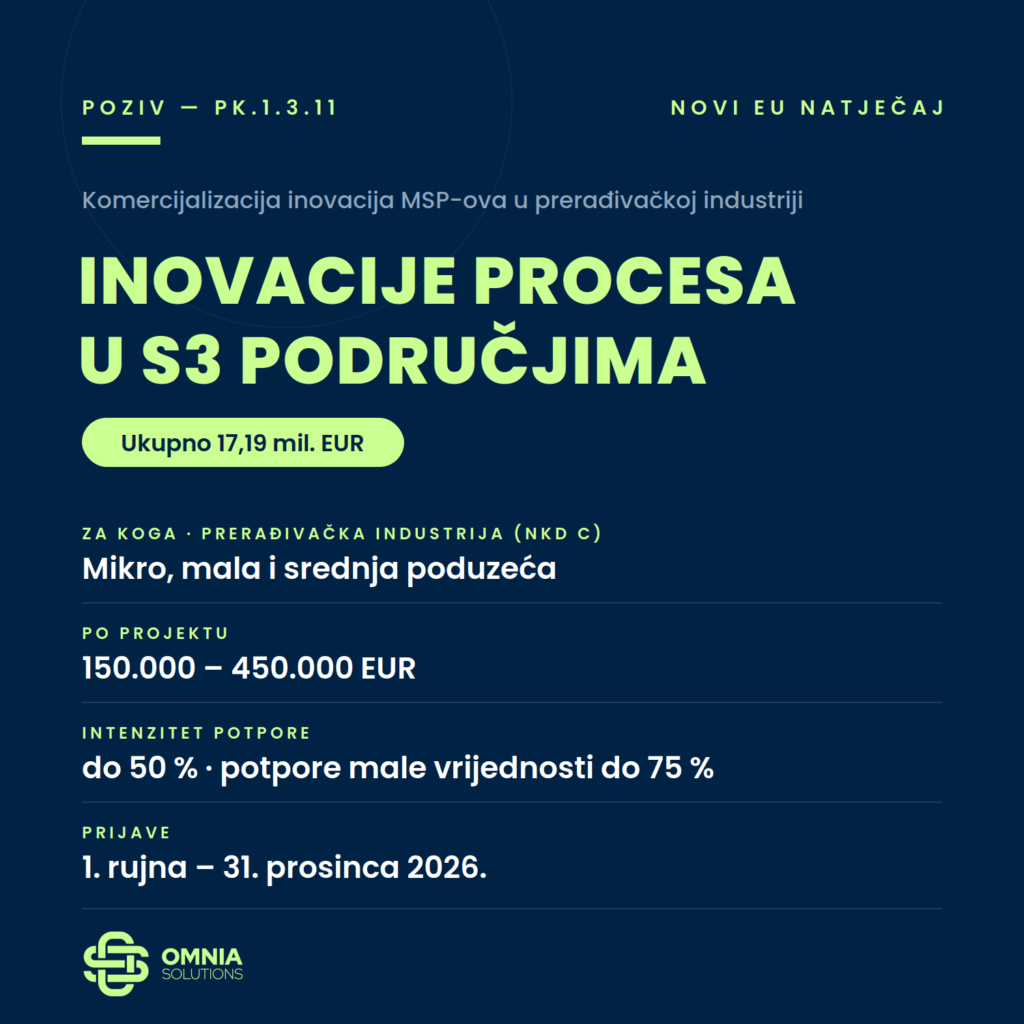
On 10 July 2026, the Ministry of Economy published a new call for grants “Process Innovation in S3 Areas” (Inovacije procesa u S3 područjima, call code: PK.1.3.11), financed from the European Regional Development Fund under the Competitiveness and Cohesion Programme 2021–2027. The total allocation of the call is EUR 17,188,524.40, and an individual project can receive EUR 150,000 to 450,000 in grants. Applications are submitted through the eKohezija system from 1 September 2026 at 11:00 until 31 December 2026 at 11:00, or until the available funds are exhausted.
The call is intended for micro, small and medium-sized enterprises in manufacturing (NKD 2025, sector C) that want to commercialise an innovative product or service that is new to the market through process and organisational innovation, with a focus on digitalisation and the green transition.
It is one of the few calls in this programming period that directly finances the commercialisation phase (TRL 7 and above) rather than research and development in earlier phases. This makes it particularly interesting for manufacturing companies that already have a developed product and need support to enter the market.
Together with the previously opened calls for Proof of Concept (Dokazivanje inovativnog koncepta, PoC) and the SPARK and VALID calls, this is the fourth call for innovative projects opened within a short time, and for all of these calls the application deadline is the beginning of September 2026.
Key information about the call
| Call name | Process Innovation in S3 Areas |
| Call code | PK.1.3.11 |
| Responsible bodies | Ministry of Economy (PT1), HAMAG-BICRO (Croatian Agency for SMEs, Innovations and Investments; PT2) |
| Source of funding | European Regional Development Fund (ERDF), Competitiveness and Cohesion Programme (PKK) 2021–2027 |
| Total allocation | EUR 17,188,524.40 |
| Grant amount per project | EUR 150,000 to 450,000 |
| Aid intensity | up to 50% (GBER Art. 28 and 29), up to 75% for de minimis costs |
| Eligible applicants | SMEs, manufacturing (NKD 2025, sector C) |
| Partnership | Not allowed, the applicant acts alone |
| Project duration | up to 24 months |
| Type of call | Open procedure, permanent call modality |
| Submission of applications | 1 September 2026 (11:00) to 31 December 2026 (11:00), via the eKohezija system |
Who can apply for the PK.1.3.11 call?
An eligible applicant is a legal or natural person that is a micro, small or medium-sized enterprise as defined in Annex I to the General Block Exemption Regulation (GBER) and that carries out an economic activity within sector C, Manufacturing, according to NKD 2025.
In addition, the applicant must meet several key conditions:
- it has been registered to carry out an economic activity for at least 12 months before submitting the project proposal,
- it has at least one employee based on hours worked in the year preceding the application (n-1),
- it has a positive EBITDA for year n-1 (for personal income taxpayers: no loss reported on the DOH forms),
- its operating revenue amounts to at least 30% of the total project value for the last approved accounting period,
- it is not an undertaking in difficulty, a large enterprise, a flat-rate sole proprietorship (paušalni obrt), an association or a religious organisation.
It is important to note that one company (one OIB identification number) can submit only one project proposal, and partnerships of any kind are not eligible.
What is financed: commercialisation of innovations at TRL 7 and above
The purpose of the call is to support innovative SMEs in manufacturing in the commercialisation of innovative products that are new to the market and that fall within at least one of the seven thematic priority areas of the Smart Specialisation Strategy to 2029 (S3):
- Personalised healthcare
- Smart and clean energy
- Smart and green transport
- Security and dual use
- Sustainable and circular food
- Customised and integrated wood products
- Digital products and platforms
Eligible activities relate to a product/service at technology readiness level TRL 7 and above, that is, technology demonstrated in an operational environment. Basic research and development from TRL 1 to TRL 6 are not financed.
The project must include at least one process and/or organisational innovation linked to digitalisation or the green transition, for example introducing software for production automation, implementing an ERP system, IoT sensors in production, optimising energy consumption, circular processes for recycling by-products or switching to more environmentally friendly technologies.
Three groups of activities are eligible:
- Process and/or organisational innovation aimed at digitalisation or the green transition (GBER Art. 29), a mandatory activity in every project;
- Adapting the innovative product/service to market requirements (GBER Art. 28);
- Supporting project activities (de minimis aid), no more than 30% of total eligible costs.
Eligible costs
The main eligible cost categories include:
- salaries of staff working on the project (calculated using the SVJT/PMF method),
- depreciation of instruments, equipment, buildings and land to the extent they are used for the project,
- contract research, knowledge and patents bought or licensed from external sources,
- overheads at a flat rate of up to 15% of direct staff costs,
- costs of intellectual property protection and innovation advisory services,
- under the de minimis component: purchase of new machinery, equipment and hardware, external services (market research, testing, design, marketing), employee training in green and digital skills,
- project management and application preparation (up to EUR 35,000) and publicity and visibility (up to EUR 1,500).
Ineligible costs include, among others, deductible VAT, used equipment, the purchase of vehicles, land and buildings, travel costs, exhibiting at trade fairs, leasing and employee bonuses.
How projects are evaluated and why the order of submission is decisive
The call is implemented as an open procedure in the permanent call modality, which means that project proposals are processed, evaluated and financed in the order of submission until the allocation is exhausted. In other words, a good-quality application submitted earlier has a real advantage, and the call may close before 31 December 2026 if the allocation is used up.
A project proposal must score at least 80 out of 100 points, with mandatory minimum thresholds for individual criteria. Before applying, you should also pay attention to the incentive effect. Activities relating to State aid must not start before the project proposal is submitted, while the costs of preparing the documentation are eligible from the date the call was published (10 July 2026).
Deadlines and how to apply
Project proposals are submitted exclusively through the eKohezija information system (ekohezija.gov.hr), from 1 September 2026 at 11:00 until 31 December 2026 at 11:00. The application includes the Application Form, the Applicant’s Statement, the Joint Statement, the Statement on Aid Received, the Annex to the Application Form with a financial analysis and evidence of the TRL level, the Financial Structure of the project and the mandatory initial survey.
How Omnia Solutions can help you
Omnia Solutions specialises in preparing applications for EU innovation calls, from the eligibility assessment and GBER analysis of company size, through developing the project concept and the budget according to the SVJT methodology, to preparing the complete application documentation and providing support during implementation. As applications are financed in the order of submission, it is best to start preparing immediately, since less than two months remain until the call opens on 1 September.
Contact us for a free eligibility check of your project at info@omniasolutions.hr
Frequently asked questions (FAQ)
How much grant funding can I apply for under the Process Innovation in S3 Areas call?
The minimum grant per project is EUR 150,000 and the maximum is EUR 450,000. The aid intensity is up to 50% of eligible costs for innovation aid (GBER Art. 28 and 29), or up to 75% for costs financed as de minimis aid.
Who can apply for the PK.1.3.11 call?
Micro, small and medium-sized enterprises carrying out an economic activity in manufacturing (NKD 2025, sector C), registered for at least 12 months, with at least one employee, a positive EBITDA in the previous year and operating revenue of at least 30% of the project value.
When does the Process Innovation in S3 Areas call open and close?
Applications are accepted from 1 September 2026 at 11:00 until 31 December 2026 at 11:00 through the eKohezija system. As this is a permanent call processed in the order of submission, the call may close earlier if the allocation of EUR 17.19 million is used up.
What technology readiness level (TRL) is required to apply?
The product or service must be at TRL 7 or higher, that is, technology demonstrated in an operational environment. Development activities from TRL 1 to TRL 6 are not eligible for financing.
Must the innovation be new to the market or only new to the company?
The product or service being commercialised must be new to the market, and the project must include at least one process or organisational innovation linked to digitalisation or the green transition.
Is partnership allowed on the project?
No. Applicants must act alone. Partner organisations and partnerships of any kind are not eligible, and one company can submit only one project proposal.
Can I claim an advance payment?
Yes. The beneficiary can request an advance payment of up to 30% of the approved grant with a bank guarantee, or up to 10% with a notarised blank debenture (solemnizirana bjanko zadužnica).