SPARK and VALID 2026: EUR 15 million for early-stage innovation

Two new calls under the DIGIT project open up room for projects that have an idea and know-how but lack the funds for the next step forward. Below is an overview of the conditions, amounts and deadlines of the SPARK and VALID calls, along with a few observations from practice.
In recent years, the Croatian innovation system has been gaining instruments it did not have before, and the two calls that have just been announced, SPARK and VALID, are a good example of this shift. They are calls under the DIGIT project, i.e. Digital, Innovative and Green Technologies (Digitalne, inovativne i zelene tehnologije), which the Ministry of Science, Education and Youth is implementing with the support of the World Bank and whose total value is EUR 106 million. Together, the two calls have EUR 15 million in grants available, which makes them one of the more concrete opportunities for companies in the early or development stage.
It is worth highlighting from the outset the segment these incentives target. In the past period, a large share of the available funds went to investment in production capacity and the digitalisation of established companies, while the phase of applied research, prototype development and idea validation often lacked a suitable funding source. SPARK and VALID put exactly this phase at the centre.
SPARK and VALID, two calls with a related logic
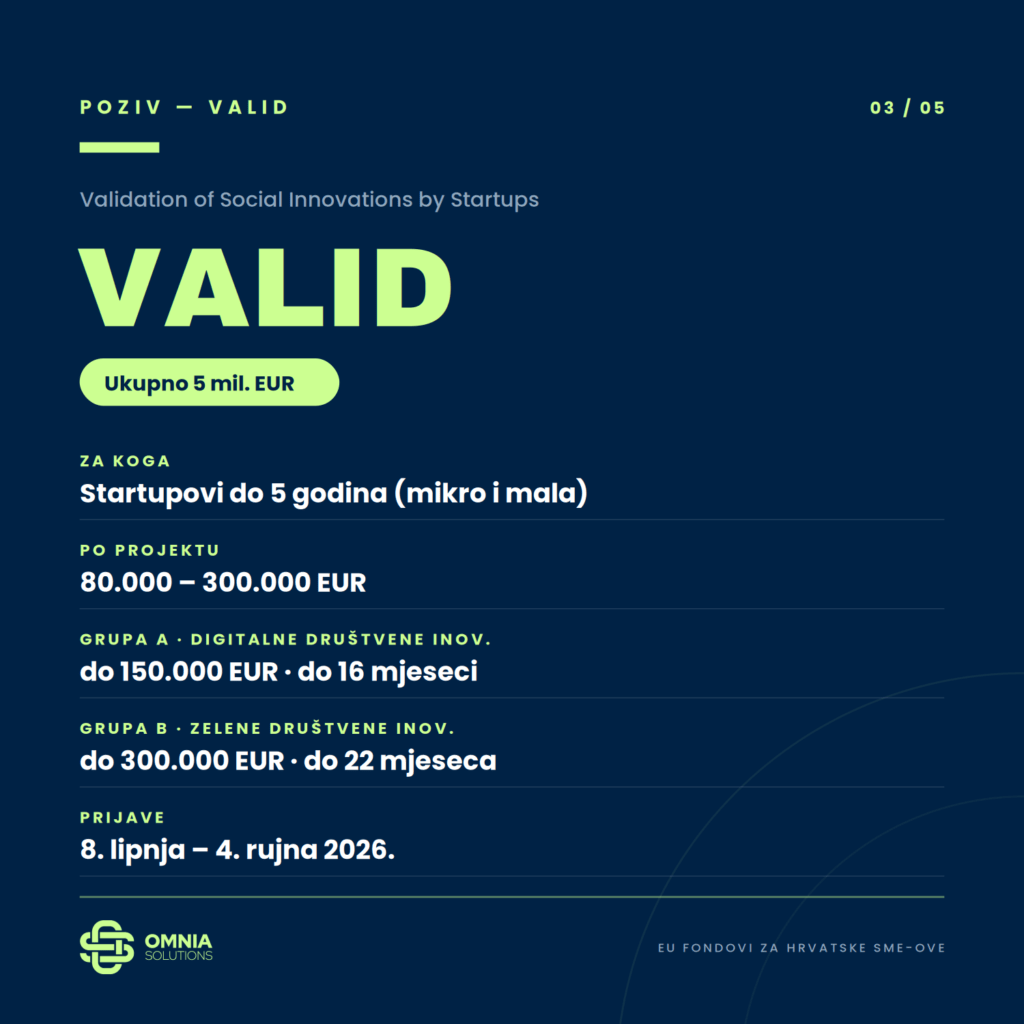
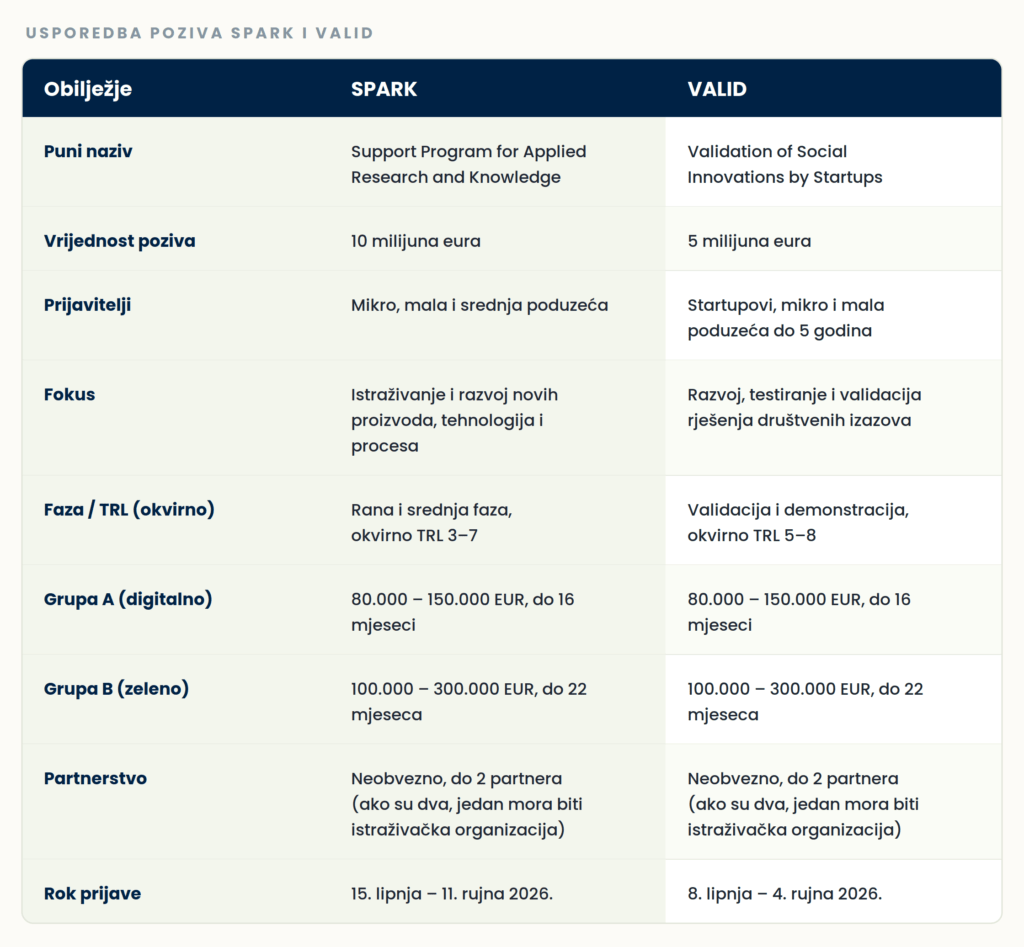
SPARK, whose full name is Support Program for Applied Research and Knowledge, is worth EUR 10 million and is intended for micro, small and medium-sized enterprises that want to invest in research and development of new products, technologies or processes. VALID, or Validation of Social Innovations by Startups, is worth EUR 5 million and is aimed at start-ups, i.e. micro and small enterprises up to five years old that have an innovative solution to a social challenge but need support for prototype development, testing and market preparation.
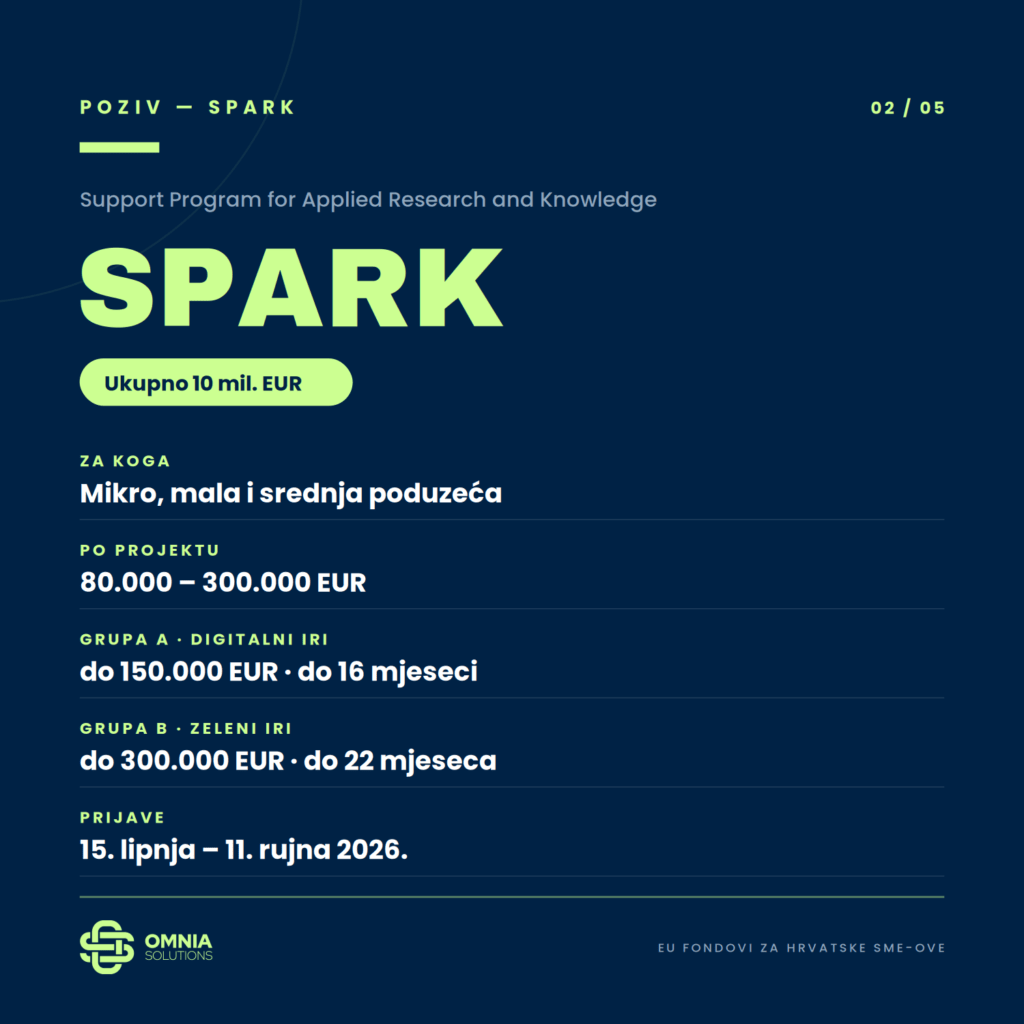
Although they address different applicant profiles, both calls follow a related structure. Each is organised into two thematic groups, and a project must choose one of them. Group A is oriented towards digital solutions, while Group B covers green, circular and sustainable solutions. In SPARK, Group A covers the application of digital technologies to strengthen productivity and efficiency, and Group B covers green solutions being prepared for commercialisation. In VALID, Group A covers digital social innovations, for example digital tools and data-driven models, while Group B covers green social innovations such as community-based renewable energy models or sustainable mobility for vulnerable groups.
Grant amounts, duration and application deadlines
The financial framework of the two calls is aligned. In both Group A strands, the grant amount ranges from EUR 80,000 to 150,000 with a project duration of up to 16 months, while in the Group B strands the range is EUR 100,000 to 300,000 with a duration of up to 22 months.
Applications for VALID are accepted from 8 June to 4 September, and for SPARK from 15 June to 11 September 2026, so both calls remain open until early September.
Both calls place particular emphasis on including women in the innovation and technology sector, an element that is increasingly valued in the selection process through horizontal policies.
What makes an application successful in practice?
Experience with calls of a similar type shows that several factors repeatedly separate the applications that succeed from those that stall at the threshold.
Choosing the thematic group
Since a project must choose either the digital or the green direction, and the amounts and durations differ between the groups, this choice is more than a formality. It determines the scope of the project, the budget and how the activities will be assessed. This is where most applicants gain the most value from an early conversation with an expert who knows the call, because changing direction after the budget has been set rarely comes without losses.
Alignment with the selection criteria
A call of this type requires each project to make a clear contribution to the competitiveness of the economy through the development of digital or green solutions, and points are awarded when this contribution is described concretely and measurably rather than in general terms. An application is largely won before the call even opens, at the stage when the idea is shaped according to what is assessed.
How do SPARK and VALID fit into the wider picture of innovation funding?
Viewed in isolation, SPARK and VALID are two useful calls with decent grant amounts. In a wider context, they are part of a more deliberate steering of funds towards the early stage of the innovation chain, the stage at which it is decided whether an idea will reach the market at all. This direction is also reflected in the wider debate on the priorities of European innovation funding under the next multiannual financial framework, in which more and more attention is paid to bridging the gap between research and commercialisation.
For Croatian companies, this means that such calls are worth following because of the logic they introduce, in addition to the individual amounts. Companies that gain experience now in preparing and implementing an applied research project will be in a better position for the instruments still to come.
Deadlines and application preparation
The preparation window is short. Both calls open in June and close in early September, which leaves little time for serious preparation of the documentation and the budget. Companies considering an application are advised first to assess which call and which thematic group their project fits best, and only then to start writing.
Preparing an application for SPARK or VALID
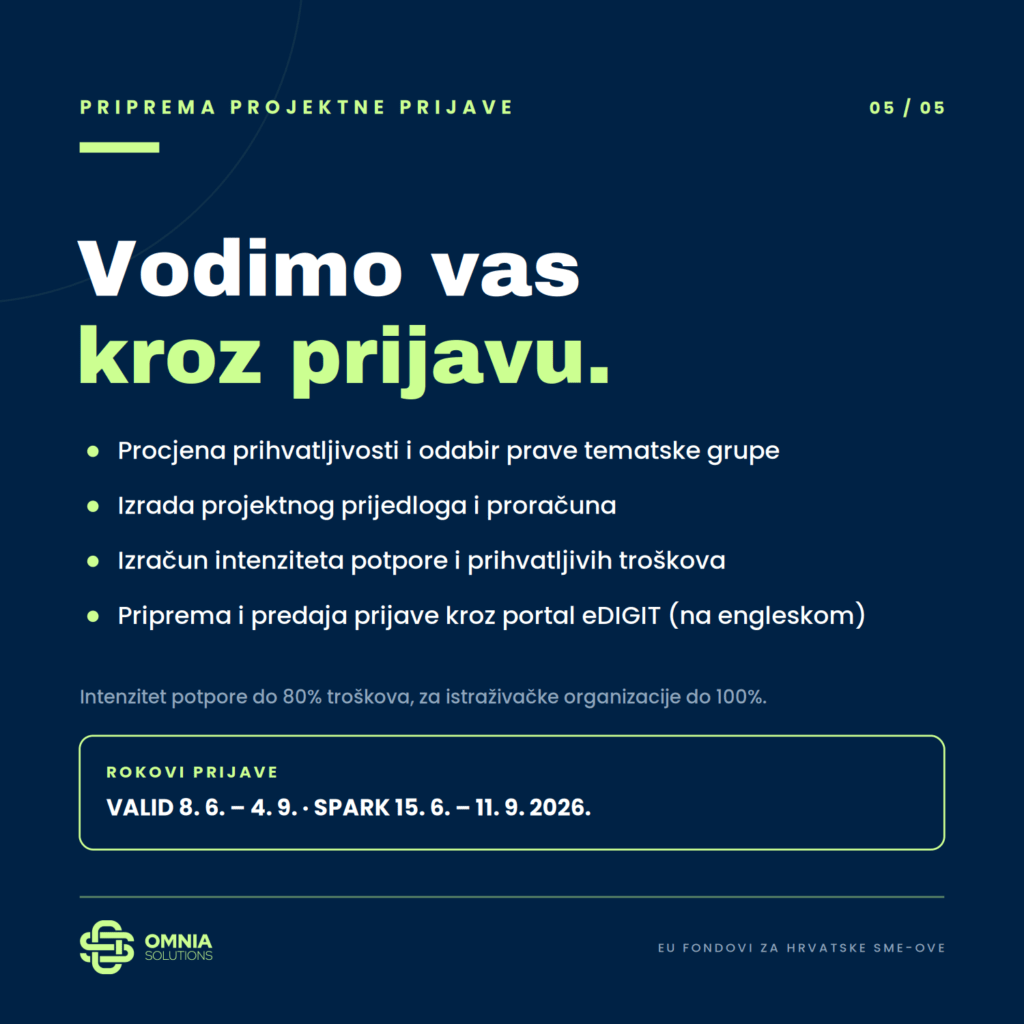
Omnia Solutions regularly guides companies through the entire process, from the eligibility assessment and the choice of thematic group to drafting the project proposal and the budget, and later implementation. For companies that have SPARK or VALID on their radar, the Omnia team can assess whether their project fits and where it has the most room.
For a wider overview of current opportunities, the Complete guide to EU funds and grants for 2026 is also available.
Frequently asked questions about the SPARK and VALID calls
What is the SPARK call?
SPARK (Support Program for Applied Research and Knowledge) is a call worth EUR 10 million intended for micro, small and medium-sized enterprises for research and development of new products, technologies or processes, under the DIGIT project.
What is the VALID call?
VALID (Validation of Social Innovations by Startups) is a call worth EUR 5 million intended for start-ups, i.e. micro and small enterprises up to five years old, for prototype development, testing and validation of innovative solutions to social challenges. Under the VALID call, eligible applicants are those that have not paid out profits since they were founded.
Who can apply for SPARK and VALID?
Micro, small and medium-sized enterprises can apply for SPARK, and start-ups, i.e. micro and small enterprises up to five years old, can apply for VALID.
What is the grant amount per project?
The grant amount per project ranges from EUR 80,000 to 150,000 in Group A, with a project duration of up to 16 months, and from EUR 100,000 to 300,000 in Group B, with a duration of up to 22 months. Both calls have the same grant ranges and project durations per group.
What are the application deadlines for SPARK and VALID?
Applications for VALID are accepted from 8 June 2026 to 4 September 2026, and for SPARK from 15 June to 11 September 2026. Both calls remain open until early September 2026.
Under which programme are SPARK and VALID awarded?
Both calls are part of the DIGIT project (Digital, Innovative and Green Technologies), with a total value of EUR 106 million, implemented by the Ministry of Science, Education and Youth with the support of the World Bank.
What is the difference between Group A and Group B?
In both calls, Group A is oriented towards digital solutions, and Group B towards green, circular and sustainable solutions. The groups also differ in grant amount and project duration, and each project must choose one group.
Is a partnership with a research organisation mandatory?
No, partnerships are not mandatory in either SPARK or VALID.