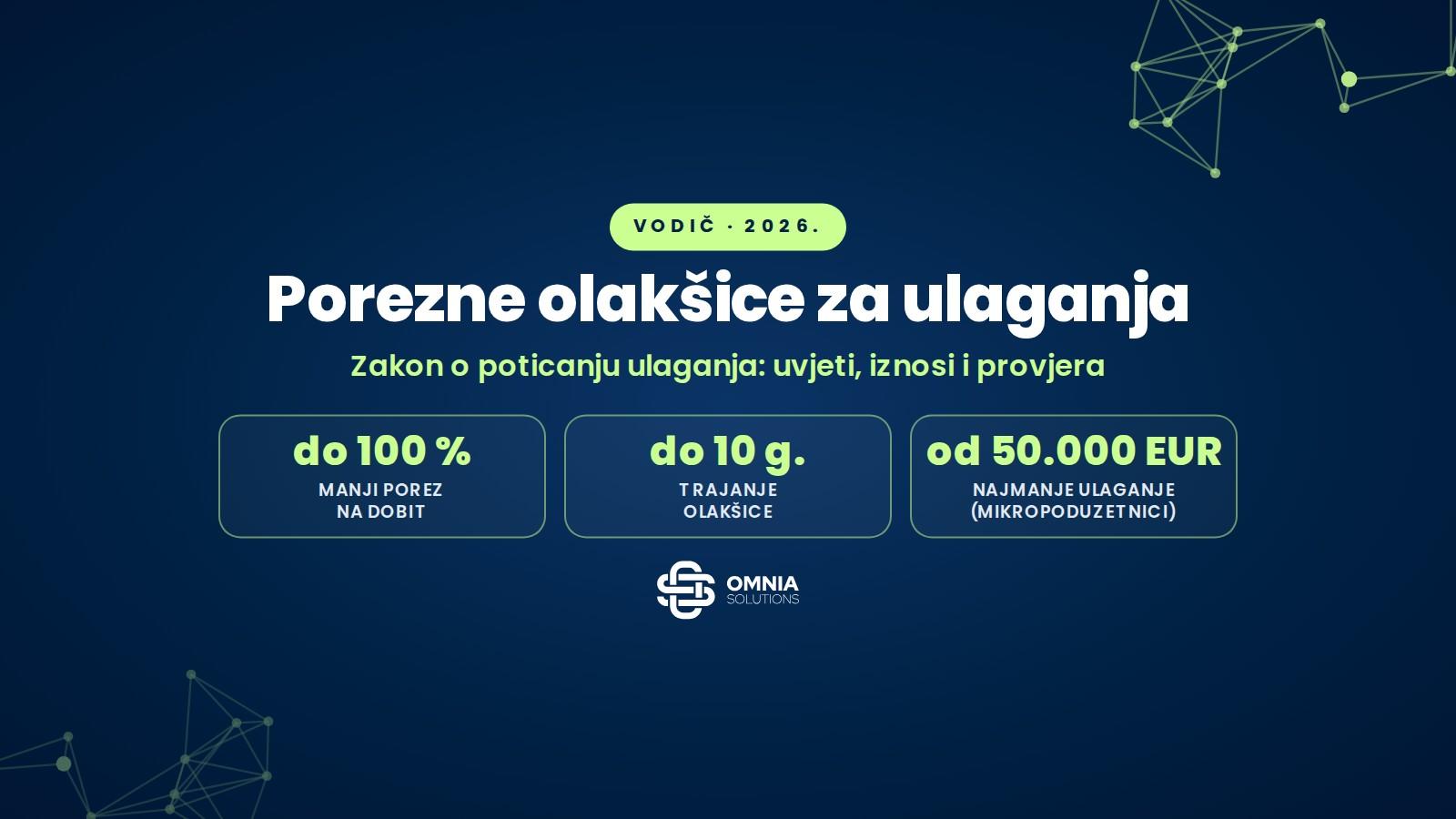
Tax incentives for investment in Croatia are governed by the Investment Promotion Act (Zakon o poticanju ulaganja). An entrepreneur investing in manufacturing, development and innovation, IT or another eligible activity can pay 50, 75 or 100% less corporate income tax for up to 10 years and qualify for a grant for each new job. The basic condition is an investment of at least EUR 150,000 with five new jobs, or EUR 50,000 with three for micro-enterprises. Applications are accepted throughout the year and are not scored, as only compliance with the conditions is checked. The application must be submitted before the investment starts.
This guide covers all conditions under the Investment Promotion Act (Official Gazette NN 63/22 and 136/24) and the Investment Promotion Regulation (Uredba o poticanju ulaganja, NN 156/22 and 148/25), with sample calculations and a list of activities that cannot use the incentives. The information was checked against the official texts on 20 October 2026. To check what this means for your investment, contact us.
Free introductory call
Can you use tax incentives for your investment?
Tell us what you plan to invest in and we will check which incentives and aid you can apply for. The introductory call is free. Email or call us.
In brief: tax incentives for investment in 2026
- How much: corporate income tax is reduced by 50% for up to 10 years for an investment of EUR 150,000 with 5 new jobs, by 75% from EUR 1 million with 10 jobs, and by 100% above EUR 3 million with 15 jobs.
- Micro-enterprises: from EUR 50,000 with 3 new jobs, with tax reduced by 50% for up to 5 years.
- Without new jobs: manufacturing companies that invest at least EUR 500,000 in automation, robotisation or digitalisation, while keeping their headcount and increasing productivity.
- Money for jobs: up to 10 or 20% of wage costs for two years, at most EUR 5,000 or 10,000 per job, depending on unemployment in the county. The highest level, up to EUR 15,000, applies where unemployment is above 10%, which no county had from January to September 2026.
- Who cannot use it: trade, tourism and hospitality, transport, construction and real estate, primary agriculture, finance and several other sectors. A separate regulation applies to tourism.
- The most important rule: the application is submitted through the e-Investicije system before the first binding order or the start of construction.
What the Investment Promotion Act is and who can use it
The Investment Promotion Act (the abbreviations ZPU and ZOPU are also used in practice) is a State regional aid programme aligned with EU State aid rules, namely Commission Regulation (EU) No 651/2014. It is implemented by the Ministry of Economy. Aid is granted to an entrepreneur who invests in long-term assets, for example in building a plant, machinery, equipment and software, and at the same time creates new jobs or modernises production.
The beneficiary can be:
- a company (d.o.o., j.d.o.o., d.d.) registered in Croatia;
- a sole proprietor (obrt) liable for corporate income tax. A sole proprietor who pays personal income tax can switch to corporate income tax by submitting a written request to the Tax Administration by the end of the year, for the following year, and in justified cases the Tax Administration may also approve a shorter deadline;
- a micro, small, medium-sized or large enterprise. Size is determined according to the EU definition, together with linked and partner enterprises.
Undertakings in difficulty and persons convicted by final judgment of economic crime cannot receive aid. Four groups of activities are eligible (Art. 5 and 16):
- manufacturing and processing activities, including food and beverage processing;
- development and innovation activities, that is, the development of new products and the significant improvement of existing products, production series, processes and technologies;
- business support activities: data centres, product engineering and design centres, contact centres, information technology and software development centres, and high-tech logistics and distribution centres for projects in the manufacturing industry;
- high value-added activities: creative services (architecture, design, media communication, advertising), production of batteries, solar panels, wind turbines, heat pumps, electrolysers and carbon capture and storage equipment, and industrial engineering services.
The investment must be an initial investment. This means a new establishment, an increase in the capacity of an existing establishment, the production of products the establishment has not produced before, or a fundamental change in the production process (Art. 6). A simple replacement of worn-out equipment does not qualify. Land, existing buildings, used equipment, assets bought from linked companies and investments in third-party assets are not eligible costs. The exception is that micro-enterprises using the incentive under Art. 12 may include used equipment up to five years old, provided it was not bought from linked companies and has not already received aid (Art. 7 of the Act and Art. 7 of the Regulation).
How much you can reduce corporate income tax
The incentive reduces the corporate income tax rate. That rate is 10% for entrepreneurs with annual revenue of up to EUR 1 million and 18% for others, so the rates with the incentive are as follows:
| Investment | New jobs within three years | Tax reduction | Duration | Rate instead of 10% | Rate instead of 18% |
|---|---|---|---|---|---|
| from EUR 50,000, micro-enterprises only (Art. 12) | at least 3 | 50% | up to 5 years | 5% | 9% |
| EUR 50,000 to 1 million, IT and software development centres (Art. 13) | at least 10 | 50% | up to 10 years | 5% | 9% |
| EUR 150,000 to 1 million (Art. 13) | at least 5 | 50% | up to 10 years | 5% | 9% |
| EUR 1 million to 3 million (Art. 13) | at least 10 | 75% | up to 10 years | 2.5% | 4.5% |
| more than EUR 3 million (Art. 13) | at least 15 | 100% | up to 10 years | 0% | 0% |
| from EUR 500,000, production modernisation (Art. 20) | not required, but the number of employees must not decrease | 50, 75 or 100%, according to the same investment amounts | up to 10 years | 5%, 2.5% or 0% | 9%, 4.5% or 0% |
Three more rules are important in practice:
- The incentive applies only to profit from the activity to which the investment relates. For projects starting on or after 1 January 2025, income from capital, rent, interest and intellectual property is excluded from that profit, and separate accounts are kept for the investment activity (Art. 12, 13 and 20 of the Act and Art. 7 of the Regulation).
- The incentive is used after the first year of the investment, provided that at least the prescribed minimum amount was invested in the first year. Each year, the reduction applied is the one for which the prescribed investment amount was reached in the previous year, so, for example, the 75% reduction is used only for the year after the one in which the total investment reached EUR 1 million. New jobs must be created within three years of the start of the investment (Art. 7 of the Regulation).
- The total amount of aid is capped. The sum of incentives and aid must not exceed the maximum permitted share of eligible investment costs for your region, so the incentive may end before the 10 years expire. The regional limits are shown in the table below.
Example: what the incentive is worth
A medium-sized manufacturing company from Varaždin County with revenue above EUR 1 million invests EUR 1.5 million in a new hall and machinery and creates 10 jobs. It is entitled to a 75% reduction in corporate income tax, so it pays 4.5% instead of 18% on the profit from the investment activity. If that activity generates EUR 400,000 of profit per year, the tax is EUR 18,000 instead of EUR 72,000, which is EUR 54,000 less every year.
For a medium-sized enterprise in Northern Croatia, the upper limit is 60% of eligible costs, that is, EUR 900,000 for an investment of EUR 1.5 million. This limit also includes aid for jobs and all other State aid for the same costs, and in the calculation future aid and costs are discounted to their present value (Art. 6, point 14). At EUR 54,000 per year, the incentive would amount to at most EUR 540,000 over ten years, which is below that limit. The actual amount depends on the year from which the incentive is used and how much has been invested by then.
Incentive without new jobs: production modernisation
Manufacturing and processing companies can receive the same incentive (50, 75 or 100% for up to 10 years) without hiring if they invest at least EUR 500,000 in modernisation to Industry 4.0 level (Art. 20). The conditions are:
- new equipment, machinery or software that is technologically more advanced than the assets being modernised, for example robots, automation and production management systems, and software for digitalisation, machine learning and artificial intelligence;
- the number of employees must not fall below the initial level, that is, the average for the 12 months before the investment starts;
- in the year after the three-year investment period, productivity per employee (total revenue divided by the average number of employees) must be at least 10% higher than in the year before the project application, otherwise the incentive is lost for the entire period and must be repaid with interest (Art. 20 of the Act and Art. 18 of the Regulation);
- for large enterprises, the cost of modernisation must exceed the depreciation of the assets being modernised in the three previous tax years;
- large enterprises in the City of Zagreb cannot use this incentive, because there they can receive aid only for an investment in a new economic activity.
Read about which solutions fall under Industry 4.0 in the article Industry 4.0, 5.0 and 6.0. For the same investments, it is also worth checking the HBOR (Croatian Bank for Reconstruction and Development) loan for production modernisation with a principal write-off of up to 50%, subject to the aid cumulation rules described below.
Aid for new jobs: how much per job in your county
In addition to the tax incentive, a grant is available for each new job linked to the investment. It is calculated as a percentage of wage costs for two years (gross salary plus contributions on salary), and the percentage and maximum amount depend on the registered unemployment rate in the county according to data from the Croatian Bureau of Statistics (DZS) valid on the date the investment starts (Art. 14).
| County unemployment rate | Aid | Maximum per job |
|---|---|---|
| up to 5% | up to 10% of wage costs for two years | EUR 5,000 |
| 5 to 10% | up to 20% of wage costs for two years | EUR 10,000 |
| more than 10% | up to 30% of wage costs for two years | EUR 15,000 |
According to DZS data, no county had an unemployment rate above 10% from January to September 2026. The highest rates were recorded in January, in Osijek-Baranja County (9.8%) and Virovitica-Podravina County (9.7%).
| Group | Counties | Rate from January to September 2026 |
|---|---|---|
| consistently 5 to 10% | Osijek-Baranja, Virovitica-Podravina, Vukovar-Srijem, Brod-Posavina, Sisak-Moslavina | 5.2 to 9.8% |
| depends on the month (above 5% at the start of the year, below it in summer) | Šibenik-Knin, Dubrovnik-Neretva, Split-Dalmatia, Lika-Senj, Požega-Slavonia, Zadar, Bjelovar-Bilogora | 2.5 to 8.3% |
| consistently up to 5% | City of Zagreb, Zagreb, Krapina-Zagorje, Varaždin, Koprivnica-Križevci, Međimurje, Karlovac, Primorje-Gorski Kotar, Istria | 1.0 to 4.0% |
In the counties of the middle group, the rate rises above 5% and falls below it during the year, and the rate valid on the date the investment starts is the one that counts. It should therefore be checked before the first order. Sisak-Moslavina County is also close to the threshold, with a rate of 5.3% in September 2026.
Sample calculation
If the wage cost of a new worker including contributions (gross 2) is EUR 2,000 per month, it amounts to EUR 48,000 over two years. In Varaždin County the aid is 10% of that amount, or EUR 4,800, and in Osijek-Baranja County 20%, or EUR 9,600.
Full amount or 80%
The full amount is approved if you hire people from these groups (Art. 9 of the Regulation):
- persons registered as unemployed for at least six months;
- persons over 50 years of age registered as unemployed;
- persons without work experience registered as unemployed with the Croatian Employment Service;
- persons whose employment contract was terminated because bankruptcy proceedings were opened.
For other new workers, 80% of the amount is approved, which in the Varaždin County example is EUR 3,840 and in the Osijek-Baranja County example EUR 7,680 per job. Until December 2025, this share was 40%.
- Payment: at the earliest after the first year from the creation of the jobs, with an employment contract of at least 12 months and payroll statements for 12 months.
- What does not count: hiring from linked companies, or persons who worked for you or for a linked company in the last six months.
- Retention: each new job must be kept for three years from when it is first filled (micro, small and medium-sized enterprises) or five years (large enterprises), and when combined with the tax incentive, for no less than the period in which the incentive is used.
- Budget: grants are paid up to the amount provided for this purpose in the State budget for each year (Art. 21).
- Higher amounts: for development and innovation activities and production for a climate-neutral economy, the aid is 50% higher; for business support, creative services and industrial engineering, 25% higher; and for projects with 100, 300 or 500 new jobs, 25, 50 or 100% higher (Art. 16 and 18).
- Training: up to 50% of the costs of training new workers can be covered (medium-sized enterprises up to 60%, small and micro-enterprises up to 70%; for workers with disabilities 10 percentage points more, but at most 70%), up to a maximum of half of the aid for jobs (Art. 15).
Other aid under the Act
- Equipment for development and innovation: up to 20% of the cost of new high-tech equipment, at most EUR 500,000 (Art. 16).
- Capital costs: for manufacturing investments of at least EUR 5 million with 50 new jobs (30 for micro, small and medium-sized enterprises). In counties with unemployment of 5 to 10%, the aid is 10% of the cost of the factory and new machinery, at most EUR 1 million, and above 10% it is 20%, at most EUR 2 million. Machinery and equipment must account for at least 40% of the investment, and at least half of it must be high-tech (Art. 17).
- Inactive State property: for investments of at least EUR 3 million with 15 new jobs, inactive State land or buildings can be leased free of charge for up to 10 years (in more developed areas only after unsuccessful public tenders for their sale), with an obligation to invest in that property at least 50% of its appraised value (Art. 19).
How much in total: the regional aid ceiling
All aid for the same investment, including tax incentives, aid for jobs and aid from other sources, must not together exceed the maximum aid intensity from the regional aid map for 2022–2027 (Art. 9 and 10). The intensity is the share of aid in the eligible investment costs.
| Region | Counties | Large enterprise | Medium-sized | Small and micro |
|---|---|---|---|---|
| City of Zagreb | City of Zagreb | 35% | 45% | 55% |
| Northern Croatia | Međimurje, Varaždin, Koprivnica-Križevci, Krapina-Zagorje, Zagreb | 50% | 60% | 70% |
| Pannonian Croatia | Bjelovar-Bilogora, Virovitica-Podravina, Požega-Slavonia, Brod-Posavina, Osijek-Baranja, Vukovar-Srijem, Karlovac | 50% | 60% | 70% |
| Sisak-Moslavina County | Sisak-Moslavina | 60% | 70% | 75% |
| Adriatic Croatia | Primorje-Gorski Kotar, Lika-Senj, Zadar, Šibenik-Knin, Split-Dalmatia, Istria, Dubrovnik-Neretva | 40% | 50% | 60% |
- For a large enterprise in the City of Zagreb, aid can be granted only for an initial investment in a new economic activity.
- The annual amount of aid per beneficiary can be at most EUR 7 million.
- The beneficiary must finance at least 25% of eligible costs from its own resources or through external financing free of any State aid.
Who cannot use the Act
Under the Act, regional aid and training aid cannot be granted in these sectors (Art. 10):
- trade;
- tourism, including the provision of accommodation and food and beverage service activities;
- transport and storage and related infrastructure;
- construction and real estate;
- primary agricultural production, fisheries and aquaculture;
- energy generation and distribution and energy infrastructure;
- finance and insurance;
- health, social care and education;
- water management, waste management and environmental remediation;
- mining and quarrying;
- steel, coal, synthetic fibres and shipbuilding (except small shipbuilding, under Art. 2 of the Regulation);
- broadband networks and research infrastructures.
Export-related aid and aid that favours domestic over imported goods are also excluded. Processing of agricultural products is generally eligible, unless the amount of aid is fixed on the basis of the price or quantity of products purchased from primary producers.
Tourism and hospitality: a separate regulation
Since the amendments to the Act in November 2024, tourism has been excluded from the Investment Promotion Act. Investment in tourism is promoted by the Regulation on Investment Promotion in the Tourism Sector (Uredba o poticanju ulaganja u sektoru turizma, NN 39/24), implemented by the Ministry of Tourism and Sport. It provides for a reduction in corporate income tax of 50% (from EUR 150,000 with 5 new jobs), 75% (from EUR 1 million with 10) or 100% (from EUR 3 million with 15), for up to 10 years. For reconstruction and new construction that meet the prescribed energy criteria, 3, 6 or 10 new jobs respectively are sufficient.
- hotels, aparthotels, tourist resorts and campsites of at least four stars;
- heritage hotels and dispersed hotels created by renovating cultural and historical heritage;
- ancillary facilities, for example health, congress, nautical, cultural or sports and recreation facilities;
- nautical tourism of at least four anchors;
- tourism and hospitality facilities in amusement and theme parks, and stand-alone tourism infrastructure (e.g. congress or sports and recreation facilities), with an investment of at least EUR 4 million;
- restaurants, inns, bistros, taverns, konobas and wine cellars (kleti) in certain categories of the tourism development index, with an investment of at least EUR 1 million.
The facility must operate for at least six months a year, and the application is submitted before works begin. For the period from 2024 to 2026, the Regulation provides EUR 100 million, and aid is granted until the deadline set by the General Block Exemption Regulation (GBER), so for investments after 2026 it should be checked whether its application will be extended.
Free introductory call
Which incentives and aid can you apply for with your investment?
Send us the investment amount, the county and the number of new jobs, and we will check the conditions with you. The introductory call is free. Email or call us.
When it is too late: the start of the investment
The application is submitted before the investment project starts (Art. 22), and costs incurred before the application are not recognised (Art. 6 of the Regulation). The start of the investment is whichever of the following occurs first:
- the start of construction works, according to the date of the notification of the start of construction;
- the first legally binding commitment, for example an equipment order or another contract that makes the investment irreversible.
Buying land, obtaining permits and feasibility studies are not considered the start of the investment. You can collect quotes and pro forma invoices, but the order, contract or advance payment should wait until after the application. The investment is carried out within three years of its start. All investments by the same beneficiary, at group level, started within three years of the start of the aided project are considered part of the same project.
How to apply: step by step
- Eligibility check: activity, company size, investment amount, number of new jobs and region.
- Five-year business plan with a projected balance sheet and profit and loss account, for the whole company and separately for the investment activity, together with forms OP-1 to OP-8 and the joint statement.
- Construction documents: a final building permit or confirmation of the main design, and the notification of the start of construction. If construction starts in the second or third year of the project, they can be submitted later, but before construction starts.
- Submission through the Ministry of Economy’s e-Investicije system, before the investment starts.
- Certificate of aid beneficiary status: the Ministry issues it within 60 days of a complete application or, within the same period, informs you that the conditions are not met.
- Implementation: investment and hiring within three years, with annual reports.
Obligations after obtaining the status
- Annual report: form GI-1, and for projects from 1 January 2025 also forms GI-2 and GI-3-ZPU-POPP and an overview of the separate accounts. It is submitted together with the corporate income tax return and to the Ministry of Economy by 30 April at the latest for the previous year, until the end of the retention period.
- Retention of the investment and jobs: the investment must be retained for three years after completion (micro, small and medium-sized enterprises) or five years (large enterprises), and each new job for three or five years respectively from when it is first filled. In neither case for less than the period in which the aid is used (Art. 6, point 12).
- Repayment: if the conditions are not met, incentives and aid are repaid increased by the base reference rate plus 100 basis points, and the Ministry’s notice is an enforceable document.
- Security instrument for grants: a blank promissory note (bjanko zadužnica) for amounts below EUR 500,000 and a bank guarantee for EUR 500,000 and above.
- The fine for failing to submit the annual report ranges from EUR 13,270 to 66,360 for a legal person, and without a justified reason the aid beneficiary status is also lost.
- Public disclosure: individual aid above EUR 100,000 is published on the State aid website.
What changed from 2024 to 2026
- November 2024 (NN 136/24): higher aid per job (EUR 5,000, 10,000 and 15,000 instead of EUR 3,000, 6,000 and 9,000) with lower unemployment thresholds (5 and 10% instead of 10 and 15%); tourism excluded; higher aid for capital costs (up to EUR 1 million and 2 million instead of EUR 500,000 and EUR 1 million) with 30 instead of 50 jobs for micro, small and medium-sized enterprises; investments in third-party assets no longer eligible. The changes apply to projects starting on or after 1 January 2024, and the rule on profit only from the investment activity applies to projects from 1 January 2025.
- December 2025 (NN 148/25): applications exclusively electronic, a business plan with a separate projection for the investment activity, new forms GI-2 and GI-3-ZPU-POPP, and 80% instead of 40% of aid for workers outside the special groups.
- 2026: according to a search of the Official Gazette (Narodne novine) on 20 October 2026, there are no new amendments. The European Commission plans to adopt new State aid block exemption rules (GBER) applying from January 2027, so amendments to the Act are possible. We will update this guide then.
Outdated information you will still find online
Information that is no longer valid can still be found online, including in the answers of AI assistants. The most common examples are:
- EUR 3,000, 6,000 or 9,000 per job: this applied until the 2024 amendments. Today the amounts are EUR 5,000, 10,000 or 15,000, and the unemployment thresholds are 5 and 10%.
- Act on the Promotion of Investment and Improvement of the Investment Environment (Zakon o poticanju investicija i unapređenju investicijskog okruženja): this is the 2012 act. It was replaced by an act from 2015, which was in turn replaced by the 2022 Investment Promotion Act, valid today with the 2024 amendments.
- Four-star hotels under this Act: since the 2024 amendments, tourism falls under the separate tourism regulation.
- Incentive on the company’s entire profit: for projects from 1 January 2025, the incentive applies only to profit from the investment activity.
- 40% aid for workers outside the special groups: since December 2025, it is 80%.
- Incentive for micro-enterprises without new jobs: micro-enterprises need at least three new jobs. Without hiring, the incentive is available only to a manufacturing company that invests at least EUR 500,000 in modernisation.
- Amounts in kuna: these refer to the period before the introduction of the euro; the Act now sets amounts in euros.
Combining with HBOR and HAMAG-BICRO loans and EU aid
The incentives under the Act can be combined with other sources of investment financing, subject to the State aid cumulation rules (Art. 7 and 10):
- Different costs: aid for different eligible costs can be combined.
- The same costs: the total of all aid for the same costs, for example tax incentives, grants from EU calls and the aid contained in a favourable loan or principal write-off, must not exceed the maximum intensity for the region.
- Own contribution: at least 25% of eligible costs must be financed without State aid, for example from own funds or with a loan on market terms.
- De minimis aid must not lead to the maximum intensity for the same costs being exceeded.
That is why the financing structure should be put together before the application. For an overview of loans with a principal write-off and lower interest rates, read the guide HBOR loans for entrepreneurs 2026; for loans for smaller investments from HAMAG-BICRO (Croatian Agency for SMEs, Innovations and Investments), see the page HAMAG-BICRO loans; and for grants, see the guide Grants and EU funds for entrepreneurs.
How Omnia Solutions can help you
Omnia Solutions is a Zagreb consultancy specialising in EU funds and favourable loans. For tax incentives for investment, we help you with every step:
- eligibility check and choice of measure, that is, the incentive linked to hiring or the incentive for modernisation;
- planning the start of the investment, so that orders and contracts do not precede the application;
- the five-year business plan with a projection for the investment activity, and the application forms;
- submitting the application in the e-Investicije system and communication with the Ministry of Economy;
- structuring the financing with HBOR and HAMAG-BICRO loans and EU aid, within the limits of the aid cumulation rules;
- monitoring obligations during implementation.
The scope of our service, from the initial screening to the annual reports, is described on the page Tax incentives for investment: advisory and application. The first consultation is free. Read more about loans on the page HBOR loans: advice and application preparation.
Frequently asked questions about tax incentives for investment
What is the Investment Promotion Act?
The Investment Promotion Act (NN 63/22 and 136/24) is a State regional aid programme through which the State promotes investment in manufacturing, development and innovation, business support and high value-added activities. For entrepreneurs who invest and create new jobs or modernise production, it allows lower corporate income tax for up to 10 years, as well as grants for new jobs and training. It is implemented by the Ministry of Economy.
How much do I need to invest to qualify for the tax incentive?
At least EUR 150,000 with 5 new jobs. Micro-enterprises can qualify from EUR 50,000 with 3 new jobs, IT and software development centres from EUR 50,000 with 10, and manufacturing companies that modernise production from EUR 500,000 without new jobs.
By how much is corporate income tax reduced?
By 50% for investments of EUR 150,000 to 1 million with 5 new jobs, by 75% for investments of EUR 1 million to 3 million with 10, and by 100% above EUR 3 million with 15, for up to 10 years. With an 18% rate, this means 9%, 4.5% or 0%, and with a 10% rate, 5%, 2.5% or 0%. The incentive applies to profit from the investment activity.
How much is the aid per new job?
Up to 10% of wage costs for two years and at most EUR 5,000 in counties with unemployment of up to 5%, up to 20% and at most EUR 10,000 with unemployment of 5 to 10%, and up to 30% and at most EUR 15,000 with unemployment above 10%. The full amount is approved for hiring long-term unemployed persons and other prescribed groups registered with the Croatian Employment Service (HZZ), and 80% for other workers.
Can a sole proprietorship use tax incentives for investment?
Yes, if it is liable for corporate income tax. A sole proprietorship that pays personal income tax, including a flat-rate sole proprietorship, must switch to the corporate income tax system before applying, which is possible by submitting a written request to the Tax Administration by the end of the year, for the following year. In justified cases, the Tax Administration may also approve a shorter deadline.
Which activities cannot use the Act?
Trade, tourism and hospitality, transport and storage, construction and real estate, primary agriculture, fisheries and aquaculture, energy, finance and insurance, health, social care and education, water management and waste, mining, steel, coal, synthetic fibres, shipbuilding except small shipbuilding, and broadband networks and research infrastructures.
Can I qualify for an incentive for investing in a hotel, campsite or restaurant?
Not under the Investment Promotion Act, but you can under the Regulation on Investment Promotion in the Tourism Sector, implemented by the Ministry of Tourism and Sport. It provides for a reduction in corporate income tax of 50 to 100% for up to 10 years, for example for hotels and campsites of at least four stars and for restaurants in certain tourism development categories with an investment of at least EUR 1 million.
When is the application submitted?
Before the investment starts, that is, before the start of construction works and before the first legally binding equipment order, whichever comes first. Costs incurred before the application are not recognised. Buying land, permits and feasibility studies are not considered the start of the investment.
How is the application submitted and how long does approval take?
The application is submitted electronically through the Ministry of Economy’s e-Investicije system, together with a five-year business plan and the prescribed forms. Applications are accepted throughout the year. The Ministry issues the certificate of aid beneficiary status within 60 days of a complete application.
Can the incentive be combined with an HBOR loan or an EU call?
Yes, but the total of all aid for the same costs must not exceed the maximum aid intensity for the region, from 35% for large enterprises in the City of Zagreb to 75% for small enterprises in Sisak-Moslavina County. At least 25% of eligible costs must be financed without State aid.
What if I do not create enough jobs?
If the condition on jobs or on retaining the investment is not met, the right to the incentive ends for the entire period, and the incentives and aid already used must be repaid increased by the base reference rate plus 100 basis points.
Does the incentive apply to the company’s entire profit?
Not for projects starting on or after 1 January 2025. The incentive applies only to profit from the activity to which the investment relates, excluding income from capital, rent, interest and intellectual property, and separate accounts are kept for that activity.
Planning an investment in 2026 or 2027?
The application must be submitted before the first order or the start of construction. Check in good time which incentives and aid you can use, free of charge and with no obligation.
Sources
- Investment Promotion Act, NN 63/22 and Act on Amendments, NN 136/24
- Investment Promotion Regulation, NN 156/22 and Regulation on Amendments, NN 148/25
- Regulation on Investment Promotion in the Tourism Sector, NN 39/24 and Ministry of Tourism and Sport: Investment promotion in tourism
- Ministry of Economy: Investment aid and e-Investicije system
- DZS: Persons in employment by sex and county in 2026, first quarter and second quarter
- European Commission: regional aid map for Croatia 2022–2027 and amendment for Sisak-Moslavina County
- Tax Administration: corporate income tax
- Herbert Smith Freehills: draft new General Block Exemption Regulation (17 March 2026)
The conditions are summarised from the official texts as of 20 October 2026 and may change. The regulations in force and the decision of the Ministry of Economy prevail.