Status on 4 November 2026, based on the Eurostat and Croatian Bureau of Statistics flash inflation estimates for October 2026 and the terms of HBOR and HAMAG-BICRO programmes.
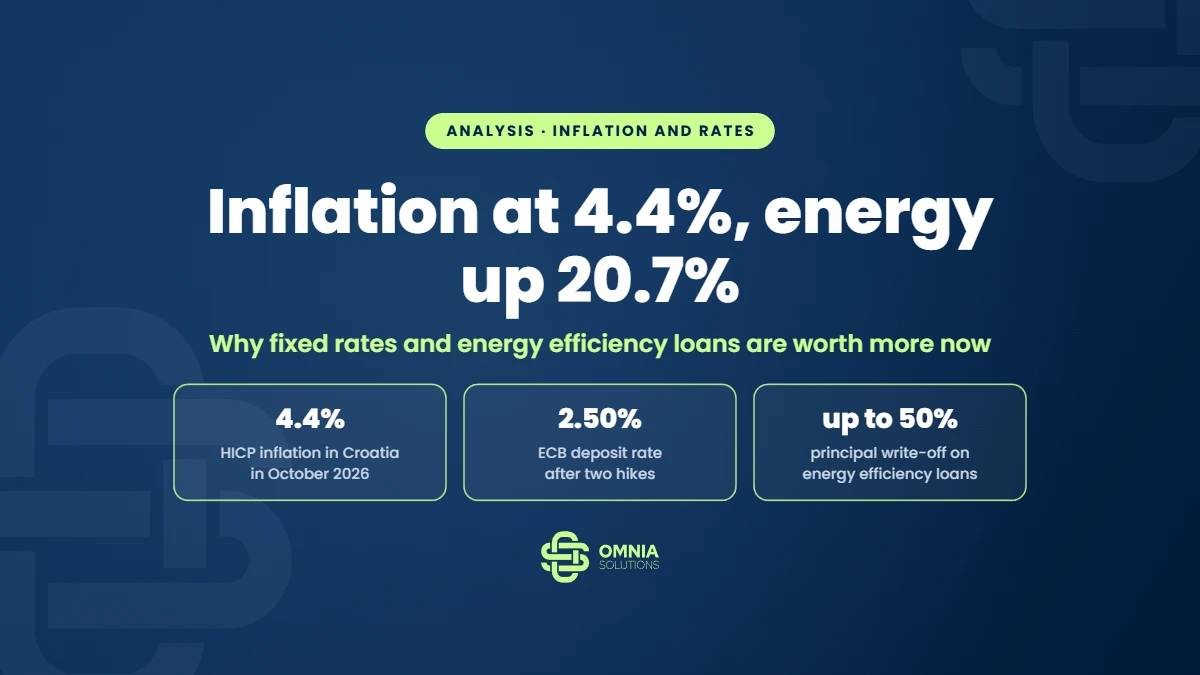
Euro area inflation rose to 4.0% in October according to Eurostat’s flash estimate, the highest since September 2023. In Croatia the Harmonised Index of Consumer Prices rose by 4.4% and the national consumer price index by 4.9%. Energy rose the most, by 20.7% in a year. The European Central Bank has raised interest rates twice this year, and markets expect another hike in December. For businesses this means more expensive bank loans and higher energy bills. Fixed rates from HBOR and HAMAG-BICRO and loans with half the amount interest-free are now worth more than at the start of the year, and the HBOR energy efficiency loan lowers both costs.
Summary
- According to the flash estimates for October 2026, inflation was 4.0% in the euro area and 4.4% in Croatia (HICP). The national consumer price index rose by 4.9%.
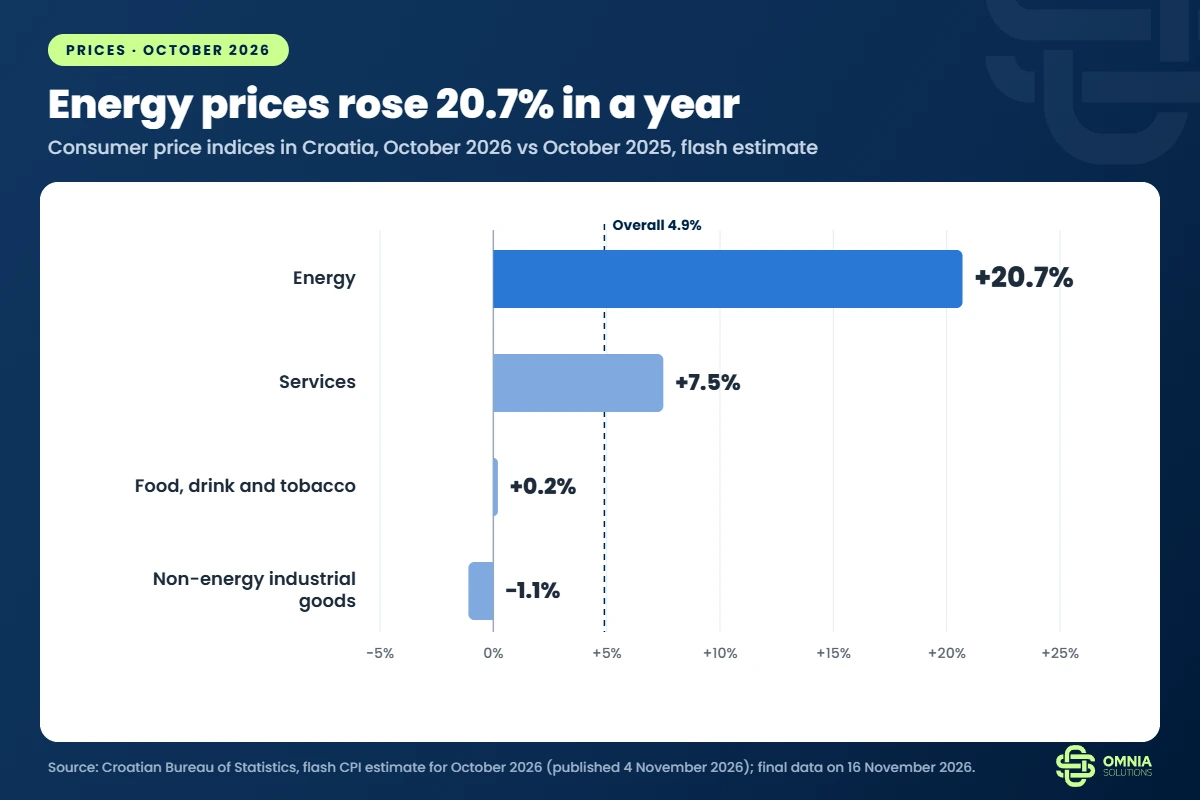
- In Croatia energy prices rose by 20.7%, services by 7.5% and food, drink and tobacco by 0.2%.
- The ECB raised its deposit rate from 2.00% to 2.25% in June and to 2.50% in September, and kept it unchanged on 29 October. Markets expect another hike in December.
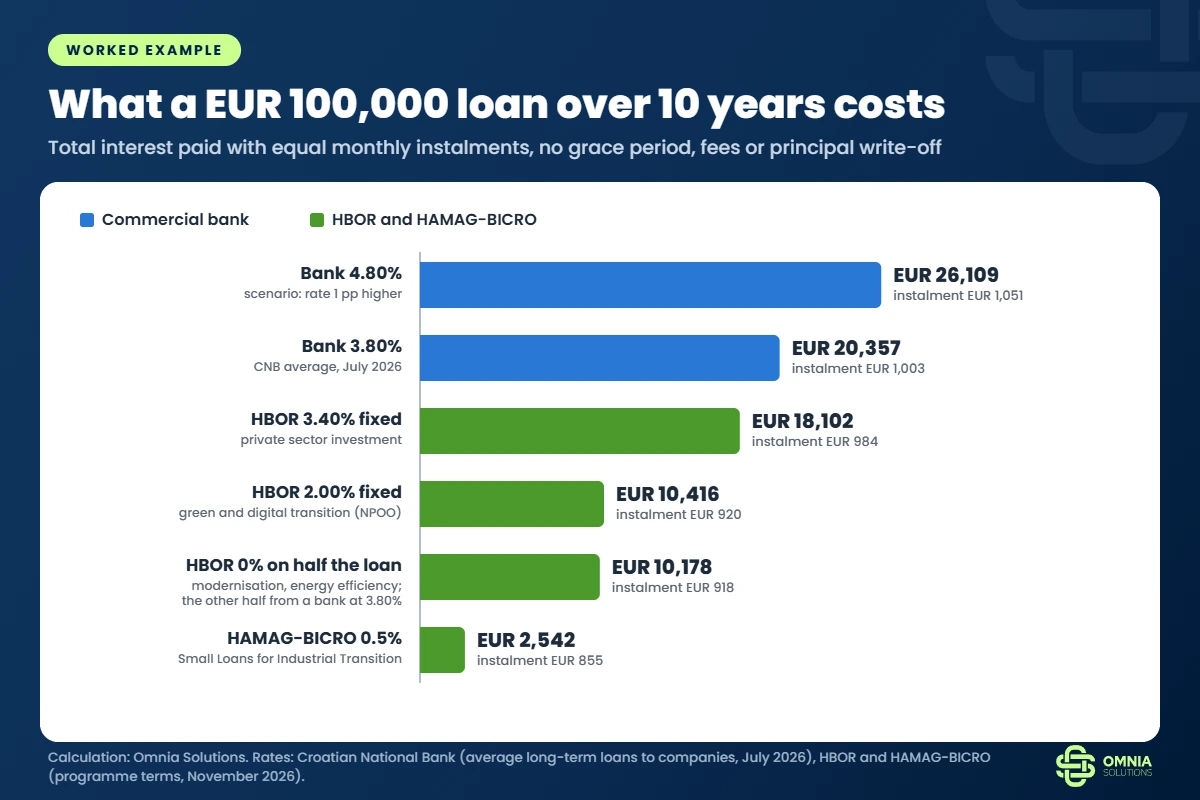
- On a EUR 100,000 loan over 10 years, a bank loan at 3.80% costs EUR 20,357 in interest and an HBOR loan at 2.00% fixed EUR 10,416. A HAMAG-BICRO small loan at 0.5% costs EUR 2,542 in interest.
- The HBOR energy efficiency loan goes up to EUR 3,000,000, half of it from the ERDF at 0%, and up to 50% of the principal can be written off based on the energy savings achieved.
Sources: 10, listed at the end · How we check our information · Report an error
Inflation in October: Croatia and the euro area
Eurostat published its flash estimate for October on 4 November 2026. Euro area annual inflation rose from 3.8% in September to 4.0%. Energy was 20.8% more expensive than a year earlier, services 3.3%, food, alcohol and tobacco 1.6% and non-energy industrial goods 1.2%. Core inflation, excluding energy, food, alcohol and tobacco, stayed at 2.5%.
Croatia has been above the euro area average throughout 2026. The Harmonised Index of Consumer Prices (HICP) rose by 3.6% in January, reached 5.4% in April, fell to 3.6% in July and stood at 4.4% in October according to the DZS flash estimate. The gap to the euro area was 2.4 percentage points in April and 0.4 points in October.
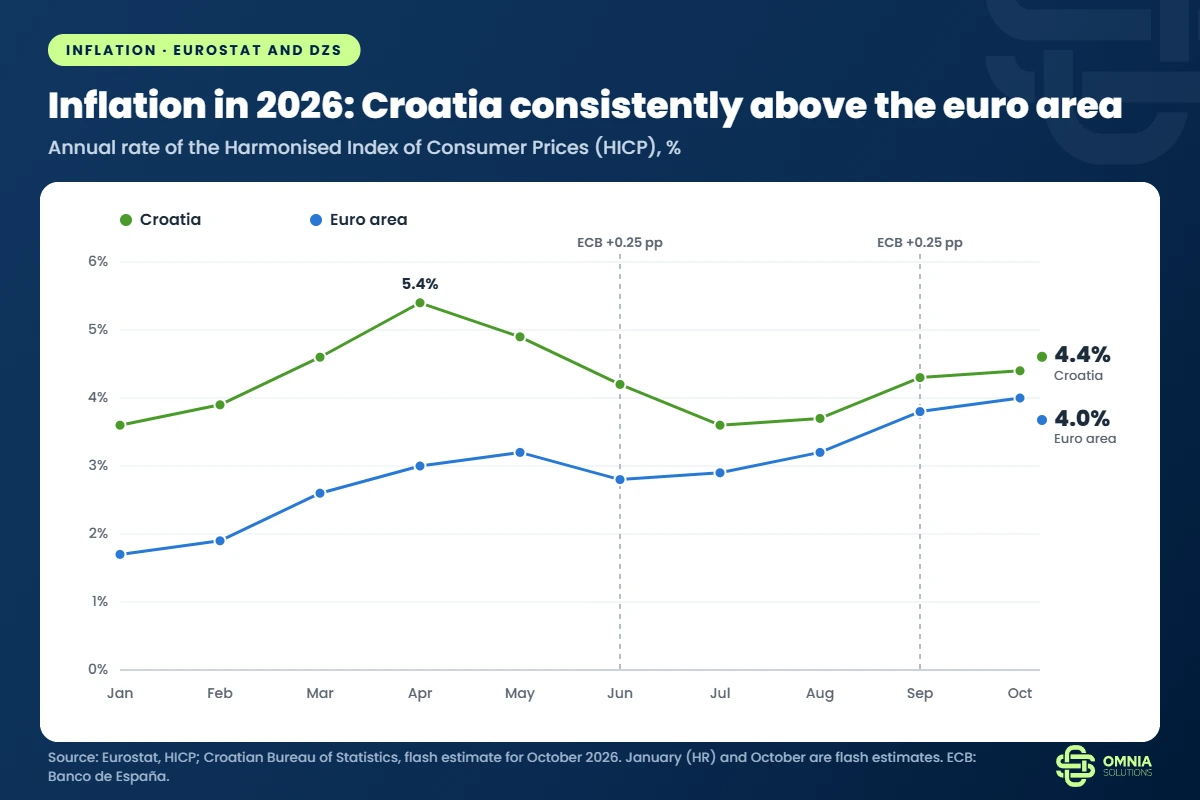
The HICP is comparable across member states and is the basis for comparison with the euro area. The national consumer price index (CPI), calculated by the DZS under its own methodology, rose by 4.9% in October. The two indices differ in coverage and weights.
What is getting more expensive: energy and services
According to the DZS flash estimate, energy in October was 20.7% more expensive than a year earlier and services 7.5%. Food, drink and tobacco rose by 0.2%, while non-energy industrial goods fell by 1.1%. Compared with September, non-energy industrial goods (2.2%) and energy (1.2%) rose the most. The DZS will publish final data on 16 November 2026.
Businesses face higher bills for electricity, gas and fuel, and the services they buy, from transport to maintenance, are also more expensive. How industrial energy prices in Croatia compare with the EU is shown in our analysis Industrial electricity and gas prices.
Interest rates are rising: what the ECB has done
On 11 June 2026 the ECB raised its deposit rate from 2.00% to 2.25%, and on 10 September 2026 to 2.50%. At its meeting on 29 October it kept rates unchanged, with President Christine Lagarde noting that the Governing Council had also discussed another increase. According to Euronews, markets put the probability of a 0.25 percentage point hike at the 16–17 December meeting at about 84%.
With a variable-rate loan linked to Euribor, higher reference rates feed into the instalment at the next rate reset. According to the Croatian National Bank (CNB), the average rate on new long-term loans to companies was 3.80% in July 2026, 0.24 percentage points higher than a year earlier. A fixed-rate loan does not follow that change.
What a EUR 100,000 loan costs from a bank, HBOR and HAMAG-BICRO
We compared the total interest on a EUR 100,000 loan repaid over 10 years in equal monthly instalments. The calculation does not include a grace period, fees or principal write-offs, so for programmes with a write-off the actual cost can be much lower. For the bank loan we used the CNB average of 3.80% and a scenario in which the rate is one percentage point higher for the whole period.
| Source of the loan | Rate | Monthly instalment | Total interest |
|---|---|---|---|
| Commercial bank, scenario with a rate 1 pp higher | 4.80% | EUR 1,051 | EUR 26,109 |
| Commercial bank, CNB average for July 2026 | 3.80% | EUR 1,003 | EUR 20,357 |
| HBOR, Private sector investment | 3.40% fixed | EUR 984 | EUR 18,102 |
| HBOR, green and digital transition (NPOO) | 2.00% fixed | EUR 920 | EUR 10,416 |
| HBOR, programme with 0% on half the loan (other half from a bank at 3.80%) | 0% and 3.80% | EUR 918 | EUR 10,178 |
| HAMAG-BICRO, Small Loans for Industrial Transition | 0.5% | EUR 855 | EUR 2,542 |
- If the bank rate were one percentage point higher for the whole period, from 3.80% to 4.80%, total interest would rise from EUR 20,357 to EUR 26,109 and the monthly instalment from EUR 1,003 to EUR 1,051.
- HBOR’s Private sector investment programme at 3.40% fixed is close to today’s bank average, but the rate stays the same if the ECB keeps raising rates.
- Programmes with half the loan from the ERDF at 0% (production modernisation, energy efficiency, sustainable tourism, processing of agricultural products) and NPOO programmes at 2.00% fixed cost about half as much interest as the bank average. The first group also allows a write-off of 40% or 50% of the principal.
- HAMAG-BICRO’s Small Loans for Industrial Transition at 0.5% to 1.5% are among the cheapest sources for investments of up to EUR 100,000 outside the City of Zagreb. Applications open on 20 November 2026 at 8:00.
You can calculate the cost of an HBOR loan and a bank loan for your own amount and term in our HBOR loan calculator, and we compare all programmes in HAMAG-BICRO loans and HBOR loans 2026.
Energy up 20%: how to finance savings
When energy prices rise by 20%, every kilowatt-hour saved is worth 20% more than a year earlier, so an investment in savings pays back faster. For a company that spends EUR 100,000 a year on energy, a 20% price rise means EUR 20,000 more in annual costs. An investment that cuts consumption by 30% saves EUR 36,000 a year at the new prices.
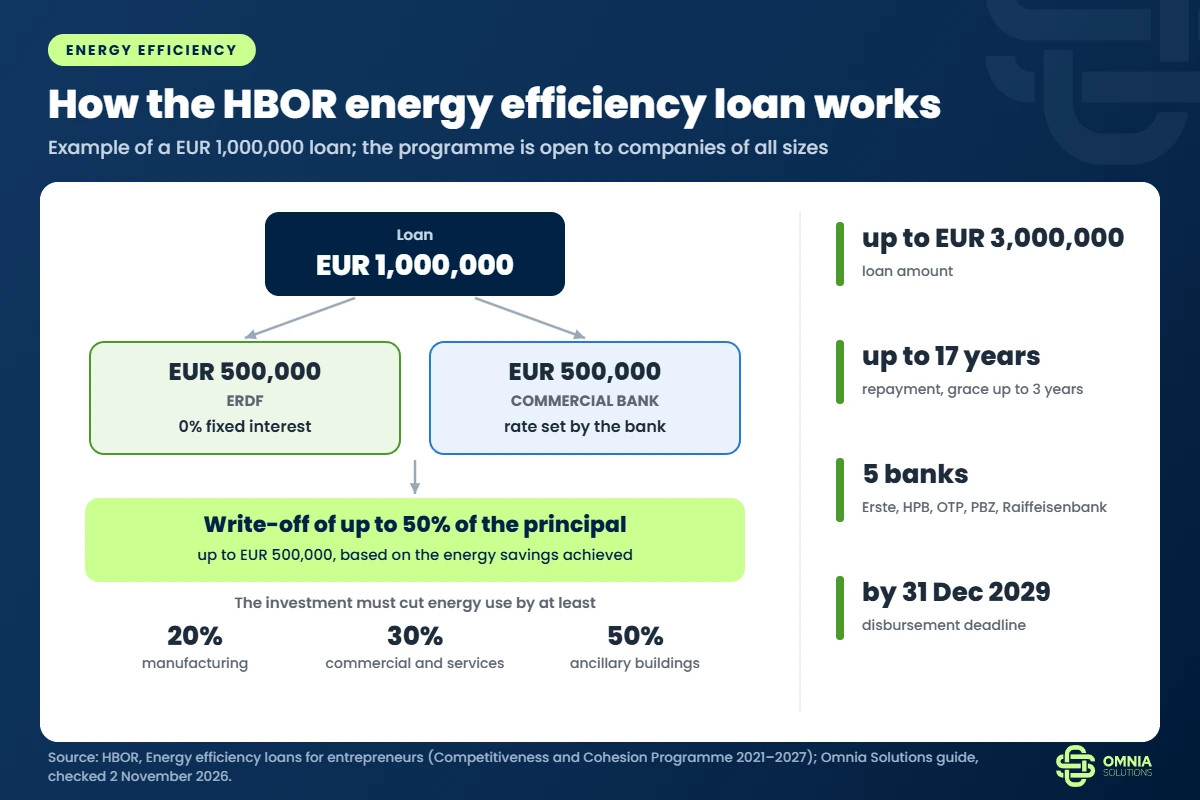
HBOR’s energy efficiency loan for entrepreneurs is funded from the Competitiveness and Cohesion Programme 2021–2027. Loans go up to EUR 3,000,000. Half is financed by the European Regional Development Fund (ERDF) at 0% fixed and the other half by a commercial bank on its own terms. Repayment runs for up to 17 years with a grace period of up to 3 years, and once the criteria are met up to 50% of the disbursed principal can be written off, depending on the energy savings achieved.
- Companies of any size in manufacturing and in the commercial and service sectors, registered for at least one year, can apply.
- The investment must cut energy use by at least 20% in manufacturing, 30% in the commercial and service sectors and 50% for ancillary buildings.
- Applications go through Erste, HPB, OTP, PBZ or Raiffeisenbank, not directly to HBOR. The loan must be disbursed by 31 December 2029.
- Eligible investments could include a heat pump, a solar power plant for own consumption, more efficient machines and lighting or thermal insulation.
We describe the terms, a worked example and the most common mistakes in our guide HBOR energy efficiency loan 2026.
What businesses can do now
- Check how many of your loans carry a variable rate and when the rate resets.
- For new investments, compare HBOR and HAMAG-BICRO programmes with your bank’s offer in the HBOR loan calculator.
- If you are investing in production, look at the production modernisation loan with 0% on half the amount and a write-off of up to 50% of the principal.
- If energy is a large cost item, commission an energy audit and calculate the savings for the HBOR energy efficiency loan.
- If you are outside the City of Zagreb and on the list of mapped stakeholders, prepare an application for the Small Loans for Industrial Transition.
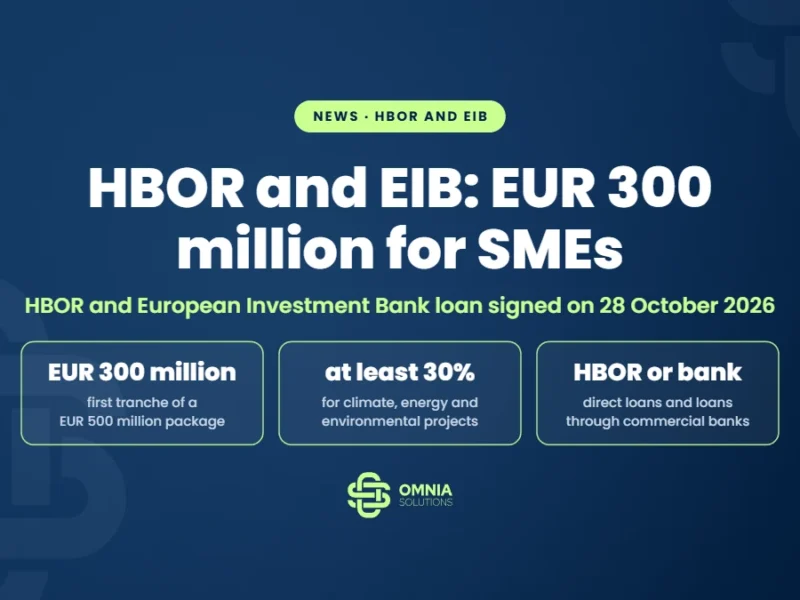
- Follow the terms of the new EUR 300 million from HBOR and the EIB, at least 30% of which is earmarked for green projects.
Frequently asked questions
What was inflation in Croatia in October 2026?
According to the flash estimate of the Croatian Bureau of Statistics (DZS), the Harmonised Index of Consumer Prices (HICP) rose by 4.4% and the national consumer price index by 4.9%. Euro area inflation was 4.0% according to Eurostat’s flash estimate. The DZS will publish final data for Croatia on 16 November 2026.
How much have energy prices risen?
According to the DZS flash estimate, energy in Croatia was 20.7% more expensive in October 2026 than a year earlier. In the euro area, energy prices rose by 20.8% according to Eurostat.
Will the ECB keep raising interest rates?
The ECB raised its deposit rate in June and September 2026, to 2.50%, and kept it unchanged on 29 October. Markets put the probability of a hike at the 16–17 December meeting at about 84%, but no decision has been taken.
Is an HBOR loan cheaper than a bank loan?
It depends on the programme. Private sector investment loans at 3.40% or 3.90% fixed are close to the bank average of 3.80%, but the rate does not change if the ECB raises rates. Programmes with 0% on half the loan and NPOO programmes at 2.00% save about EUR 10,000 in interest on a EUR 100,000 loan over 10 years compared with a bank loan at 3.80%, and some also offer a write-off of up to 50% of the principal.
Who can apply for the HBOR energy efficiency loan?
Companies of any size in manufacturing and in the commercial and service sectors, in the activity classes listed in the programme and registered for at least one year. The investment must cut energy use by at least 20% in manufacturing or 30% in the commercial and service sectors. Applications go through Erste, HPB, OTP, PBZ or Raiffeisenbank.

About the author
Matija Vlahovski, MSc in Economics
Co-founder and director of Omnia Solutions. He has more than 13 years of experience in business financing, mostly with HAMAG-BICRO loans, HBOR loans, investment studies and tax incentives. He has taken part in preparing and implementing more than 130 projects, through which clients were awarded more than EUR 20 million in grants and more than EUR 2 million in tax incentives. Before consulting, he worked at Privredna banka Zagreb, preparing loan proposals for small and medium-sized enterprises. He holds a HANFA licence.
Sources
- Eurostat, Euro area annual inflation up to 4.0% (4 November 2026)
- Eurostat, Annual inflation up to 3.8% in the euro area (16 October 2026)
- Eurostat, Annual inflation up to 2.9% in the euro area (19 August 2026)
- Financije.hr, October inflation accelerates to 4.9%, based on the DZS flash estimate (4 November 2026, in Croatian)
- Lider, January 2026 figures from the DZS and Eurostat’s flash estimate (11 February 2026)
- Euronews, Eurozone inflation hits 4%: Which countries saw prices jump the most? (4 November 2026)
- Banco de España, ECB raises rates by 25 basis points in June (11 June 2026) and the September decision (10 September 2026, in Spanish)
- Croatian National Bank, Interest rate statistics of credit institutions for July 2026 (31 August 2026)
- HBOR, Energy efficiency loans for entrepreneurs, Private sector investment, Green transition investment (NPOO) and Production modernisation loans (in Croatian)
- HAMAG-BICRO, Small Loans for Industrial Transition (in Croatian)
Fixed-rate loans and energy savings
Let us calculate how much your investment can save with an HBOR or HAMAG-BICRO loan
We will compare HBOR and HAMAG-BICRO programmes with your bank’s offer, check eligibility for loans with 0% on half the amount and a principal write-off, calculate the energy savings and prepare the documentation. The introductory call is free of charge.