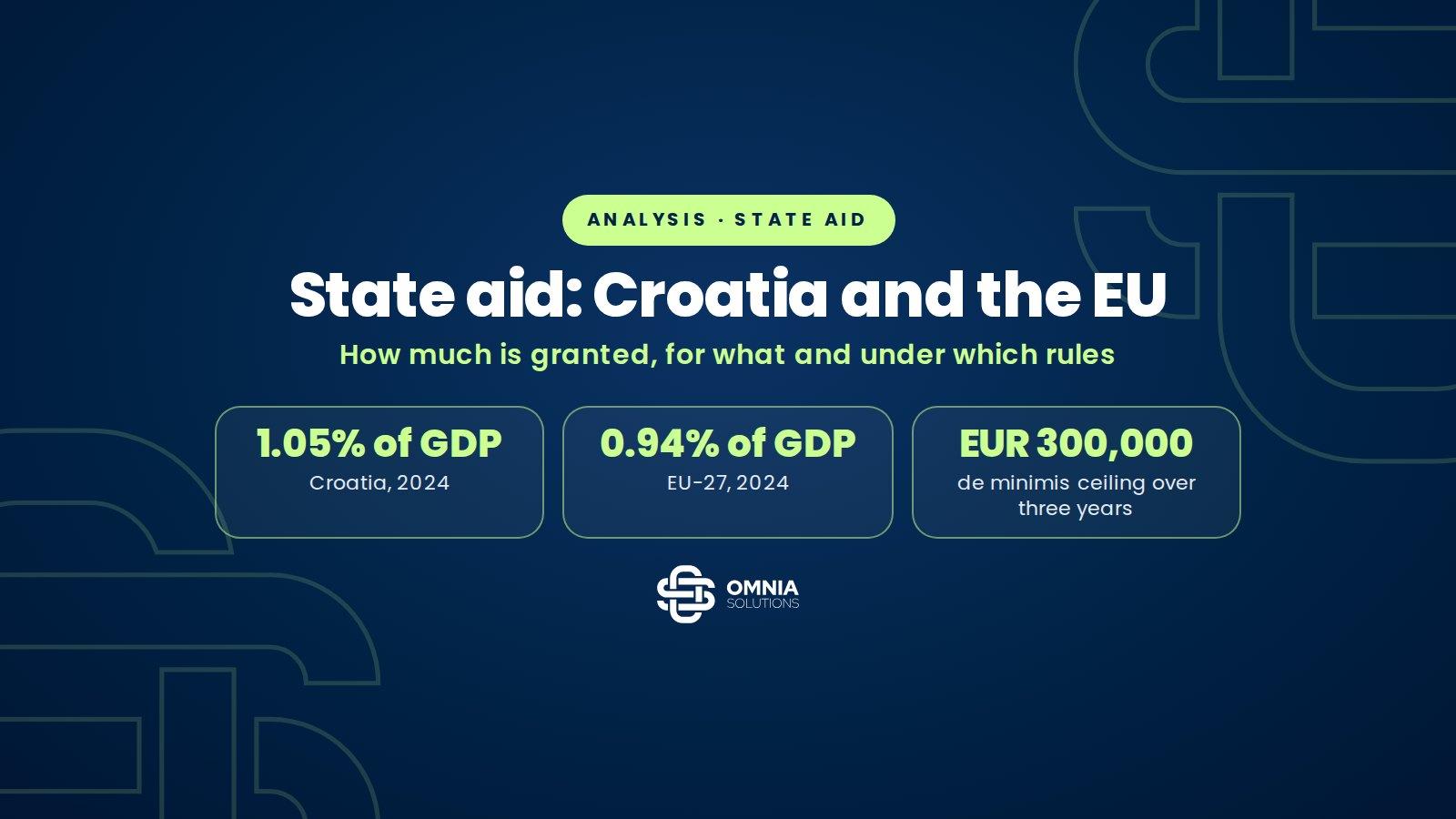
In 2024 Croatia spent 1.05% of gross domestic product (GDP) on state aid, against 0.94% for the EU as a whole, according to comparable European Commission data. A year earlier Croatia stood at 1.89%; the drop is mainly due to the end of crisis measures. The Ministry of Finance, which also counts public service compensation, puts aid at EUR 1,449.1 million, or 1.69% of GDP, plus EUR 205.7 million of de minimis aid. Compared with the EU, Croatia spends relatively more on sectoral and regional aid and on research and innovation, where at around 0.15% of GDP it ranks second in the EU. New block exemption rules are due to apply from 2027, and the de minimis ceiling is EUR 300,000 over three years.
State aid is any selective advantage that the state, a local authority or a public body gives certain companies from public resources, such as grants, soft loans, guarantees, tax relief or exemptions from contributions. EU law prohibits it in principle, except where it serves objectives the EU recognises and follows the rules. This analysis compares Croatia and the EU using two official sources, the European Commission’s State aid Scoreboard and the annual report of the Croatian Ministry of Finance, and explains the rules businesses need to know.
In brief
- According to the European Commission, Croatia spent 1.05% of GDP on state aid in 2024 and the EU-27 0.94% (EUR 168.23 billion).
- According to the Ministry of Finance, aid in Croatia amounted to EUR 1,449.1 million (1.69% of GDP). By our calculation, the difference is mainly explained by public service compensation in transport, broadcasting and postal services, worth EUR 612.9 million.
- Crisis aid for COVID-19 and the war in Ukraine fell in Croatia from EUR 1,110.2 million in 2022 to EUR 2.5 million in 2024.
- Croatia spends relatively more on sectoral development (22% of aid), regional development (19%) and research, development and innovation (14%). In the EU the largest objective is environmental protection and energy.
- According to the Ministry of Finance, 82.8% of aid was awarded as grants and 14% as tax relief.
- The rules are changing. Since 1 January 2026 de minimis aid must be recorded in a central register, and a new General Block Exemption Regulation is due to apply from 1 January 2027.
Key figures
State aid in Croatia and the EU, 2024
Sources: European Commission, State aid Scoreboard 2025 (2024 data, published 15 January 2026); Croatian Ministry of Finance, Report on State Aid for 2024 (December 2025); Regulation (EU) 2023/2831.
How much Croatia spends on state aid compared with the EU
Every year the European Commission publishes the State aid Scoreboard, which presents all member states using the same methodology. According to the edition published on 15 January 2026, member states granted EUR 168.23 billion of state aid in 2024, 0.94% of EU GDP and 17% less than in 2023. Of this, EUR 151.90 billion (0.85% of GDP) was regular aid for EU objectives and EUR 16.33 billion was crisis aid linked to the war in Ukraine and the pandemic.
Croatia spent 1.05% of GDP in the same year, 0.11 percentage points above the EU-wide level. The Commission notes a considerable decline in Croatia, from 1.89% in 2023 to 1.05% in 2024. Crisis measures were less than 2% of Croatian aid in 2024, so almost all of it was regular aid.
The Commission excludes most aid to railways and compensation for services of general economic interest, such as public transport or public broadcasting, from its totals. The Ministry of Finance includes them and reports EUR 1,449.1 million for 2024, or 1.69% of GDP. Public service compensation amounted to EUR 612.9 million (0.72% of GDP). Without it, about 0.97% of GDP remains, close to the Commission figure.
Regular and crisis aid
The pandemic and the energy crisis multiplied state aid across the EU. In 2020 member states granted 2.41% of GDP, and in 2022 still 1.47%, half of it crisis aid. In Croatia crisis aid for the pandemic and the consequences of the war in Ukraine reached EUR 1,110.2 million in 2022, more than half of all aid. It fell to EUR 556.6 million in 2023 and to EUR 2.5 million in 2024.
Regular aid in Croatia meanwhile grew from EUR 1,033.4 million in 2022 to EUR 1,524.4 million in 2023, and stood at EUR 1,446.6 million in 2024. These figures are calculated from the Ministry of Finance report, which from the 2024 report onwards no longer counts Common Agricultural Policy incentives and direct payments as state aid. Because of this change in methodology, figures for earlier years in older reports are not comparable with the new ones.
Interactive chart
Regular and crisis aid: Croatia and the EU
2022
2023
2024
2022
2023
2024
Crisis aid in Croatia fell from EUR 1,110.2 million in 2022 to EUR 2.5 million in 2024. Regular aid in 2024 was EUR 1,446.6 million.
Sources: Croatian Ministry of Finance, Report on State Aid for 2024 (December 2025) (new methodology, excluding CAP incentives and direct payments); European Commission, State aid Scoreboard 2025 (2024 data, published 15 January 2026). Regular aid in Croatia: Omnia Solutions calculation.
What aid in Croatia is granted for
According to the Ministry of Finance report for 2024, transport received the most aid (EUR 365.9 million), mainly as compensation for public transport services. Environmental protection and energy efficiency (EUR 172.1 million), broadcasting and audiovisual services (EUR 170.3 million), aid granted by local and regional government (EUR 167.4 million) and research, development and innovation (EUR 160.4 million) follow. Regional aid amounted to EUR 134.9 million, mostly granted as tax relief.
Chart
What state aid in Croatia is granted for, 2024
Transport
Environmental protection and energy efficiency
Broadcasting and audiovisual
Aid granted by local and regional government
Research, development and innovation
Regional aid
Agriculture and fisheries
Tourism
Employment
Postal services
Shipbuilding
Broadband
Small and medium-sized enterprises
Culture
COVID-19 and war in Ukraine
Training
EUR 1,449.1 million in total. Transport, broadcasting and postal services are mostly public service compensation (EUR 612.9 million across all categories).
Source: Croatian Ministry of Finance, Report on State Aid for 2024 (December 2025), Table 2.
On the Commission methodology, which allows comparison with other member states, sectoral development accounts for 22% of Croatian aid, regional development for 19% and research, development and innovation for 14%. In the EU these shares are around 8 to 9%, and the largest objective is environmental protection and energy, with 41% of all aid. Aid for research, development and innovation in Croatia amounts to around 0.15% of GDP, the second highest in the EU after Belgium.
Chart
Croatia and the EU: share of objectives in total aid, 2024
Sectoral development
Regional development
Research, development and innovation
Croatia spends relatively more on sectoral, regional and research aid. In the EU the largest objective is environmental protection and energy, with 41% of total aid.
Source: European Commission, State aid Scoreboard 2025 (2024 data, published 15 January 2026). EU-27 shares: Omnia Solutions calculation from amounts by objective.
Instruments also differ. In the EU, grants account for about 58% of aid and tax advantages for about 22%. In Croatia, according to the Ministry of Finance, 82.8% of aid was granted as grants and interest subsidies, 14.0% as tax relief and exemptions, and 3.2% as soft loans, guarantees and equity. Part of the difference is explained by public service compensation, which the report shows entirely as grants and which the ministry includes in its total.
De minimis aid
De minimis aid is aid small enough not to distort competition, so it does not have to be notified to the European Commission. Under Regulation (EU) 2023/2831, in force from 1 January 2024 to 31 December 2030, a single undertaking may receive at most EUR 300,000 of such aid in one member state over any period of three years; the previous ceiling was EUR 200,000. For services of general economic interest the ceiling is EUR 750,000, and in primary agriculture EUR 50,000 over three years.
In 2024 Croatia granted EUR 205.7 million of de minimis aid (0.24% of GDP), against EUR 252.9 million in 2023. Most of it is granted by central government and the rest by local and regional authorities. Since 1 January 2026 every de minimis award must be recorded in a central register within 20 working days. In Croatia this is the Register of State Aid and De Minimis Aid, publicly available at rdp.gov.hr, where any business can check how much aid it has already received.
The regional aid map: how much investment aid is possible
Regional investment aid may cover only part of eligible costs, and the maximum share is set by the regional aid map. Under European Commission decision SA.64581, valid from 1 January 2022 to 31 December 2027, all of Croatia is an assisted area. For large enterprises the maximum intensity is 50% in Pannonian and Northern Croatia, 40% in Adriatic Croatia and 35% in the City of Zagreb. Medium-sized enterprises get an extra 10 percentage points and small enterprises 20 for investments with eligible costs up to EUR 50 million. For Sisak-Moslavina County, as a Just Transition Fund area, the European Commission has allowed higher intensities since 15 March 2023, namely 60% for large, 70% for medium-sized and 75% for small enterprises. We show how development and aid differ by county in our article on regional disparities in Croatia.
Interactive chart
Regional aid map 2022–2027: maximum aid intensity for investment
Pannonian Croatia
Northern Croatia
Adriatic Croatia
City of Zagreb
Pannonian Croatia
Northern Croatia
Adriatic Croatia
City of Zagreb
Pannonian Croatia
Northern Croatia
Adriatic Croatia
City of Zagreb
The maximum share of eligible initial investment costs that regional aid may cover. Intensities are higher in Sisak-Moslavina County (60, 70 and 75%).
Source: European Commission, decision SA.64581 on the regional aid map for Croatia from 1 January 2022 to 31 December 2027 and the amendment for Sisak-Moslavina County of 15 March 2023.
Croatia’s Investment Promotion Act is also based on regional aid. Under it, investors can obtain corporate income tax relief and grants for new jobs, the amount of which depends on unemployment in the county. How the relief is calculated is explained in our article on investment tax incentives in Croatia.
Rules changing in 2026 and 2027
- The General Block Exemption Regulation (GBER) allows aid to be granted without prior Commission approval. In 2024 it covered 69% of active measures in the EU, but about 36% of aid spending. Under Regulation (EU) 2023/1315, the current regulation applies until 31 December 2026. The Commission published a draft of the new regulation on 25 February 2026, with application planned from 1 January 2027.
- The Clean Industrial Deal State Aid Framework (CISAF), in force from 25 June 2025 to 31 December 2030, replaced the temporary crisis framework. It allows aid for renewable energy, industrial decarbonisation, clean-tech manufacturing de-risking private investment and temporary electricity price relief for energy-intensive users.
- In March 2026 the Croatian Government adopted state aid policy guidelines for 2026–2028. The aim is to reduce the share of sectoral aid and shift money to horizontal objectives, namely environment and decarbonisation, research and innovation, training and employment, and regional investment.
- Individual awards above EUR 100,000 are published, in the Commission’s state aid transparency database or on a national website.
What this means for businesses
- Before applying for aid, check in the register at rdp.gov.hr how much de minimis aid you have received in the past three years. Aid that would take you over EUR 300,000 cannot be granted as de minimis aid.
- The guidelines for 2026–2028 foresee more money for research and innovation, the green transition and regional investment and less for individual sectors, so more calls can be expected in those areas.
- Investment tax relief depends on the county, company size and number of new jobs, so it pays to calculate it before deciding where to invest.
- Soft loans and guarantees from HBOR and HAMAG-BICRO often contain an element of state aid, most often as de minimis aid. Funding options are covered in our guide EU grants for businesses in Croatia 2026.
Methodology: the EU comparison is based on the European Commission’s State aid Scoreboard 2025, which excludes most aid to railways, compensation for services of general economic interest, de minimis aid and Common Agricultural Policy payments, and shows amounts in constant 2024 prices. Euro amounts for Croatia, the breakdown by category and instrument, and de minimis aid come from the Ministry of Finance report for 2024, which uses current prices and GDP from the Croatian Bureau of Statistics. We calculated EU shares by objective and regular aid in Croatia from published amounts. Data for years after 2024 have not yet been published in either source.
This is the third of five articles on Croatia and EU money. The others cover absorption of 2021–2027 EU funds, participation in Horizon Europe, net balances in the EU budget and regional disparities by county.
Frequently asked questions
How much does Croatia spend on state aid?
According to the European Commission, Croatia spent 1.05% of GDP on state aid in 2024, against 0.94% in the EU. According to the Ministry of Finance, including public service compensation, the amount was EUR 1,449.1 million, or 1.69% of GDP.
Why do the European Commission and Ministry of Finance figures differ?
The Commission excludes most aid to railways and compensation for services of general economic interest, such as public transport and public broadcasting. The ministry includes them. In 2024 this compensation amounted to EUR 612.9 million, or 0.72% of GDP.
How much de minimis aid can one company receive?
At most EUR 300,000 over any period of three years, under Regulation (EU) 2023/2831. In primary agriculture the ceiling is EUR 50,000, and for services of general economic interest EUR 750,000.
Where can I check how much aid my company has received in Croatia?
In the Register of State Aid and De Minimis Aid at rdp.gov.hr. Since 1 January 2026 every de minimis award must be recorded in the register within 20 working days.
What is the maximum regional aid intensity in Croatia?
For large enterprises, 50% of eligible costs in Pannonian and Northern Croatia, 40% in Adriatic Croatia and 35% in the City of Zagreb. Medium-sized enterprises get an extra 10 and small enterprises an extra 20 percentage points. In Sisak-Moslavina County the intensities are 60% for large, 70% for medium-sized and 75% for small enterprises.
Are the state aid rules changing in 2027?
Yes. Under Regulation (EU) 2023/1315, the current General Block Exemption Regulation applies until 31 December 2026, and the new one is due to apply from 1 January 2027. The Commission published the draft in February 2026.
Sources
- European Commission, State aid Scoreboard 2025
- Croatian Government and Ministry of Finance, Report on State Aid for 2024 (in Croatian)
- Commission Regulation (EU) 2023/2831 on de minimis aid
- European Commission, regional aid map for Croatia 2022–2027 (SA.64581)
- European Commission, review of the General Block Exemption Regulation
- European Commission, Clean Industrial Deal State Aid Framework (CISAF)
- Croatian Register of State Aid and De Minimis Aid
- State aid policy guidelines 2026–2028 (Narodne novine 32/2026)
- Invest in Croatia, amendment to the regional aid map for Sisak-Moslavina County (15 March 2023)
- Act amending the Investment Promotion Act, Official Gazette 136/2024 (in Croatian)
Planning an investment in Croatia?
Let us check which aid and tax relief your investment qualifies for
We will review your investment, location and aid received so far, and propose a combination of grants, soft loans and tax relief. The introductory call is free.