Updated on 29 October 2026 with the latest available data.
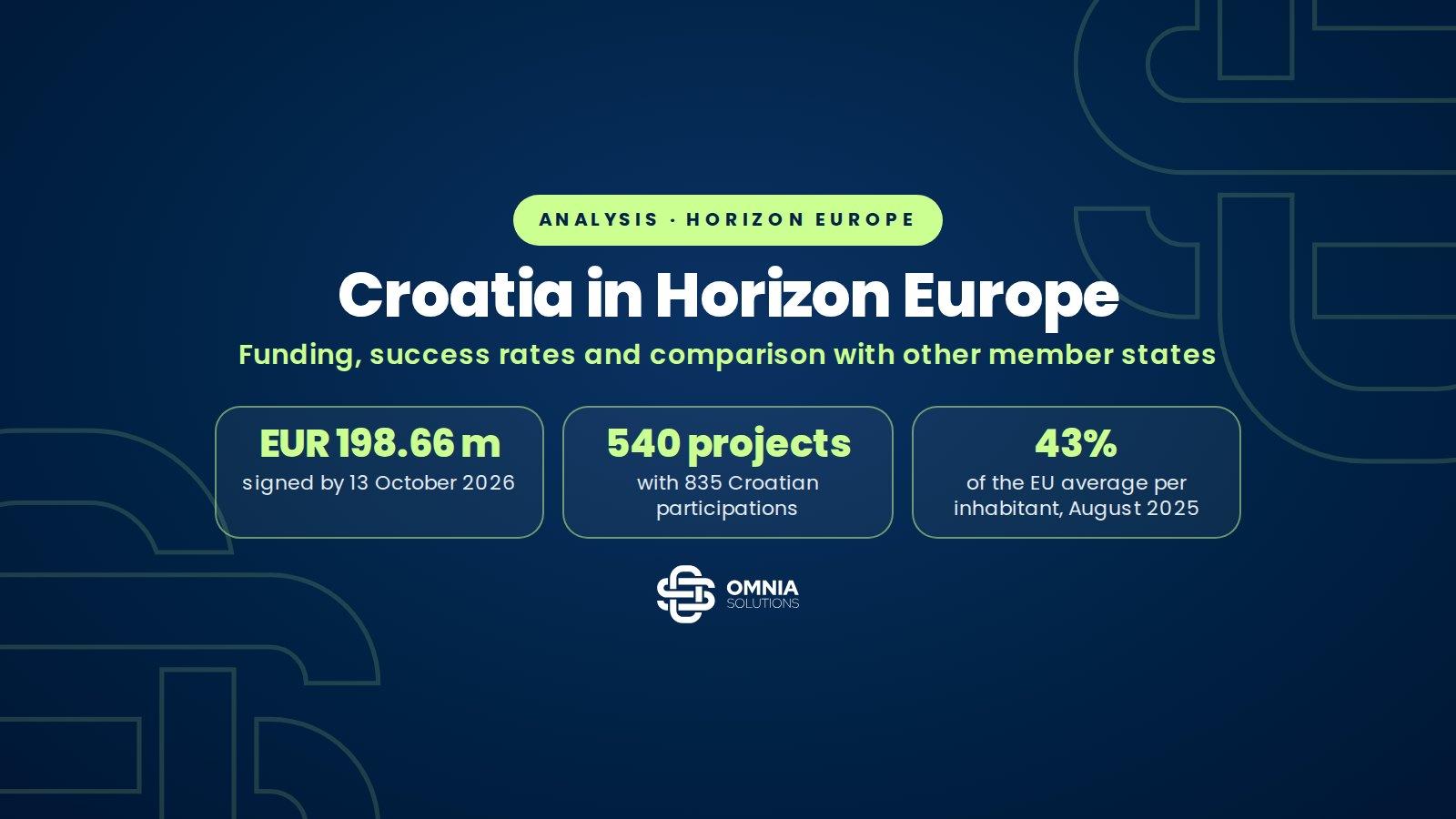
By 13 October 2026 Croatian organisations had signed 540 Horizon Europe projects with 835 participations and EUR 198.66 million of net EU contribution. That is more than in the whole of the previous programme, Horizon 2020 (EUR 137.2 million according to MZOM and AMPEU). The success rate of Croatian applications is 15%. On like-for-like data from August 2025, Croatia receives 43% of the EU average per inhabitant and 86% per researcher. Most money comes from Cluster 5 on climate, energy and mobility (EUR 45.8 million) and from the widening part of the programme (EUR 43.1 million), while success rates are lowest at the European Research Council (3%) and the European Innovation Council (4%).
Horizon Europe is the EU’s research and innovation framework programme for 2021–2027. Unlike cohesion funds, its money is not divided among countries in advance; it is awarded through calls in which consortia from across Europe compete on the excellence of their projects. Success in Horizon Europe is therefore a good indicator of a country’s research and innovation strength. This analysis uses data from the Croatian Ministry of Science, Education and Youth (MZOM) and the Agency for Mobility and EU Programmes (AMPEU), the European Commission, the Estonian Research Council and Eurostat.
In brief
- By 13 October 2026 Croatian organisations had won EUR 198.66 million in 540 projects and coordinated 54 of them.
- In five years of Horizon Europe Croatia has received more than in all of Horizon 2020 (EUR 137.2 million) and more than twice the amount from the Seventh Framework Programme (EUR 91.7 million).
- By August 2025 Croatia had received EUR 41.6 per inhabitant, 43% of the EU-27 average. Slovenia and Estonia received more than EUR 180 per inhabitant.
- The participation success rate, from the same source and date for all countries, is 16%, against an EU-27 average of 19%.
- Croatia is a widening country with access to dedicated calls (Teaming, Twinning, ERA Chairs, Hop-on). The part of the programme for widening participation and strengthening the European Research Area provides 24% of Croatian funding.
- Companies take part more and more; the private sector accounts for 29% of participations. In the European Innovation Council Croatia has so far won EUR 8.79 million in 15 projects, with a 4% success rate.
Key figures
Croatia in Horizon Europe, 2021 to October 2026
Source: Croatian Ministry of Science, Education and Youth and AMPEU, “Sudjelovanje Republike Hrvatske u programu Obzor Europa”, October 2026 (Horizon Dashboard, data as of 13 October 2026); ETAG based on eCORDA data (11 August 2025) and Eurostat for the EU comparison.
How much Croatian organisations have won from Horizon Europe
According to the October 2026 brochure by MZOM and AMPEU, based on European Commission data, Croatian organisations had signed grants for 540 projects by 13 October 2026. They take part 835 times and coordinate 54 projects. The net EU contribution is EUR 198.66 million, or EUR 0.37 million per project on average. The national portal obzoreuropa.hr shows the same amount as of 5 October 2026.
The ministry notes that in the first five years of the programme Croatian organisations secured more funding than in all of Horizon 2020, when they won EUR 137.2 million in 585 projects with a 13.43% success rate. In the Seventh Framework Programme (2007–2013) they won EUR 91.7 million. Growth is visible in the official snapshots. The total was EUR 136.4 million at the end of 2024, EUR 161 million in August 2025, EUR 165.3 million in November 2025 and EUR 198.66 million in October 2026.
Chart
How much Croatian organisations have won, by official snapshot
to end-2024
to August 2025
to November 2025
to October 2026
all of Horizon 2020
The snapshots come from different official sources but are consistent over time. Amounts are net EU contribution for signed grants.
Sources: Croatian Ministry of Science, Education and Youth (2021–2024); ETAG (11 August 2025); AMPEU, 2026 work plan; Ministry and AMPEU (13 October 2026).
Sources differ slightly on the Horizon 2020 total (from EUR 134.8 to 137.7 million), probably because of different extraction dates and definitions. We use the figure from the most recent official Croatian source.
How Croatia compares with similar countries
The latest comparison showing all countries in the same way and on the same date was published by the Estonian Research Council, based on Commission data as of 11 August 2025. Croatia then had EUR 161 million, 657 participations and 296 organisations. Per inhabitant that is EUR 41.6, or 43% of the EU-27 average of EUR 97.6. Slovenia received EUR 180.7 per inhabitant, Estonia EUR 208.8 and Greece EUR 180.9. Czechia (EUR 51.5) and Lithuania (EUR 63.3) are ahead of Croatia, while Slovakia (EUR 25.1) and Hungary (EUR 22.7) are behind.
The picture changes when funding is divided by the number of researchers. Per full-time equivalent researcher Croatia received 86% of the EU average, close to Lithuania and Portugal. The per-inhabitant gap therefore mostly reflects the small number of researchers, especially in companies. In its 2026 Country Report for Croatia the European Commission notes that business-employed researchers number around a quarter of the EU average.
Interactive chart
Croatia and similar member states in Horizon Europe
Estonia
Greece
Slovenia
Portugal
EU-27
Lithuania
Czechia
Croatia
Slovakia
Hungary
By August 2025 Croatia had received EUR 41.6 per inhabitant, 43% of the EU-27 average. Estonia and Slovenia received more than EUR 180.
Show the data in a table
| Country | EUR per inhabitant | Per researcher (EU-27 = 100) | Participation success rate |
|---|---|---|---|
| Estonia | EUR 208.8 | 192 | 18% |
| Greece | EUR 180.9 | 186 | 17% |
| Slovenia | EUR 180.7 | 163 | 19% |
| Portugal | EUR 100.2 | 88 | 16% |
| EU-27 | EUR 97.6 | 100 | 19% |
| Lithuania | EUR 63.3 | 85 | 17% |
| Czechia | EUR 51.5 | 57 | 18% |
| Croatia | EUR 41.6 | 86 | 16% |
| Slovakia | EUR 25.1 | 34 | 18% |
| Hungary | EUR 22.7 | 25 | 18% |
Sources: ETAG (Estonian Research Council), overview of Horizon Europe participation, eCORDA data as of 11 August 2025; Eurostat (population on 1 January 2025, researchers 2024). Per-inhabitant and per-researcher figures: Omnia Solutions calculation.
Success rates need care because definitions differ. From the same source and date for all countries, the success rate of Croatian participations is 16% and the EU-27 average 19%. A ministry presentation for 2021–2024 gives 17.01% for Croatia against an “EU average” of 16.15%, but probably on a different basis. For comparisons with other countries we therefore use the first pair. Across the whole programme the European Commission reports that 14% of eligible proposals succeed.
Where Croatian organisations win funding, and where they do not
More than half of Croatian funding (57%) comes from Pillar II, which finances projects in six thematic clusters. The strongest is Cluster 5 on climate, energy and mobility, with EUR 45.84 million in 84 projects. Cluster 6 on food, bioeconomy, natural resources, agriculture and environment brings EUR 28.29 million, has the most projects (107) and the highest success rate among the clusters (22%). Health (EUR 16.69 million) and digital, industry and space (EUR 11.42 million) follow.
The second-largest source is the part for widening participation and spreading excellence, with EUR 43.10 million in 46 projects. One of the largest projects there is MARBLE, a centre of excellence in maritime robotics and technologies for a sustainable blue economy, led by the Faculty of Electrical Engineering and Computing in Zagreb with partners from Norway and Italy. According to CORDIS, the EU contribution to MARBLE is EUR 15.0 million.
Results are weakest where individuals and companies compete on excellence alone. Croatian organisations take part in six European Research Council (ERC) projects with EUR 10.49 million, with a 3% success rate. In the European Innovation Council (EIC) they take part in 15 projects with EUR 8.79 million, with a 4% success rate. The same pattern appears in other widening countries. According to Commission data from January 2025, widening countries have an ERC success rate of 6.8% against 15.0% for the others, and 7.9% against 14.2% in the EIC.
Interactive chart
Where Croatian organisations win funding
Cluster 5: climate, energy, mobility
Widening participation and spreading excellence
Cluster 6: food, bioeconomy, environment
Cluster 1: health
Cluster 4: digital, industry, space
Marie Skłodowska-Curie Actions
European Research Council (ERC)
European Innovation Council (EIC)
Cluster 2: culture and society
Reforming the R&I system
Research infrastructures
European innovation ecosystems
Cluster 3: civil security
European Institute of Innovation and Technology
European Institute of Innovation and Technology
Research infrastructures
Reforming the R&I system
Cluster 6: food, bioeconomy, environment
Cluster 1: health
Cluster 4: digital, industry, space
Cluster 5: climate, energy, mobility
Marie Skłodowska-Curie Actions
Widening participation and spreading excellence
Cluster 3: civil security
Cluster 2: culture and society
European innovation ecosystems
European Innovation Council (EIC)
European Research Council (ERC)
Cluster 5 and the widening part together account for 45% of Croatian funding.
Source: Croatian Ministry of Science, Education and Youth and AMPEU, “Sudjelovanje Republike Hrvatske u programu Obzor Europa”, October 2026 (Horizon Dashboard, data as of 13 October 2026).
Who wins the most
The largest recipient is the Faculty of Electrical Engineering and Computing of the University of Zagreb (EUR 11.65 million), followed by Centar izvrsnosti MARBLE d.o.o. (EUR 11.63 million), GENOS d.o.o. (EUR 10.34 million), the Faculty of Mechanical Engineering and Naval Architecture (EUR 6.16 million) and the Ruđer Bošković Institute (EUR 6.12 million). The ten largest recipients together hold EUR 67.1 million, 33.8% of Croatia’s total, and include the companies GENOS, RISE, BIO-MI, Jadrolinija and DILJ.
The private sector’s share is growing. According to data AMPEU presented at the annual Horizon Europe conference in May 2026, the private sector accounts for 29% of Croatian participations and higher education institutions for 31%. A breakdown of funding in euros by type of organisation has not been published.
Chart
The ten Croatian organisations with the most Horizon Europe funding
Faculty of Electrical Engineering and Computing, Zagreb
Centar izvrsnosti MARBLE d.o.o.
GENOS d.o.o.
Faculty of Mechanical Engineering and Naval Architecture, Zagreb
Ruđer Bošković Institute
Research and Innovation Services d.o.o.
BIO-MI d.o.o.
Jadrolinija
DILJ d.o.o.
Maritime Centar izvrsnosti d.o.o.
The ten largest recipients hold EUR 67.1 million, 33.8% of Croatia’s total. They include the companies GENOS, RISE, BIO-MI, Jadrolinija and DILJ.
Source: Croatian Ministry of Science, Education and Youth and AMPEU, “Sudjelovanje Republike Hrvatske u programu Obzor Europa”, October 2026 (Horizon Dashboard, data as of 13 October 2026).
What widening country status means
Croatia is one of 15 widening countries, together with Bulgaria, Cyprus, Czechia, Estonia, Greece, Hungary, Latvia, Lithuania, Malta, Poland, Portugal, Romania, Slovakia and Slovenia. These member states have weaker research and innovation results and have access to dedicated calls.
- Teaming for Excellence funds the creation or upgrading of centres of excellence with leading European partners, as with MARBLE.
- Twinning links an institution from a widening country with at least two leading institutions from other countries, for up to three years and EUR 0.8 to 1.5 million per project.
- ERA Chairs lets an institution recruit an outstanding researcher and team, with EUR 1.5 to 2.5 million per project.
- Excellence Hubs fund regional innovation ecosystems, with EUR 1.5 to 4.5 million.
- Hop-on lets an organisation from a widening country join an already funded project, with at least 90% of the extra funding going to it.
- The EIC Pre-Accelerator is aimed at early-stage deep-tech companies and is open only to widening countries, associated countries and outermost regions.
Amounts are from the Horizon Europe work programme for 2026–2027. In the first EIC Pre-Accelerator round (April 2026) 70 companies from 22 countries were selected, one of them from Croatia, Hey Tech d.o.o. The EIC Accelerator lists of selected companies published in February 2025, June 2025 and February 2026 include no Croatian company.
What support Croatia offers applicants
- The network of national contact points has 26 advisers in six institutions (MZOM, the Croatian Science Foundation, SRCE, HAMAG-BICRO, the Ministry of the Interior and AMPEU), 16 of them at AMPEU. The national portal is obzoreuropa.hr.
- Under its measures to strengthen national participation, MZOM gives up to EUR 2,500 for preparing an application, and EUR 3,000 to a partner or EUR 6,000 to a coordinator of a proposal that passed the threshold but was not funded. Micro, small and medium-sized enterprises are eligible.
- The call for projects with a Seal of Excellence (MSCA, ERC Proof of Concept, EIC Pre-Accelerator) under the DIGIT project closed on 3 July 2026 because the funds were fully allocated.
- The Croatian Science Foundation has run a programme supporting researchers’ study visits to the host institutions of ERC grantees before applying.
What this means for businesses
Horizon Europe is not a programme in which a company applies alone for support for its own investment. The usual route is to join a consortium in which the company develops, tests or applies a solution, with a role that is clear and needed by the project. Clusters 4, 5 and 6 and the Hop-on instrument are the most relevant for companies. For stand-alone technology projects there are the EIC Pre-Accelerator and EIC Accelerator, but success rates are low and the EIC Accelerator requires mature technology, as we explained in our article on technology readiness levels.
The wider picture of R&D investment in Croatia, compared with the EU and the world, is in our analysis of R&D spending, and the changes proposed for the 2028–2034 EU budget are covered in our article on the 2028–2034 MFF.
Methodology: Croatian data cover grants signed from 2021 to 13 October 2026 and come from the MZOM and AMPEU brochure, which is based on European Commission data (Horizon Dashboard). The country comparison comes from one source with the same date for all countries (ETAG, eCORDA data as of 11 August 2025), so it is not directly comparable with the latest Croatian total. We calculated per-inhabitant and per-researcher figures from Eurostat data on population on 1 January 2025 and researchers in 2024. The per-researcher figure divides several years of funding by one year’s number of researchers, so it is an intensity indicator, not the amount an individual researcher receives.
This is the second of five articles on Croatia and EU money. The others cover absorption of 2021–2027 EU funds, state aid, net balances in the EU budget and regional disparities by county.
Frequently asked questions
How much has Croatia received from Horizon Europe?
By 13 October 2026 Croatian organisations had signed grants for 540 projects with a net EU contribution of EUR 198.66 million. That is more than in the whole of the previous programme, Horizon 2020, in which they won EUR 137.2 million according to MZOM and AMPEU.
What is the success rate of Croatian Horizon Europe applications?
According to MZOM and AMPEU the success rate is 15%. On comparable data for all countries from August 2025, the success rate of Croatian participations is 16%, against an EU-27 average of 19%.
Is Croatia below the EU average in Horizon Europe?
Yes. By August 2025 it had received EUR 41.6 per inhabitant, 43% of the EU average. Per researcher it stands at 86% of the average, so the gap mostly reflects the small number of researchers.
What is a widening country in Horizon Europe?
It is one of 15 member states with weaker research and innovation results, including Croatia. Organisations from these countries can apply to dedicated calls such as Teaming, Twinning, ERA Chairs, Excellence Hubs, Hop-on and the EIC Pre-Accelerator.
Can companies take part in Horizon Europe?
Yes, most often as partners in consortia in the thematic clusters, and technology companies also on their own through the European Innovation Council. The private sector accounts for 29% of Croatian participations.
Is there national support for Horizon Europe applications in Croatia?
Yes. MZOM gives up to EUR 2,500 for preparing an application and EUR 3,000 or EUR 6,000 for proposals that passed the threshold but were not funded. National contact points, mostly at AMPEU, give advice.
Sources
- MZOM and AMPEU, Sudjelovanje Republike Hrvatske u programu Obzor Europa, October 2026
- Croatian national Horizon Europe portal (obzoreuropa.hr)
- Estonian Research Council (ETAG), overview of Horizon Europe participation, September 2025
- European Commission, Annual Report on R&TD activities and monitoring of Horizon Europe in 2025, COM(2026) 255
- Horizon Europe Work Programme 2026–2027, Part 11: Widening participation and strengthening the ERA
- CORDIS, MARBLE project
- AMPEU, annual Horizon Europe conference, May 2026
- European Innovation Council, EIC Pre-Accelerator results, April 2026
- MZOM, measures to strengthen national participation in EU programmes
- European Commission, 2026 Country Report Croatia, SWD(2026) 211
- European Commission, data on widening countries’ participation in Horizon Europe (January 2025)
- MZOM, national support system and measures to strengthen national participation (presentation, in Croatian)
- AMPEU, work plan for 2026 (in Croatian)
- European Innovation Council, EIC Accelerator results, February 2026
- Eurostat, population on 1 January (tps00001) and researchers in full-time equivalent (rd_p_persocc)
Preparing a Horizon Europe project?
Let us talk about your company’s role in a consortium
We help you find the right call, define your company’s role in the consortium and prepare the exploitation and impact parts of the proposal. The introductory call is free.