Updated on 29 October 2026 with the latest available data.
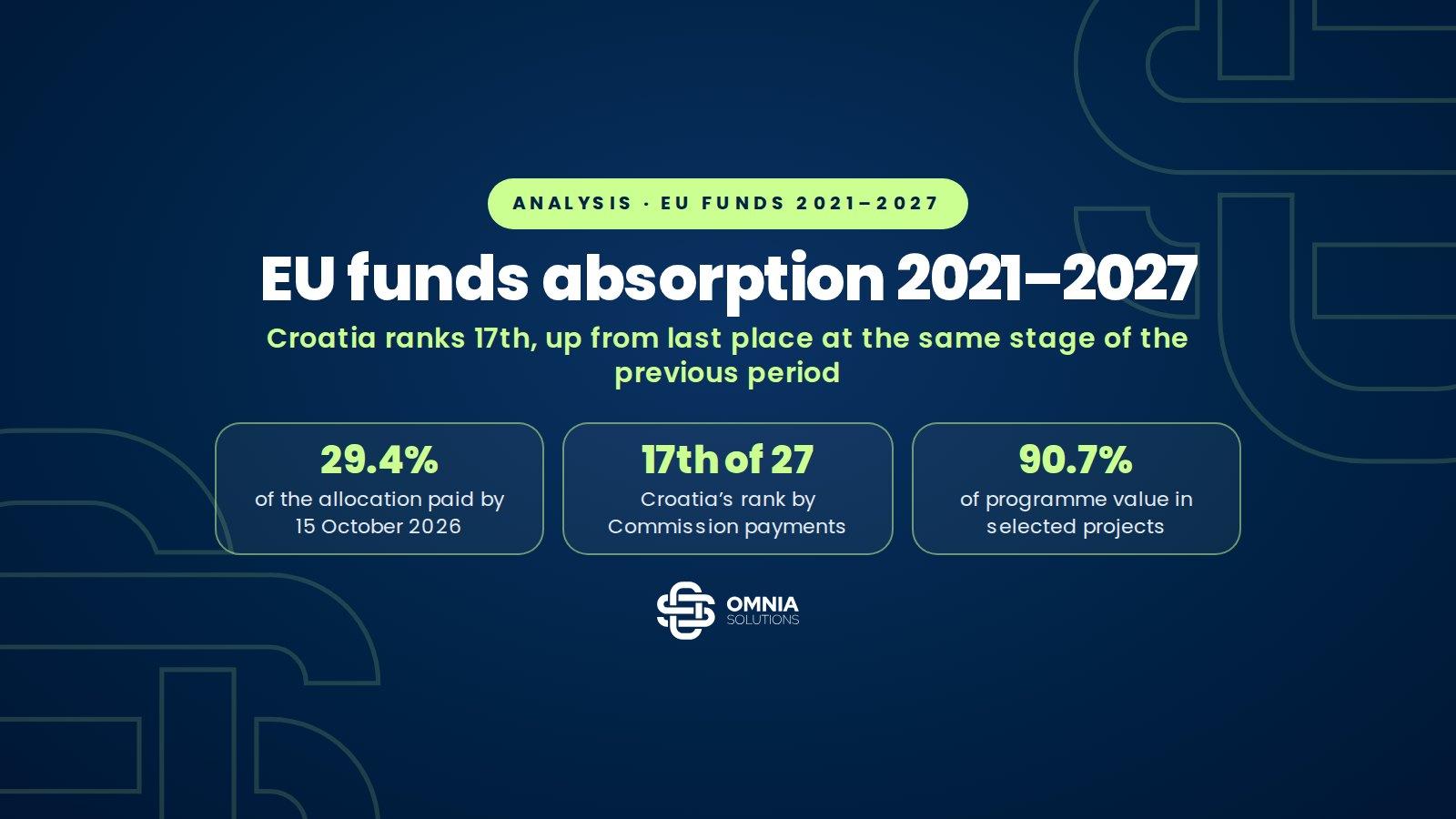
For 2021–2027 Croatia has an allocation of EUR 8.95 billion from EU cohesion policy funds and the European Maritime, Fisheries and Aquaculture Fund. By 15 October 2026 the European Commission had paid EUR 2.63 billion, or 29.4%. That puts Croatia 17th of 27 member states, slightly above the EU average of 28.9%. At the same stage of 2014–2020 Croatia was last. Projects worth 90.7% of programme value have been selected, above the EU average of 77.9%, but beneficiaries have so far spent and declared only 26.9%. Expenditure is eligible until 31 December 2029, or until the end of 2030 for programmes that moved at least 10% of their funds to new priorities.
This analysis uses European Commission data from the Cohesion Open Data Platform, downloaded on 29 October 2026. It shows how much money has actually been paid, how other member states compare, how many projects have been selected and how much has been spent, what changed with the mid-term review and which deadlines apply. It ends with what this means for businesses planning applications.
In brief
- Croatia’s EU allocation is EUR 8.95 billion (EUR 8.71 billion without fisheries). With national co-financing, the cohesion programmes are worth EUR 10.14 billion.
- The European Commission has paid EUR 2.63 billion (29.4%), of which EUR 0.56 billion was pre-financing and EUR 2.07 billion interim payments (23.1%).
- Croatia ranks 17th of 27 on total payments and 13th on interim payments, the better measure of actual spending. Estonia (57.3%), Finland (48.4%) and Luxembourg (47.4%) lead; Spain (19.9%), Hungary (21.0%) and Italy (22.7%) are slowest.
- Croatia started late. In mid-2024 it had selected only 4.7% of programme value, against 22.7% in the EU. It overtook the EU average during 2025.
- In the mid-term review Croatia moved EUR 688 million to defence, STEP technologies, water and housing.
- For businesses, most of the current programmes are already committed. New calls can be expected mainly under the new priorities and in open-ended calls.
Key figures
Croatia and EU cohesion funds 2021–2027
Source: European Commission, Cohesion Open Data Platform (payments as of 15 October 2026, selection and spending as of 31 August 2026); Regulation (EU) 2025/1914.
How much Croatia has drawn from 2021–2027 EU funds so far
Croatia has four programmes for 2021–2027. Competitiveness and Cohesion is worth EUR 5.20 billion from the EU budget, Efficient Human Resources EUR 1.93 billion, the Integrated Territorial Programme EUR 1.57 billion and the fisheries and aquaculture programme EUR 0.24 billion. That is EUR 8.95 billion in total. The Commission’s cohesion policy overviews leave out fisheries and quote EUR 8.71 billion, or EUR 10.14 billion with national co-financing.
By 15 October 2026 the Commission had paid Croatia EUR 2,629.4 million. Of this, EUR 564.0 million was pre-financing, which the Commission pays in advance regardless of project progress, and EUR 2,065.4 million was interim payments, which reimburse money that beneficiaries have already spent and Croatia has declared to the Commission. Total payments equal 29.4% of the allocation, interim payments 23.1%.
The difference matters for comparisons. Pre-financing varies widely between member states, especially because of the extra pre-financing paid to programmes that moved funds to new priorities. Interim payments therefore show more faithfully how much money has turned into projects.
How Croatia compares with other member states
On total payments Croatia ranks 17th with 29.4%, slightly above the weighted EU-27 average (28.9%) but below the median of 31.7%. Estonia (57.3%), Finland (48.4%), Luxembourg (47.4%) and Lithuania (41.0%) lead. Spain (19.9%), Hungary (21.0%), Italy (22.7%), Germany (24.4%) and Austria (24.5%) are at the bottom. Slovenia, with 25.8%, is behind Croatia.
On interim payments Croatia ranks 13th with 23.1%, above the EU average of 20.2%. It ranks 9th on selected projects and 16th on money actually spent. The chart lets you compare all four measures. The ranking should be read with care because allocations differ in size. For Poland, with an allocation of EUR 76 billion, each percentage point is EUR 760 million; for Croatia it is about EUR 90 million.
Interactive chart
EU member states: absorption of 2021–2027 funds
Estonia
Finland
Luxembourg
Lithuania
Netherlands
Czechia
Sweden
Cyprus
Latvia
Romania
Slovakia
Greece
Denmark
Malta
Poland
France
Croatia
EU-27 average
Ireland
Slovenia
Portugal
Belgium
Bulgaria
Austria
Germany
Italy
Hungary
Spain
Paid = Commission pre-financing and interim payments as a share of the EU allocation, as of 15 October 2026. With 29.4% Croatia ranks 17th of 27.
Show the data in a table
| Country | Total paid | Interim payments only | Selected for projects | Spent |
|---|---|---|---|---|
| Estonia | 57.2% | 39.8% | 114.6% | 42.6% |
| Finland | 48.4% | 27.8% | 67.8% | 34.1% |
| Luxembourg | 47.4% | 37.5% | 88.4% | 42.6% |
| Lithuania | 41.0% | 25.4% | 107.2% | 29.7% |
| Netherlands | 38.4% | 22.9% | 136.9% | 49.4% |
| Czechia | 37.3% | 31.9% | 97.6% | 38.9% |
| Sweden | 36.9% | 30.4% | 75.5% | 34.7% |
| Cyprus | 36.7% | 29.6% | 78.3% | 33.1% |
| Latvia | 36.6% | 21.1% | 92.0% | 22.5% |
| Romania | 36.3% | 27.4% | 110.9% | 34.3% |
| Slovakia | 35.4% | 19.9% | 68.8% | 23.4% |
| Greece | 33.0% | 25.0% | 90.4% | 28.0% |
| Denmark | 32.3% | 25.5% | 103.5% | 36.6% |
| Malta | 31.7% | 24.5% | 90.5% | 29.6% |
| Poland | 30.3% | 20.8% | 74.4% | 21.9% |
| France | 30.0% | 24.0% | 85.2% | 35.8% |
| Croatia | 29.4% | 23.1% | 90.7% | 26.9% |
| EU-27 average | 28.9% | 20.2% | 77.9% | 24.5% |
| Ireland | 26.5% | 19.9% | 73.1% | 34.8% |
| Slovenia | 25.8% | 15.7% | 70.9% | 17.7% |
| Portugal | 25.4% | 18.3% | 70.2% | 21.1% |
| Belgium | 25.0% | 17.8% | 98.1% | 29.9% |
| Bulgaria | 24.7% | 16.8% | 78.3% | 16.9% |
| Austria | 24.5% | 17.8% | 73.3% | 21.8% |
| Germany | 24.4% | 14.9% | 69.7% | 22.8% |
| Italy | 22.7% | 13.6% | 62.7% | 19.1% |
| Hungary | 21.0% | 16.1% | 57.0% | 21.3% |
| Spain | 19.9% | 12.6% | 66.2% | 14.0% |
Source: European Commission, Cohesion Open Data Platform, datasets “2021-2027 EU Payments by MS” and “2021-2027 Finances Detailed Planned vs Implemented” (ERDF, CF, ESF+, JTF and EMFAF, excluding Interreg). Calculation and ranking: Omnia Solutions.
Projects selected and money actually spent
Commission payments are only one measure. Every two to three months member states also report how many projects have been selected for support and how much beneficiaries have already spent. Both are expressed as a share of planned programme value, including the national share.
At the end of August 2026 Croatia’s cohesion programmes had selected projects worth EUR 9.20 billion, or 90.7% of the planned EUR 10.14 billion. The EU average is 77.9%. Spending declared stood at EUR 2.73 billion, or 26.9%, against 24.5% in the EU. A gap of this size between selection and spending is normal at this stage, because large infrastructure projects are paid only as they are built.
The trend shows how late Croatia started. Its two main programmes, Competitiveness and Cohesion and the Integrated Territorial Programme, were approved only in November and December 2022, and in mid-2024 projects worth just 4.7% of programme value had been selected, against an EU average of 22.7%. By the end of 2024 Croatia had jumped to 33.0%, it overtook the average during 2025, and at the end of 2025 it was above the average on spending for the first time.
Interactive chart
Projects selected and money spent: Croatia and the EU since 2023
Show the data in a table
| Cut-off | Croatia, selected | EU-27, selected | Croatia, spent | EU-27, spent |
|---|---|---|---|---|
| Jun 2023 | 0.0% | 4.2% | 0.0% | 0.2% |
| Dec 2023 | 1.4% | 10.9% | 0.1% | 1.0% |
| Jun 2024 | 4.7% | 22.7% | 0.3% | 2.1% |
| Dec 2024 | 33.0% | 38.3% | 3.9% | 5.4% |
| Jun 2025 | 49.4% | 48.6% | 7.1% | 9.5% |
| Dec 2025 | 71.0% | 63.6% | 18.9% | 17.5% |
| Jun 2026 | 84.5% | 74.0% | 24.2% | 22.8% |
| Aug 2026 | 89.3% | 77.6% | 26.9% | 24.5% |
Solid lines show selected projects, dashed lines money actually spent, both as a share of planned programme value (EU and national share, cohesion and fisheries). Hover over or tap the chart.
Source: European Commission, Cohesion Open Data Platform, “2021-2027 Finances Detailed Planned vs Implemented”, reporting cut-offs from June 2023 to August 2026. Calculation: Omnia Solutions.
The programmes differ a lot. Competitiveness and Cohesion has selected 95.7% of its value and spent 21.9%. Its Cohesion Fund part has selected projects worth 135% of the planned amount, meaning more commitments than available money. Such over-commitment is a common way to make sure funds are fully used if some projects come in cheaper or drop out. The Integrated Territorial Programme has selected 73.5% and spent 23.1%. Efficient Human Resources is the fastest, with 90.9% selected and 43.1% spent.
Interactive chart
Croatia’s four programmes: allocation and payments
Competitiveness and Cohesion
Efficient Human Resources
Integrated Territorial Programme
Fisheries and aquaculture (EMFAF)
Competitiveness and Cohesion
Efficient Human Resources
Integrated Territorial Programme
Fisheries and aquaculture (EMFAF)
The Competitiveness and Cohesion programme accounts for 58% of Croatia’s allocation.
Source: European Commission, Cohesion Open Data Platform, payment status October 2026.
In its publication “Regionalni razvoj u Hrvatskoj, 2026.” the Ministry of Regional Development and EU Funds reports that 85.7% of funds have been allocated, against 74.3% in the EU. These figures match Commission data for the end of June 2026 and are consistent with the figures shown here. In an April 2026 interview with tportal, Minister Nataša Mikuš Žigman also gave wider figures for the cohesion funds, agriculture and home affairs (excluding the National Recovery and Resilience Plan), with 67% contracted and 25% paid out of EUR 14.6 billion. Those figures use a different base and cannot be compared directly with the data in this article.
Croatia is faster now than in 2014–2020
The progress is clearest relative to other member states. At the end of 2019, the sixth year of 2014–2020, the Commission had paid Croatia 26.6% of its allocation from the same types of funds, while the EU-27 average was 36.8%. Croatia was last of 27. In the sixth year of the current period the Commission has paid it 29.4% of its allocation, and Croatia sits in the middle of the ranking.
The EU average has also changed. It is eight percentage points lower than at the same stage of the previous period. The European Court of Auditors links the slower start of the period to the parallel implementation of the Recovery and Resilience Facility, into which countries moved some mature projects, and to strained administrative capacity. Croatia has therefore improved both on its own record and relative to others.
Interactive chart
Same stage, two budget periods: how much was paid
2014–2020, end of 2019
2021–2027, 15 October 2026
2014–2020, end of 2019
2021–2027, 15 October 2026
In the sixth year of 2014–2020 Croatia was last in the EU. In the sixth year of 2021–2027 it is slightly above the EU average, which is slower today than it was then.
Source: European Commission, Cohesion Open Data Platform, “ESIF 2014-2020 EU payments” (as of 31 December 2019) and “2021-2027 EU Payments by MS” (15 October 2026). Calculation: Omnia Solutions.
The comparison has two limits. For 2014–2020 only year-end data are available, so the end of 2019 is compared with mid-October 2026. In addition, the 2014–2020 programmes were adopted in 2014 and 2015, while the current ones were approved only at the end of 2022. According to the latest platform data, Croatia has so far been paid 99.6% for the previous period (including REACT-EU), and programme closure is still ongoing.
EUR 688 million moved to new priorities
Regulation (EU) 2025/1914, adopted in September 2025, allowed member states to move part of their cohesion funds at mid-term to new priorities, namely the defence industry and dual-use products, military mobility and civil preparedness, affordable housing, water resilience, energy, and technologies under the Strategic Technologies for Europe Platform (STEP). Incentives include one-off pre-financing of 20 to 30%, EU co-financing raised by 10 percentage points and an extra 1.5% pre-financing for programmes that move at least 10% of their funds.
Croatia moved EUR 688 million, 7.9% of its cohesion policy allocation (EUR 8.71 billion), with EUR 285 million going to defence and security, EUR 198 million to STEP technologies and competitiveness, EUR 154 million to water management and EUR 52 million to housing. Two programmes were amended, Competitiveness and Cohesion and the Integrated Territorial Programme. In February 2026 HRT and Hina reported a 10% reallocation, a figure that applies to individual programmes. By our calculation from Commission data, 10.04% of Competitiveness and Cohesion and 10.55% of the Integrated Territorial Programme were reallocated.
Chart
Reallocated to new EU priorities: EUR 688 million
Defence and security
STEP technologies and competitiveness
Water management
Affordable housing
Two programmes were amended, Competitiveness and Cohesion and the Integrated Territorial Programme. Amounts include technical assistance.
Sources: European Commission, mid-term review factsheet for Croatia (March 2026); Cohesion Open Data Platform, programme priorities.
Across the EU, EUR 34.6 billion was reallocated, almost 10% of the funds covered by the review, including EUR 15.2 billion for competitiveness and EUR 11.9 billion for defence and civil preparedness.
Deadlines: the N+3 rule and the end of 2029 or 2030
Cohesion money cannot be spent indefinitely. Under the N+3 rule, funds committed to a programme in a given year are automatically decommitted by the Commission if the country does not spend and claim them by the end of the third year after commitment. The first such calculation took place at the end of 2025. Commission data for Croatia record no decommitment or reduction of its allocation, which suggests the first target was met. We found no official confirmation.
Expenditure is eligible if paid by 31 December 2029. The 2025 regulation extends this to 31 December 2030 for programmes that moved at least 10% of their funds to new priorities. By our calculation both amended Croatian programmes reach that threshold, and the Ministry gave EUR 504 million as the threshold for Competitiveness and Cohesion. We found no formal confirmation of the extension for the Croatian programmes, so it is safer to plan projects to finish by the end of 2029.
What this means for businesses
- Most of the money in the current programmes is already committed to selected projects, especially in Competitiveness and Cohesion. New calls can be expected mainly under the new priorities (STEP technologies, defence and dual-use products, water, housing), in open-ended calls and from savings on existing projects.
- Implementation time is getting shorter. A project contracted in 2027 has less than three years until the end of 2029, so procurement, construction and payments must be ready as soon as the contract is signed.
- Open-ended calls, in which applications are assessed in the order received, reward those who prepared their documents early. An example is the Integrator call for partnerships of small and medium-sized enterprises, where submissions were suspended because of high demand and reopen on 17 November 2026 at 11:00.
- The European Commission’s proposal for the 2028–2034 budget foresees a different allocation model built on national and regional partnership plans. More in our article on EU innovation funding in the 2028–2034 MFF.
- Open and upcoming calls for businesses are covered in our guide EU grants for businesses in Croatia 2026.
Methodology: payments come from the dataset “2021-2027 EU Payments by MS” (as of 15 October 2026) and cover the European Regional Development Fund (ERDF), the Cohesion Fund (CF), the European Social Fund Plus (ESF+), the Just Transition Fund (JTF) and the European Maritime, Fisheries and Aquaculture Fund (EMFAF), excluding European territorial cooperation (Interreg). Selected projects and spending come from the dataset “2021-2027 Finances Detailed Planned vs Implemented” (as of 31 August 2026), are expressed in total cost (EU and national share) and exclude fisheries, except in the trend chart. The EU-27 average is weighted by allocation size. All percentages were calculated from exact amounts and totals were checked against the totals in the source data.
This is the first of five articles on Croatia and EU money. The others cover participation in Horizon Europe, state aid, net balances in the EU budget and regional disparities by county.
Frequently asked questions
How much has Croatia drawn from 2021–2027 EU funds?
By 15 October 2026 the European Commission had paid Croatia EUR 2.63 billion from the cohesion funds and the fisheries fund, or 29.4% of its EUR 8.95 billion allocation. EUR 2.07 billion of that was interim payments for money already spent and EUR 0.56 billion was pre-financing.
Where does Croatia rank in the EU on absorption?
On total payments Croatia ranks 17th of 27, slightly above the EU average of 28.9%. It ranks 13th on interim payments, 9th on selected projects and 16th on money actually spent. At the same stage of 2014–2020 it was last.
What is the difference between selected projects and money spent?
Selected projects show how much money is already committed to specific projects (90.7% of programme value in Croatia). Money spent is expenditure paid and declared by beneficiaries (26.9%). The Commission reimburses on the basis of spending, so payments only pick up once projects are under way.
When must 2021–2027 funds be spent?
Expenditure is eligible if paid by 31 December 2029. For programmes that moved at least 10% of their funds to new priorities the deadline is 31 December 2030. Under the N+3 rule, which also applies, funds not claimed by the end of the third year after commitment are lost.
How much did Croatia move to new EU priorities?
In the mid-term review Croatia moved EUR 688 million, with EUR 285 million going to defence and security, EUR 198 million to STEP technologies and competitiveness, EUR 154 million to water management and EUR 52 million to housing.
Are there still calls under 2021–2027?
Yes, but most of the money is already committed. New calls are expected mainly under the new priorities, in open-ended calls and from savings on existing projects.
Sources
- European Commission, Cohesion Open Data Platform, 2021–2027 overview and payment and implementation datasets (downloaded 29 October 2026)
- European Commission, mid-term review factsheet for Croatia (March 2026)
- Regulation (EU) 2025/1914 amending the ERDF, Cohesion Fund and Just Transition Fund regulations
- European Commission, glossary: decommitment (N+3 rule)
- European Court of Auditors, Review 04/2025 on the future of cohesion policy
- European Commission, 2026 Country Report Croatia
- Croatian Ministry of Regional Development and EU Funds, EU funds 2021–2027
- Croatian Ministry of Regional Development and EU Funds, publication Regionalni razvoj u Hrvatskoj, 2026. (October 2026, in Croatian)
- tportal, interview with Minister Nataša Mikuš Žigman (7 April 2026, in Croatian)
- HRT (Hina), reallocation of cohesion funds (26 February 2026, in Croatian)
Planning an EU-funded project?
Let us check which call fits your project and how to meet the deadlines
We will review your project, open and upcoming calls and implementation deadlines, and propose the fastest route to an application. The introductory call is free.