HBOR energy efficiency programme with a principal write-off of up to 50% (announcement, October 2025)

Note, 30 October 2026. This announcement was published on 10 October 2025. HBOR now implements the programme Loans for Energy Efficiency of Entrepreneurs through five commercial banks (Erste, HPB, OTP, PBZ and Raiffeisenbank), with a maximum loan of EUR 3,000,000, repayment of up to 17 years including a grace period of up to 3 years, and a write-off of up to 50% of the disbursed principal. Current conditions are in our guide HBOR energy efficiency loan 2026, and all programmes in HBOR loans for entrepreneurs 2026.
According to the October 2025 announcement, the programme is financed from the European Regional Development Fund (ERDF) in the amount of EUR 150 million, with an additional EUR 125 million to be provided by commercial banks. The total value of the programme exceeds EUR 275 million, and its aim is to increase the energy efficiency of companies and encourage the use of renewable energy sources in business.
The programme is open to businesses of all sizes and forms of ownership that are registered for manufacturing, commercial or service activities.
Eligible investments are those that contribute to higher energy efficiency and lower energy consumption, from the modernisation of production facilities and the installation of energy-efficient systems and machinery to investment in equipment for using renewable energy sources.
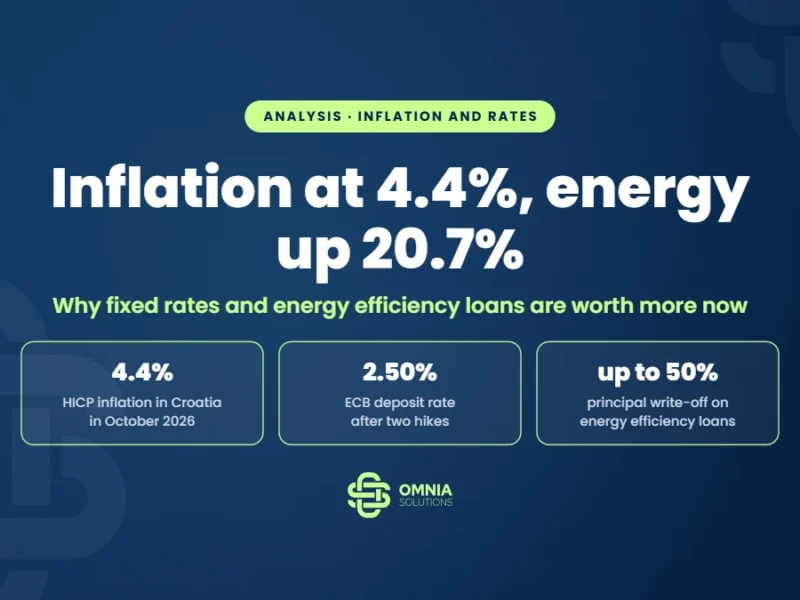
A special feature of the programme is the possibility of a capital rebate, i.e. a write-off of part of the loan principal, which depends on the energy savings achieved. The amount of the write-off is determined according to precisely defined criteria and can range from 15% to a maximum of 50%.
In manufacturing, for investments in energy units, small and medium-sized enterprises receive a 15% write-off if they achieve at least 30% savings and 50,000 kWh. A 25% write-off requires 40% savings and 100,000 kWh, while a 35% write-off is achieved with 50% savings and 200,000 kWh. The maximum write-off of 50% is possible if the project delivers at least 67% savings and 400,000 kWh and includes at least one investment in renewable energy sources. For large companies, the thresholds are higher. A 15% write-off requires 30% savings and 250,000 kWh, 25% requires 40% savings and 400,000 kWh, 35% requires 50% savings and 550,000 kWh, and a 50% write-off requires 67% savings and 700,000 kWh, also with at least one renewable energy source (RES) investment measure.
In the commercial and service sector, for small and medium-sized enterprises, the capital rebate is 15% if the project delivers 40% savings and 15,000 kWh, 25% if it achieves 50% savings and 20,000 kWh, and 35% with 60% savings and 25,000 kWh. The maximum write-off of 50% is granted if at least 67% savings and 35,000 kWh are achieved, with a mandatory investment in RES. For large companies, the criteria are 40% savings and 20,000 kWh for a 15% write-off, 50% and 30,000 kWh for 25%, 60% and 40,000 kWh for 35%, and 67% and 50,000 kWh for a 50% write-off, also with a RES investment measure.
Under the rules of HBOR (Croatian Bank for Reconstruction and Development), if a project only partially meets the prescribed criteria, for example it achieves a sufficient percentage of savings but not the minimum amount of kWh, a lower level of capital rebate applies. The same applies if a project with high savings does not include an investment in renewable energy sources, in which case the maximum write-off of 50% is reduced to 35%. This model encourages businesses to plan comprehensive energy measures and projects with a lasting impact.
Ahead of the launch of the new programme, it is worth noting that we recently secured loan financing of almost EUR 1.5 million for our client from the manufacturing and processing industry, with a 50% principal write-off, which resulted in almost EUR 750,000 in grants (non-repayable funding). This example shows how timely preparation and high-quality project documentation make it possible to make the most of the available financial instruments.
The programme is now implemented through commercial banks, and the time to prepare is now. Energy audits, savings analysis and preparation of the investment documentation are the most important prerequisites for a successful application and for achieving the highest capital rebate.
What the capital rebate is and how it is earned is explained in our article Capital rebate, HBOR loan principal write-off, and combining the loan with tax relief in Investment tax incentives 2026. The programme conditions, required energy savings and a worked example are in our guide HBOR energy efficiency loan 2026.
Guide: HBOR loans for entrepreneurs 2026
- HBOR loans for entrepreneurs 2026: all programmes, interest rates, principal write-off of up to 50%, repayment of up to 20 years and documentation.
- HBOR loan for production modernisation 2026: from EUR 100,000 to 3,000,000, half at 0% interest and a write-off of up to 50% of the principal.
- HBOR loans: advisory services and application preparation: what the application requires and how we work.