Updated on 30 October 2026. Figures were checked against the OECD and Eurostat databases on that day.
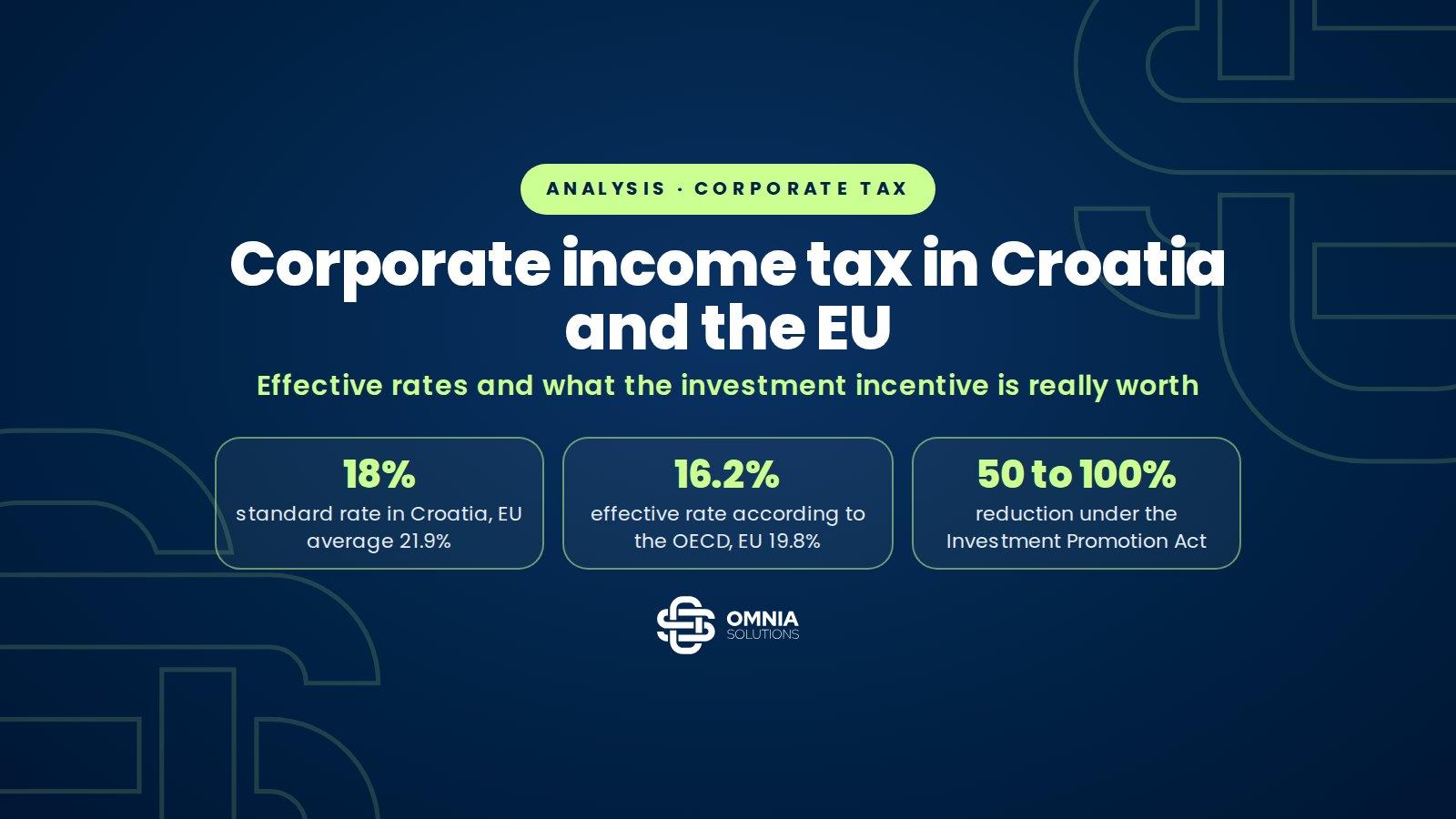
Croatia’s standard corporate income tax rate is 18%, and companies with revenue up to one million euro pay 10%. The unweighted average statutory rate across the 27 EU member states in 2026 is 21.9%, so Croatia ranks 21st and only six member states have a lower rate. According to the OECD, the effective average tax rate, which takes depreciation and other base rules into account, is 16.2% in Croatia and 19.8% on average in the EU. The Investment Promotion Act allows the rate to be reduced by 50, 75 or 100% for up to ten years. What that is worth in euro depends on three things, the profit the investment actually earns, the rate the company pays and the aid ceiling for the region.
This analysis compares statutory and effective corporate income tax rates in the EU using OECD data, corporate tax revenue using Eurostat data, and the rules of the Investment Promotion Act. It ends with three hypothetical investments, for a micro, a medium-sized and a large company, showing what the tax reduction is worth per year and in total.
In brief
- Croatia’s corporate income tax rate has been 18% since 2017 (20% before), or 10% if revenue in the tax period is up to EUR 1,000,000.
- The unweighted average statutory rate in the EU-27 in 2026 is 21.9% and the median 22%. The highest rates are in France (36.1% with the exceptional contribution of the largest companies), Malta (35%) and Germany (30.1%), the lowest in Hungary (9%), Bulgaria (10%) and Ireland (12.5%).
- According to the OECD, Croatia’s effective average tax rate is 16.2%, 1.8 percentage points below the statutory rate. The EU-27 average is 19.8%.
- Corporate income tax revenue in Croatia amounted to 3.1% of GDP in 2024, the same as in the EU, even though the statutory rate is below average.
- Under the Investment Promotion Act the rate is reduced by 50% (investment from EUR 150,000 and five jobs), 75% (from EUR 1 million and ten jobs) or 100% (over EUR 3 million and 15 jobs), for up to ten years. Micro enterprises get a 50% reduction for up to five years.
- The relief applies only to profit from the investment activity and ends when total aid reaches the maximum permitted intensity, 35 to 75% of investment costs.
Sources: 10, listed at the end · How we check our information · Report an error
Key figures
Corporate income tax in Croatia and the EU
Sources: Croatian Tax Administration; OECD, Corporate Tax Statistics; Eurostat (gov_10a_taxag); Investment Promotion Act; regional aid map for the period 2022 to 2027. Calculation: Omnia Solutions.
How does Croatia’s corporate income tax compare with the EU?
According to the Tax Administration, corporate income tax is levied at 10% if revenue in the tax period is up to EUR 1,000,000 and at 18% if revenue is higher. The standard rate of 18% has applied since 2017. From 2001 to 2016 it was 20%, and in 2000 it was 35%.
Compared with other member states, Croatia is in the bottom third. In the OECD database, which shows the combined statutory rate (central and sub-central government), the unweighted average of the 27 member states in 2026 is 21.9% and the median 22%. Lower rates than Croatia’s apply in Hungary (9%), Bulgaria (10%), Ireland (12.5%), Cyprus (15%), Romania (16%) and Lithuania (17%). Slovenia raised its rate from 19% to 22% in 2024, Austria has 23% and Germany 30.1%.
Several rates changed in 2026. From 1 January 2026 Cyprus raised its rate from 12.5% to 15% and Lithuania from 16% to 17%, while Portugal cut its rate from 30.5% to 29.5%. The French rate of 36.1% includes an exceptional contribution paid for 2025 and 2026 by companies with turnover of EUR 3 billion or more. For other French companies the rate is 25.8%, which would put the EU average at 21.5%.
Interactive chart
EU member states: statutory and effective corporate income tax rates
France
Malta
Germany
Portugal
Italy
Netherlands
Belgium
Spain
Slovakia
Luxembourg
Austria
Denmark
Estonia
Greece
Slovenia
EU-27 average
Czechia
Sweden
Finland
Latvia
Poland
Croatia
Lithuania
Romania
Cyprus
Ireland
Bulgaria
Hungary
Combined statutory rate (central and sub-central government). With 18% Croatia ranks 21st of 27 member states; only Hungary, Bulgaria, Ireland, Cyprus, Romania and Lithuania have lower rates. The French rate includes the exceptional contribution of companies with turnover of EUR 3 billion or more.
Show the data in a table
| Country | Statutory rate 2026 | Effective average rate 2025 |
|---|---|---|
| France | 36.1% | 23.6% |
| Malta | 35.0% | 28.8% |
| Germany | 30.1% | 26.8% |
| Portugal | 29.5% | 27.5% |
| Italy | 27.8% | 25.7% |
| Netherlands | 25.8% | 24.5% |
| Belgium | 25.0% | 23.4% |
| Spain | 25.0% | 23.3% |
| Slovakia | 24.0% | 22.1% |
| Luxembourg | 23.9% | 22.5% |
| Austria | 23.0% | 22.0% |
| Denmark | 22.0% | 21.6% |
| Estonia | 22.0% | 18.7% |
| Greece | 22.0% | 21.0% |
| Slovenia | 22.0% | 20.1% |
| EU-27 average | 21.9% | 19.8% |
| Czechia | 21.0% | 20.3% |
| Sweden | 20.6% | 19.5% |
| Finland | 20.0% | 19.8% |
| Latvia | 20.0% | 17.0% |
| Poland | 19.0% | 15.0% |
| Croatia | 18.0% | 16.2% |
| Lithuania | 17.0% | 14.6% |
| Romania | 16.0% | 14.4% |
| Cyprus | 15.0% | 11.4% |
| Ireland | 12.5% | 12.4% |
| Bulgaria | 10.0% | 9.1% |
| Hungary | 9.0% | 12.0% |
Source: OECD, Corporate Tax Statistics, statutory rates (CIT_C, 2026) and effective rates (EATR, asset composite, 3% interest and 1% inflation, 2025); Cyprus according to EY (reform from 1 January 2026). Unweighted average. Ranking and calculation: Omnia Solutions.
Why does the effective rate differ from the statutory rate?
The statutory rate applies to the tax base, not to book profit or to the cash an investment actually earns. How much of the profit ends up in the budget depends on the base rules, above all depreciation, but also interest deductibility, inventory valuation and reliefs. The OECD therefore calculates the effective average tax rate (EATR), which shows what share of the profit from a hypothetical profitable investment goes in tax. The calculation is consistent across countries and assumes a pre-tax return of 20%, a real interest rate of 3%, inflation of 1%, financing with 65% equity and 35% debt, and equal shares of buildings, machinery, software and inventories.
For Croatia the effective average rate in 2025 is 16.2%, 1.8 percentage points below the statutory rate. By asset type it is lowest for buildings (15.1%) and highest for inventories (17.6%). The EU-27 average is 19.8%, with an average gap to the statutory rate of 2.1 percentage points. The highest effective rates are in Malta (28.8%), Portugal (27.5%) and Germany (26.8%), the lowest in Bulgaria (9.1%), Cyprus (11.4%) and Hungary (12.0%). Hungary is the only member state where the effective rate is higher than the statutory rate.
Croatia ranks 20th of 27 on the effective rate, almost the same position as on the statutory rate (21st). The gap to Slovenia (20.1%) and Austria (22.0%) is smaller than statutory rates suggest, and Poland, with a statutory rate of 19%, has an effective rate of 15.0%, lower than Croatia’s. The comparison is therefore indicative of a location’s attractiveness, but an investment decision should not rest on the nominal rate alone.
Interactive chart
Statutory and effective rates in Croatia and selected member states, 2025
Germany
Italy
Slovakia
Austria
Slovenia
Czechia
Poland
Croatia
Romania
Bulgaria
Hungary
EU-27 average
Germany
Italy
Slovakia
Austria
Slovenia
Czechia
Poland
Croatia
Romania
Bulgaria
Hungary
EU-27 average
The effective rate is below the statutory rate almost everywhere, because tax is paid on profit after depreciation and deductions. The gap is 1.8 percentage points in Croatia and 2.1 on average in the EU-27.
Source: OECD, Corporate Tax Statistics, statutory rates (CIT_C) and effective average rates (EATR, composite, fixed scenario), 2025. Calculation: Omnia Solutions.
How much does corporate income tax bring in?
According to Eurostat, taxes on corporate profits in Croatia brought in revenue of 3.1% of GDP in 2024, the same as the EU-27 average. In 2015 the gap was considerable, 1.8% of GDP in Croatia against 2.4% in the EU. Revenue rose most in 2022, to 3.2% of GDP, when it also reached 3.2% in the EU. A lower statutory rate therefore does not mean lower corporate tax revenue. Revenue depends just as much on company profitability, the structure of the economy and the breadth of the tax base.
Interactive chart
Corporate income tax revenue as a share of GDP, Croatia and EU-27
Show the data in a table
| Year | Croatia | EU-27 |
|---|---|---|
| 2015 | 1.8% | 2.4% |
| 2016 | 2.2% | 2.5% |
| 2017 | 2.3% | 2.6% |
| 2018 | 2.2% | 2.7% |
| 2019 | 2.3% | 2.6% |
| 2020 | 2.2% | 2.4% |
| 2021 | 2.1% | 2.9% |
| 2022 | 3.2% | 3.2% |
| 2023 | 2.9% | 3.2% |
| 2024 | 3.1% | 3.1% |
Taxes on the income or profits of corporations, including holding gains, as a share of GDP. Hover over or tap the chart.
Source: Eurostat, gov_10a_taxag (D51B_C2).
How does the tax reduction under the Investment Promotion Act work?
The Investment Promotion Act (Official Gazette 63/22, amended by 136/24) grants tax aid in the form of a reduced corporate income tax rate. The Ministry of Economy decides on beneficiary status on the basis of an application submitted before the investment starts. The aid levels are as follows.
- An investment of EUR 150,000 to 1,000,000 with at least five new jobs reduces the rate by 50% for up to ten years from the year the investment starts.
- An investment of EUR 1,000,000 to 3,000,000 with at least ten new jobs reduces the rate by 75%.
- An investment of more than EUR 3,000,000 with at least 15 new jobs reduces the rate by 100%.
- A micro enterprise investing at least EUR 50,000 and creating three new jobs gets a 50% reduction for up to five years.
- For modernisation and productivity projects of at least EUR 500,000 no new jobs are required, but headcount must not fall.
Two rules determine what the relief is actually worth. First, for projects starting on or after 1 January 2025 the reduction applies only to profit from the business activity covered by the investment project, excluding income from capital, rent, interest and intellectual property. Second, the total tax aid is capped by the maximum permitted aid intensity under the regional aid map. For large companies this is 35% of investment costs in the City of Zagreb, 40% in Adriatic Croatia and 50% in Pannonian and Northern Croatia. Medium-sized companies get 10 and small and micro enterprises 20 percentage points more. In Sisak-Moslavina County the ceiling is higher, 60% for large, 70% for medium-sized and 75% for small companies. All aid for the same project counts towards the ceiling, tax and grants alike, so the measures complement each other only until together they reach the cap.
The reduction applies to the statutory rate. A company paying 18% pays 9% with a 50% reduction, 4.5% with 75% and nothing on profit from the investment activity with 100%. A company with revenue up to one million euro, which already pays 10%, pays 5% with a 50% reduction, so the saving in euro is small.
What the incentive is really worth in three examples
The examples are hypothetical and only show how the amount is calculated. Each company earns a constant profit from the investment activity, receives no other aid for the same project, and future savings are discounted at 3.71%, as in our calculator, so that they can be compared with today’s investment cost.
- A micro enterprise in Northern Croatia invests EUR 80,000 and hires three people. Its revenue is below one million euro, so it pays 10%. If the investment earns EUR 40,000 a year, the saving is EUR 2,000 a year, or EUR 10,000 over five years, EUR 8,977 at present value. That is 11.2% of the investment, far below the 70% ceiling.
- A medium-sized company in Pannonian Croatia invests EUR 2 million and hires 12 people. It pays 18%, and with a 75% reduction and profit from the investment of EUR 300,000 a year it saves EUR 40,500 a year. Over ten years that is EUR 405,000 nominal or EUR 333,285 at present value, 16.7% of the investment and below the 60% ceiling.
- A large company in the City of Zagreb invests EUR 5 million and hires 25 people. With a 100% reduction and profit from the investment of EUR 1.5 million a year it does not pay EUR 270,000 of tax a year. The ceiling of 35% of the investment, EUR 1.75 million at present value, is reached in the eighth year, so the cumulative saving is EUR 2.04 million nominal instead of EUR 2.7 million over ten years.
Worked example
Three hypothetical investments and what the tax reduction is worth
An example, not an estimate for a real company. Assumptions: the same profit from the investment activity every year, no other aid for the same project, ceiling based on investment costs, discount rate 3.71% as in Omnia’s calculator. Rules: Investment Promotion Act (Official Gazette 63/22, 136/24), regional aid map for the period 2022 to 2027. Calculation: Omnia Solutions.
The examples show that the relief is worth most to companies with a high and stable profit from the new investment. For a micro enterprise paying 10% it brings little, while for a large company in Zagreb the amount is limited by the ceiling rather than by the duration. Members of multinational and large domestic groups with consolidated revenue of at least EUR 750 million are also subject to the global minimum corporate tax, which ensures effective taxation of at least 15%, so part of the relief may be offset by a top-up tax.
What this means for businesses
- Before applying, estimate the profit from the investment activity, not the company’s total profit. The relief does not cover income from capital, rent, interest and intellectual property and cannot exceed the corporate income tax shown in the return.
- The amount for your own project can be estimated with the investment incentives calculator, which takes into account company size, county, number of new jobs, the 10% or 18% rate and the aid ceiling.
- Conditions, deadlines and obligations are described in our guide Investment tax incentives in Croatia 2026. The investment must be kept for three years (small and medium-sized companies) or five years (large companies), and the new jobs for three years from being filled (five for large companies) and no less than the period in which the relief is used, otherwise the aid must be repaid with interest.
- If grants or a favourable loan are also sought for the same project, all aid counts towards the same ceiling. How Croatia compares with the EU on state aid is shown in our state aid analysis, and open calls are listed in our guide EU grants for businesses in Croatia 2026.
- The application for beneficiary status is submitted before the investment starts. Help with the estimate and the application is described on our page Tax incentives for investment, advisory and application. The decision rests with the Ministry of Economy.
Methodology: statutory rates come from the OECD Corporate Tax Statistics database (combined statutory rate, CIT_C, standard rate excluding targeted small business rates) for 2025 and 2026. The OECD has no data for Cyprus, so its rate comes from EY’s summary of the Cypriot tax reform. Effective average tax rates (EATR) come from the same database for 2025, for the asset composite in the scenario with fixed interest and inflation rates. EU-27 averages are unweighted. Corporate tax revenue comes from Eurostat dataset gov_10a_taxag (taxes on the income or profits of corporations including holding gains, % of GDP). Incentive rules come from the Investment Promotion Act (Official Gazette 63/22, 136/24) and the regional aid map for the period 2022 to 2027, and the examples were calculated using the methodology of Omnia’s incentives calculator. All percentages, averages and ranks were calculated from the source values.
Frequently asked questions
What is the corporate income tax rate in Croatia?
The rate is 10% if revenue in the tax period is up to EUR 1,000,000 and 18% if revenue is higher. The standard rate of 18% has applied since 2017.
Is corporate income tax in Croatia lower than in the EU?
Yes. The unweighted average statutory rate of the 27 member states in 2026 is 21.9%, and with 18% Croatia ranks 21st of 27. According to the OECD, Croatia’s effective average tax rate is 16.2% against an EU average of 19.8%. Hungary, Bulgaria, Ireland, Cyprus, Romania and Lithuania have lower statutory rates.
What is an effective tax rate?
The effective average tax rate (EATR) shows what share of the profit from a typical profitable investment goes in tax once depreciation and other tax base rules are taken into account. The OECD calculates it with the same assumptions for all countries, a 3% real interest rate, 1% inflation and a 20% pre-tax return.
By how much can corporate income tax be reduced under the Investment Promotion Act?
The rate is reduced by 50% for an investment of EUR 150,000 with five new jobs, by 75% for an investment of EUR 1 million with ten jobs and by 100% for an investment of more than EUR 3 million with 15 jobs, for up to ten years. Micro enterprises investing EUR 50,000 and creating three jobs get a 50% reduction for up to five years.
Is there a ceiling on the tax relief?
Yes. Total aid for the same project must not exceed the maximum permitted intensity under the regional aid map, from 35% of investment costs for large companies in the City of Zagreb to 70% for small companies in Pannonian and Northern Croatia, or 75% in Sisak-Moslavina County. Once the ceiling is reached, the relief ends, even before the ten years are up.
Is the relief worth it for a company paying 10% corporate income tax?
With a 50% reduction such a company pays 5% on profit from the investment activity, so the saving is smaller than for a company paying 18%. In our example a micro enterprise earning EUR 40,000 a year from the investment saves EUR 2,000 a year, or EUR 10,000 over five years.

About the author
Matija Vlahovski, MSc in Economics
Co-founder and director of Omnia Solutions. He has more than ten years of experience in business financing, mostly with HAMAG-BICRO loans, HBOR loans, investment studies and tax incentives. He has taken part in more than 90 projects, through which clients were awarded more than EUR 12 million in grants and more than EUR 2 million in tax incentives. Before consulting, he worked at Privredna banka Zagreb, preparing loan proposals for small and medium-sized enterprises. He holds a HANFA licence.
Sources
- Croatian Tax Administration, Corporate income tax (rates and legislation, in Croatian)
- OECD, Corporate Tax Statistics Database, statutory rates (DSD_TAX_CIT@DF_CIT) and effective rates (DSD_ETR@DF_ETR_BASELINE)
- OECD, Explanatory annex: corporate effective tax rates
- Eurostat, Main national accounts tax aggregates (gov_10a_taxag)
- Croatian Parliament, Final Proposal of the Investment Promotion Act (May 2022, in Croatian)
- Croatian Parliament, Bill amending the Investment Promotion Act (November 2024, in Croatian)
- European Commission, decision on the regional aid map for Croatia for the period 2022 to 2027 (SA.64581)
- Croatian Tax Administration, Global minimum corporate income tax (in Croatian)
- EY Global Tax News, Cyprus enacts major tax reform legislation (7 January 2026)
- KPMG Avocats, Tax measures in Finance Act 2026 adopted in France (5 February 2026)
Planning an investment with a tax incentive?
Let us estimate what the corporate tax reduction is really worth to you
We will review your investment project, expected profit, new jobs and region, and calculate the relief, the ceiling and the obligations that come with it. The introductory call is free.