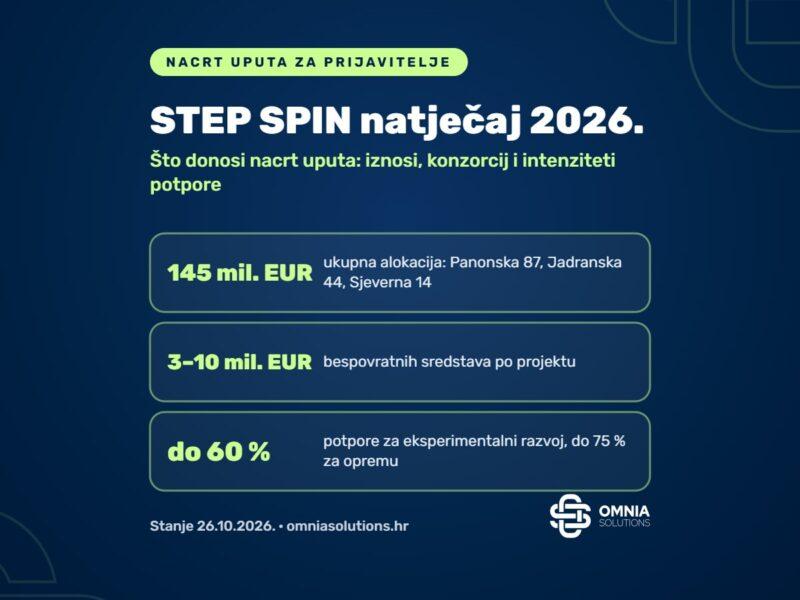
EUR 145 million for the transition to an energy and resource efficient economy (call 2024)

Note, 30 October 2026. The call Support to Enterprises for the Transition to an Energy and Resource Efficient Economy for 2024 (Potpora poduzećima za tranziciju na energetski i resursno učinkovito gospodarstvo za 2024. godinu, known as TERUG) was published on 6 June 2024. Instead of 15 July, intake started on 13 September 2024 at 11:00, and after two extensions the deadline expired on 30 June 2025 at 11:00. The call is closed. Current calls are tracked in our guides EU grants for businesses 2026 and Business incentives and upcoming calls 2026.
In June 2024 a call was published for funding to improve businesses on their way to an efficient economy. Its budget was EUR 145 million, and it worked on a first-come, first-served basis.
As companies play a key role in the transformation towards a green future, the European Union continued to strongly encourage the green transition of the economy in 2024, and this call was expected to fund at least 250 projects of SMEs (small and medium-sized enterprises) and 40 projects of mid-capitalisation companies.
What are the grant amounts?
- EUR 70,000.00 to 995,000.00 for SMEs
- EUR 265,000.00 to 4,645,200.00 for mid-capitalisation companies.
The purpose of the call was to encourage investment in companies in energy-intensive industries, and accordingly, the investments planned through the projects must contribute to achieving at least one of the following objectives:
- Promoting the circular economy by introducing resource efficiency into the production cycle and the product life cycle, including the sustainable supply of primary and secondary raw materials;
- Decarbonisation and reducing emissions from energy-intensive industries and introducing innovative low-emission technologies.
What are the conditions for applying?
- The applicant must have at least 10 employees (FTE) in 2023
- The applicant must have reported a positive EBITDA in 2023
- The applicant must have a share of energy costs in revenue ei=≥2.00% (calculation formula: ei=AOP262/(AOP128+AOP129)*100) in 2023
- In 2023, the applicant must have reported operating revenue of at least 50% of the total project value
- In 2023, the applicant must have a share of capital and reserves in total liabilities of at least 15%.
The activities are carried out within sector C Manufacturing (NKD 2007):
| 10 | Manufacture of food products |
| 11 | Manufacture of beverages |
| 13 | Manufacture of textiles |
| 14 | Manufacture of wearing apparel |
| 16 | Manufacture of wood and of products of wood and cork, except furniture |
| 17 | Manufacture of paper and paper products |
| 18 | Printing and reproduction of recorded media |
| 20 | Manufacture of chemicals and chemical products |
| 21 | Manufacture of basic pharmaceutical products and pharmaceutical preparations |
| 22 | Manufacture of rubber and plastic products |
| 23 | Manufacture of other non-metallic mineral products |
| 24 | Manufacture of basic metals |
| 25 | Manufacture of fabricated metal products |
| 28 | Manufacture of machinery and equipment n.e.c. |
| 31 | Manufacture of furniture |
According to the original announcement, projects were to be accepted from 15 July 2024.
Manufacturing companies investing in energy savings can today use the HBOR energy efficiency loan of up to EUR 3 million, with a write-off of up to 50% of the principal that we explained in the article on the capital rebate. The call Process Innovation in S3 Areas (PK.1.3.11) accepts applications until funds run out and no later than 31 December 2026. How much applicants to the TERUG call budgeted for advisory services is analysed in our article on price transparency in the consulting industry.
For more information and help in writing your project proposal, write to us at info@omniasolutions.hr.
You can follow all the information on new EU and national grant calls in our News section and on our LinkedIn profile.