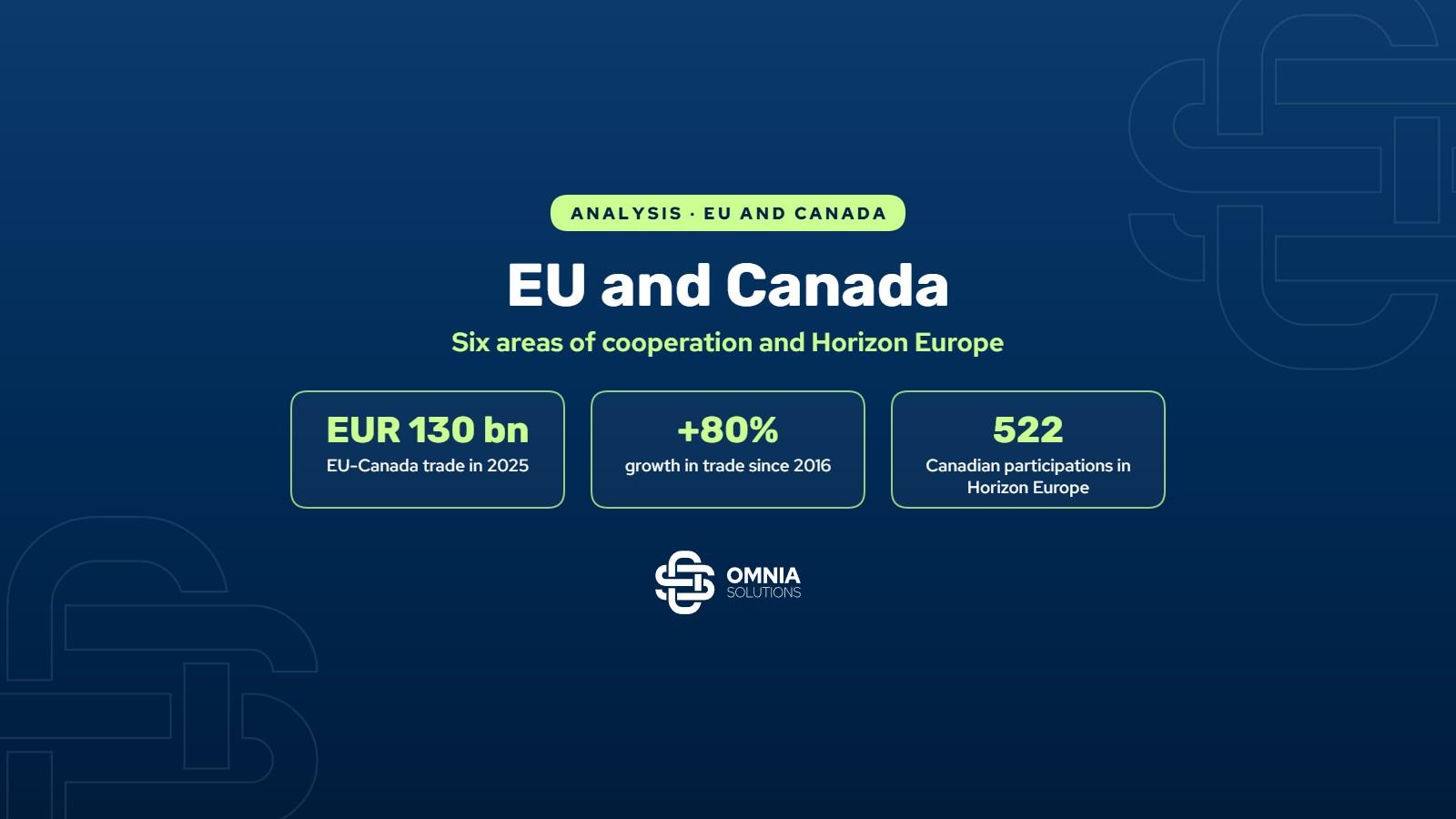
On 30 October 2026 in Montréal, the European Union and Canada began work on an Alliance for the Future, which aims to create a shared area of prosperity and economic security. The starting point is strong. Trade in goods and services exceeded EUR 130 billion in 2025 and has grown by more than 80% since 2016, while direct investment in each direction exceeds EUR 230 billion. Leaders set out six areas of cooperation, from trade and raw materials to security and research. For Croatia, the most concrete opportunity is Horizon Europe, where Canadian organisations have taken part on almost the same terms as European ones since 2024, while Croatian and Canadian researchers and companies still rarely work together.
This analysis covers official trade and investment data, the state of CETA ratification, the summit agreements, a detailed look at Canada’s participation in Horizon Europe, an assessment of the room for progress in each area, the obstacles to deeper cooperation and what all this means for Croatia and Croatian companies.
Key points
- At their 21st summit in Montréal on 29 and 30 October 2026, the EU and Canada began work on an Alliance for the Future, a shared area of prosperity and economic security.
- Trade in goods and services exceeded EUR 130 billion in 2025 and has grown by more than 80% since 2016. The EU exports more to Canada than it imports from it.
- Canada still sends 72.5% of its goods exports to the United States, and the EU accounts for 8.6% of Canada’s total goods trade, so there is plenty of room for growth.
- CETA has been provisionally applied since 21 September 2017. Eighteen of the 27 member states have completed ratification, Croatia among them in 2017.
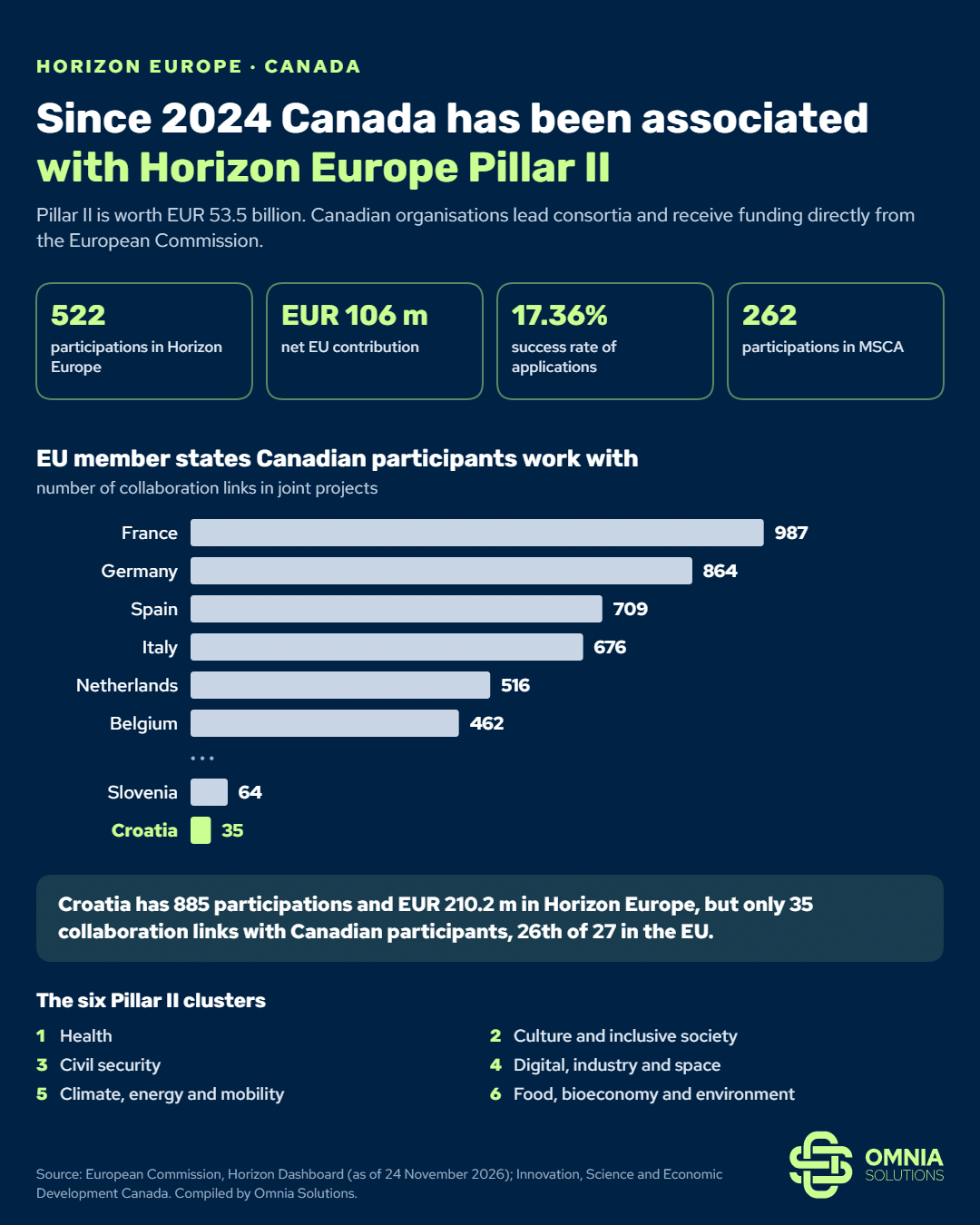
- Since 3 July 2024 Canada has been associated with Pillar II of Horizon Europe, worth EUR 53.5 billion. Canadian organisations have 522 participations and EUR 106 million in EU funding.
- Croatian and Canadian participants in Horizon Europe are connected by only 35 collaboration links, compared with 64 for Slovenia and 987 for France, which puts Croatia 26th of the 27 EU member states. We see this as Croatia’s largest untapped potential.
- By the 2027 summit, the two sides want to define a model for ever closer ties between Canada and the EU, without full membership.
- According to the Croatian Government, trade between Croatia and Canada reached 430 million dollars in 2025, 150% more than a year earlier.
Sources: 15, listed at the end · How we check our information · Report an error
Where the EU and Canada stand today
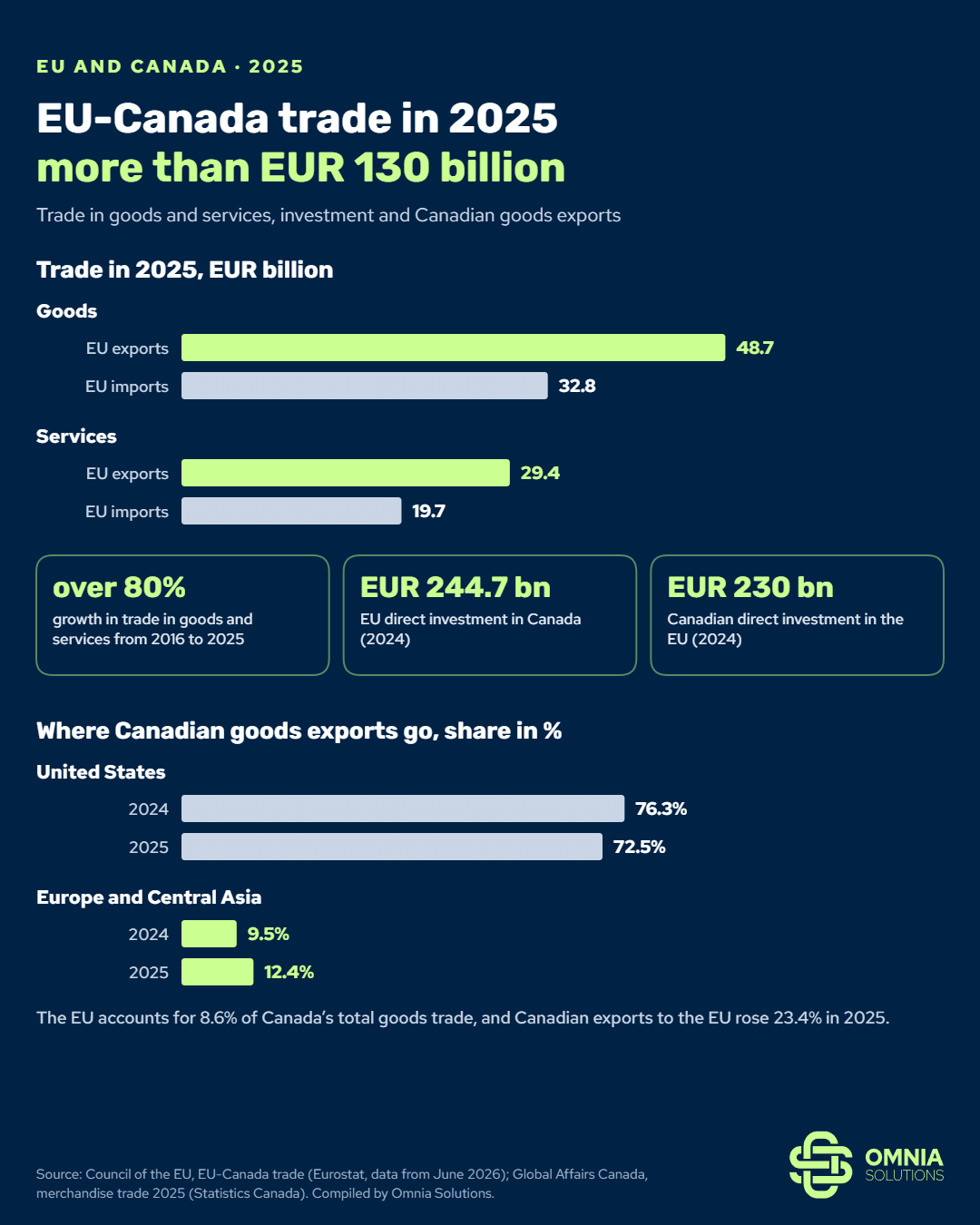
Relations are governed by the Strategic Partnership Agreement and the Comprehensive Economic and Trade Agreement (CETA), which has been provisionally applied since 21 September 2017. CETA removed 98% of tariffs. According to the Council of the EU, trade in goods amounted to EUR 81.5 billion in 2025 and trade in services to EUR 49 billion. The EU is Canada’s second largest trading partner, and Canada is the EU’s twelfth.
| EU exports to Canada | EU imports from Canada | Total | |
|---|---|---|---|
| Goods | 48.7 | 32.8 | 81.5 |
| Services | 29.4 | 19.7 | 49.1 |
| Total | 78.1 | 52.5 | 130.6 |
From 2016 to 2025, trade in goods grew by more than 76% and trade in services by about 90%. According to the ex post evaluation of the agreement cited by the Council of the EU, CETA adds EUR 3.2 billion a year to EU GDP. Investment is large in both directions. EU direct investment in Canada amounted to EUR 244.7 billion in 2024, and Canadian direct investment in the EU to EUR 230 billion.
For Canada, Europe is also a way to reduce its dependence on a single market. According to Global Affairs Canada, 72.5% of Canadian goods exports went to the United States in 2025, the lowest share since the early 1980s (76.3% in 2024). The share of Europe and Central Asia rose from 9.5% to 12.4%, and Canadian exports to the EU grew by 23.4%.
CETA is not yet fully in force. According to the Council of the EU, 18 member states have completed ratification. Croatia deposited its notification of ratification on 9 November 2017, and the most recent was Slovenia on 5 November 2026. Ratification is still missing in Belgium, Bulgaria, Cyprus, France, Greece, Ireland, Italy, Hungary and Poland. Until all member states ratify the agreement, the parts not covered by provisional application do not apply, including investment protection and the Investment Court System.
What the EU and Canada agreed in Montréal
At the 21st summit on 29 and 30 October 2026, European Council President António Costa, European Commission President Ursula von der Leyen and Canadian Prime Minister Mark Carney adopted a joint statement and began work on the Alliance for the Future. The Alliance will be based on reciprocity in industrial sectors where both sides want deeper strategic cooperation. The summit announced the following agreements.
- The main negotiations on a digital trade agreement, which complements CETA and makes cross-border data flows easier, have been concluded.
- Canada and the European Investment Bank (EIB) completed negotiations on an agreement that makes European investment in Canadian critical raw materials easier.
- Negotiations on a new generation agreement on cooperation between competition authorities have been completed.
- Canada is taking part in the European High Performance Computing Joint Undertaking (EuroHPC).
- Canada intends to join the loan supporting Ukraine.
- Frontex and the Canadian border agency agreed a working arrangement, and new dialogues are being launched on the Arctic, foreign information manipulation and interference, climate security and transport.
Leaders committed to defining a model for ever closer ties between Canada and the EU, without full membership, by the 2027 summit. A business council bringing together companies from both sides will also be set up.
Horizon Europe, the most concrete opportunity for cooperation
Of the six areas, research and innovation is the easiest place to start straight away, because the legal framework, the funding and the open calls already exist. Since 3 July 2024 Canada has been associated with Pillar II of Horizon Europe, Global Challenges and European Industrial Competitiveness. This pillar is worth EUR 53.5 billion, or 55.23% of the programme budget, and funds collaborative projects in six clusters. Canadian organisations take part almost on the same terms as organisations from EU member states. They can lead consortia, receive funding directly from the European Commission and keep their intellectual property rights, and since 2024 Canada has paid a contribution into the programme budget.
Before association, Canadian participants had to secure their own funding or take part with their own resources, and they could not lead consortia. In Horizon 2020, Canada ranked third by participation among non-EU countries that were not associated with the programme.
According to European Commission data, Canadian organisations have 522 participations in Horizon Europe and EUR 106 million in net EU contribution. They submitted 2,989 applications, with a success rate of 17.36%. About half of the participations, 262 of them, are in the Marie Skłodowska-Curie Actions, where Canada takes part as a third country. Small and medium-sized enterprises account for 32 participations and EUR 10.4 million.
Croatia has 885 participations and EUR 210.2 million in the same programme, with a success rate of 15.40%. Canadian participants work most often with France (987 collaboration links in joint projects), Germany (864) and Spain (709). Croatia has 35 links and ranks 26th of the 27 EU member states, ahead of Malta alone (17), while Slovenia has 64. Per million inhabitants, Croatia has 9 links, Slovenia 30 and the EU average is about 15, which puts Croatia 22nd in the EU on that measure.
What the Alliance for the Future brings
In the Montréal joint statement, the EU and Canada committed to working on Canada’s participation in future European research and innovation programmes. The focus is on artificial intelligence, quantum technologies, semiconductors, photonics and advanced computing, with particular attention to access for small and medium-sized enterprises, start-ups and research organisations to digital infrastructure, expertise and finance. The two sides also want greater Canadian participation in the Marie Skłodowska-Curie Actions and the European Research Council, Canada joining the BE READY pandemic preparedness partnership, and joint work on artificial intelligence for wildfires and extreme weather under the Destination Earth initiative.
The next framework programme, for 2028 to 2034, is set to be twice as large. The European Commission has proposed EUR 175 billion and high ambition projects in areas such as quantum computing, next generation artificial intelligence, fusion energy and ocean observation, and the proposal is being negotiated by the European Parliament and the Council. The future programme was also discussed at the second meeting of the EU-Canada Joint Committee on Horizon Europe on 26 March 2026.
Topics where Croatian and Canadian partners can work together
Based on the priorities in the joint statement, interests overlap most in these Pillar II clusters. The assessment is ours.
- Civil security (Cluster 3). Firefighting, disaster resilience and cybersecurity. Croatia and Canada already cooperate on firefighting aircraft, and the EU and Canada have agreed to cooperate on preventing, detecting early and fighting wildfires.
- Digital, industry and space (Cluster 4). Artificial intelligence, quantum technologies, semiconductors, and critical raw materials and recycling, where research can be linked to the new EIB framework for investment in raw materials.
- Climate, energy and mobility (Cluster 5). Power grids, energy storage and clean technologies, which are also part of the energy strand of the Alliance.
- Food, bioeconomy and environment (Cluster 6). Oceans, biodiversity and forest management, alongside EU-Canada cooperation on ocean observation and the Arctic.
- Health (Cluster 1). Pandemic preparedness and medical countermeasures, with Canada taking part in the BE READY partnership.
How to find a Canadian partner and apply
- A Pillar II consortium must include at least one partner from an EU member state and at least two more partners from other member states or associated countries. A Canadian partner counts towards them and can act as coordinator.
- Some calls explicitly ask for Canadian partners in the topic description, so it pays to search by keyword on the European Commission’s Funding and Tenders portal, which also has a partner search tool.
- Canada has national contact points for each of the six clusters, and Croatian national contact points for Horizon Europe help applicants in Croatia.
- The 2026 and 2027 work programme, adopted on 11 December 2025, is worth EUR 14 billion. Half of the call budget is paid as lump sums, some topics are tailored to newcomers and small and medium-sized enterprises, and 41 topics use two stage evaluation, where a short proposal is submitted first.
- Pillar II projects usually last three to five years, so partnerships should be built in advance.
We describe how Croatia performs across the whole programme in our article Croatia in Horizon Europe.
Six areas where cooperation can advance most
1. Trade and regulatory cooperation
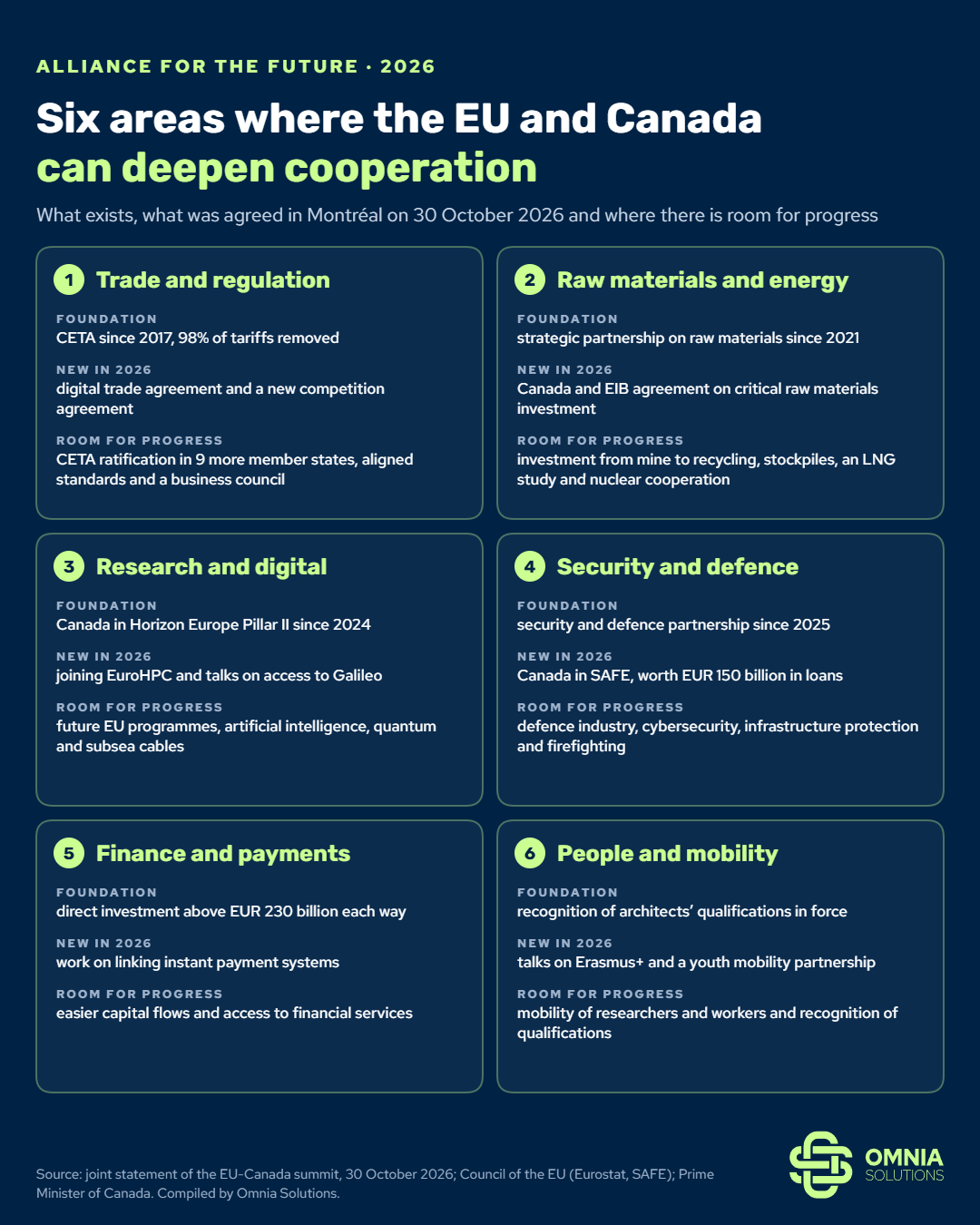
The aim is to make full use of CETA, bring standards and rules closer together, remove remaining barriers to trade and draw up sectoral plans through a dialogue on industrial policy. The digital trade agreement should give companies more legal certainty when transferring data. We see the greatest room for progress in CETA ratification in the remaining nine member states and in mutual recognition of conformity assessment results, for which leaders named digital identity, artificial intelligence systems and cybersecurity.
2. Critical raw materials and energy
According to the EIB, Canada is one of the leading producers of critical minerals, with large reserves and high environmental and social standards, while the EU wants to reduce its dependence on a small number of suppliers. A strategic partnership on raw materials has existed since 2021. The EIB and Canada signed a letter of intent in March 2026, and at the summit they completed negotiations on an agreement that opens the way for EIB investment in Canada. The two sides also agreed a joint long term feasibility study on exporting liquefied natural gas (LNG) to Europe, cooperation on grids and energy storage, and the modernisation of the nuclear cooperation agreement with Euratom. This is where interests complement each other best. Canada has raw materials and energy, and the EU has the market, industry and capital.
3. Research, innovation and digital technologies
The foundation is Canada’s association with Pillar II of Horizon Europe, described in the Horizon Europe section. At the summit, the two sides agreed to work on Canada’s participation in future European research programmes. Canada is joining EuroHPC, negotiations are starting on Canadian access to Galileo services along with talks on cooperation on IRIS², and new subsea cables between Canada, Europe and Asia are planned.
4. Security, defence and preparedness
The Security and Defence Partnership was signed on 23 June 2025. Canada takes part in SAFE, under which the EU offers member states up to EUR 150 billion in loans for joint procurement, and the Council of the EU concluded the agreement with Canada on 15 June 2026. According to the Canadian government, Canada is the only country outside Europe with privileged access to the programme. Cooperation is extending to the defence industry, maritime and space security, cybersecurity, critical infrastructure protection, pandemic preparedness and firefighting. EU member states will receive 24 Canadian DHC-515 firefighting aircraft, two of which have been ordered for Croatia.
5. Financial services and payments
The aim is to make cross-border capital flows and access to financial services easier and to link instant payment systems, so that payments between Canada and the EU become faster and cheaper. The area gets less attention, but it can lower costs for companies doing business across the Atlantic.
6. People, education and mobility
Negotiations are starting on deeper Canadian participation in Erasmus+, along with talks on the mobility of workers and researchers and a new youth mobility partnership. An agreement on the recognition of architects’ qualifications is already in force. For Croatia, ties with the Croatian community in Canada and tourism matter.
What this means for Croatia
Croatia ratified CETA in 2017. According to the Croatian Government, trade between Croatia and Canada reached 430 million dollars in 2025, 150% more than in 2024. Growth was driven by the purchase of aircraft and engines for Croatia Airlines and the delivery of ships ordered by the Canadian company Algoma from the 3. Maj shipyard. Canadian tourists made 188,000 arrivals in 2025.
At a meeting between Prime Ministers Andrej Plenković and Mark Carney in Ottawa on 22 June 2026, the talks covered energy, in particular the LNG terminal on Krk and civil nuclear energy, Canadian interest in the DONES project and the initiative to set up a Defence, Security and Resilience Bank, which foresees financing for small and medium-sized enterprises in these projects. Representatives of the Croatian company ORQA and the Canadian company Remote Robotics also met the two prime ministers ahead of signing a memorandum on a strategic partnership in the defence industry, covering unmanned systems and artificial intelligence.
Croatia took part with Greece, Italy, Spain, Portugal and France in the joint procurement of new DHC-515 firefighting aircraft. The contract for two aircraft, worth EUR 105 million, was signed on 25 March 2024 and is financed with EU funds.
Opportunities for Croatian companies
- Exports to Canada. CETA removed 98% of tariffs, and preferential treatment depends on the rules of origin. Conditions for a specific product can be checked on the European Commission’s Access2Markets portal.
- Horizon Europe projects. Canadian partners take part in Pillar II almost on the same terms as European ones, and Croatian-Canadian cooperation is small, so there is plenty of room for new consortia.
- Defence and security. SAFE also opens joint procurement to Canadian manufacturers, so industrial partnerships are possible, like the one ORQA and Remote Robotics are preparing.
- Raw materials, recycling and energy technologies. According to the EIB, the framework for investment in Canada covers the whole value chain, from exploration and extraction to processing, recycling and innovation, and European companies supplying equipment, technology and services in Canada can also benefit.
- Tourism. The number of Canadian visitors is growing, and according to the Croatian Government the trend continued in 2026.
For research, development and investment projects with foreign partners, it helps to check early which funding sources may apply. We wrote about Croatia’s participation in the EU’s largest research programme in Croatia in Horizon Europe, and about investment in research and development in our analysis of research and development spending.
What holds back deeper cooperation
- Unfinished CETA ratification. Nine member states have not yet ratified the agreement, so investment protection and the Investment Court System are not in force.
- Partial participation in EU programmes. Canada is associated only with Pillar II of Horizon Europe. In the European Research Council and the Marie Skłodowska-Curie Actions it takes part as a third country, and the European Innovation Council Accelerator is open only to Canadian companies that relocate to Europe. In calls that protect the EU’s strategic interests and security, participation by associated countries may be restricted.
- Distance and regulatory differences. Geographical distance and different standards make some trade harder, which is why regulatory alignment and mutual recognition of conformity assessment are among the goals of the Alliance.
- Croatia’s weak connections. With 35 collaboration links with Canadian participants in Horizon Europe, Croatia ranks 26th of the 27 EU member states, and it is below the EU average even per inhabitant. Croatian businesses invest 0.80% of GDP in research and development, compared with 1.50% in the EU, as we showed in our analysis of research and development spending.
- Climate commitments and energy infrastructure. LNG exports to Europe are only being explored through a joint feasibility study and must be consistent with both sides’ climate commitments.
Our assessment
For the EU and Canada as a whole, the biggest gains are in critical raw materials and energy and in the defence industry. Interests complement each other best there, and new frameworks already exist, from the agreement between Canada and the EIB to SAFE. Trade has the largest potential in value, but it depends on CETA ratification and on whether Canadian exports keep shifting towards Europe.
For Croatia, the most concrete opportunity is Horizon Europe. The legal framework and the money exist, the Canadian partner receives funding directly, and Croatian-Canadian cooperation is so small that even a few new projects would make a big difference. If Croatia reached Slovenia’s level of connection, the number of collaboration links with Canadian participants would almost double. The model of closer ties without membership, due to be defined by 2027, and the next framework programme from 2028 will show how far both sides want to go.
What Croatian applicants should do
- Follow topics in the 2026 and 2027 work programme that ask for Canadian partners, as well as topics in the civil security, digital, energy and environment clusters.
- Build partnerships in advance through Canadian and Croatian national contact points, partner search tools and existing ties, from academic exchange to the Croatian community in Canada.
- Include companies in consortia, because the work programme has topics tailored to small and medium-sized enterprises and newcomers.
- Prepare for the next framework programme from 2028, in which Canada wants to take part and which, under the Commission’s proposal, would be twice as large.
Frequently asked questions
What is the EU-Canada Alliance for the Future?
It is a framework the EU and Canada launched at their 21st summit in Montréal on 30 October 2026. The aim is a shared area of prosperity and economic security, and cooperation covers trade and regulation, digital and research technologies, critical raw materials and energy, financial services, security and preparedness, and ties between people.
How large is trade between the EU and Canada?
According to the Council of the EU and Eurostat, trade in goods and services exceeded EUR 130 billion in 2025. Trade in goods amounted to EUR 81.5 billion and trade in services to EUR 49 billion. From 2016 to 2025, total trade grew by more than 80%.
Is CETA in force?
CETA has been provisionally applied since 21 September 2017 and has removed 98% of tariffs. According to the Council of the EU, 18 of the 27 member states have completed ratification, Croatia among them in 2017. The parts not covered by provisional application, such as investment protection, will apply once all member states ratify the agreement.
Can Canada become an EU member state?
Full membership is not on the agenda. In the Montréal joint statement, leaders committed to defining a model for ever closer ties between Canada and the EU, without full membership, by the 2027 summit.
Can Canadian organisations take part in Horizon Europe?
Yes. Since 3 July 2024 Canada has been associated with Pillar II of Horizon Europe, worth EUR 53.5 billion, so Canadian organisations in that part of the programme lead consortia and receive funding directly, almost on the same terms as organisations from EU member states. According to the European Commission, they have 522 participations and EUR 106 million in net EU contribution.
How many Horizon Europe collaboration links does Croatia have with Canada?
According to the European Commission’s Horizon Dashboard, Croatian and Canadian participants are connected by 35 collaboration links, which puts Croatia 26th of the 27 EU member states, ahead of Malta alone. Slovenia has 64 links and France 987. Per million inhabitants, Croatia has 9 links, compared with an EU average of about 15.
How can a Croatian organisation find a Canadian partner for Horizon Europe?
Topics that explicitly ask for Canadian partners can be found by searching the European Commission’s Funding and Tenders portal, which also has a partner search tool. Canada has national contact points for each of the six Pillar II clusters, and Croatian national contact points help applicants in Croatia.
What is economic cooperation between Croatia and Canada like?
According to the Croatian Government, trade between Croatia and Canada reached 430 million dollars in 2025, 150% more than in 2024. Growth was driven by aircraft and engines for Croatia Airlines and ships from the 3. Maj shipyard for the Canadian company Algoma, and Canadian tourists made 188,000 arrivals.

About the author
Davor Nikolić, MSc in Political Science
Co-founder and director of Omnia Solutions. He prepares and implements projects co-financed by EU and national funds, mainly in innovation, entrepreneurship and industry. From 2012 to 2014 he was an advisor in the Cabinet of the Minister of Entrepreneurship and Crafts, and from 2014 to 2018 a senior expert advisor for the implementation, evaluation and contracting of EU business projects at the Ministry of Economy, Entrepreneurship and Crafts. As a project manager, he has worked on the preparation and implementation of European and international projects with a total value of more than EUR 60 million. Since 2025 he has been an external member of the European Affairs Committee of the Croatian Parliament. He is a doctoral candidate in International Relations at the Faculty of Social Sciences, University of Ljubljana.
Sources and methodology
- European Council: joint statement of the EU-Canada summit, 30 October 2026 (text of the statement)
- Council of the EU: EU-Canada trade, facts and figures (Eurostat, data from June 2026)
- Council of the EU: CETA, ratification details
- EUR-Lex: Council Decision (EU) 2017/38 on the provisional application of CETA
- Global Affairs Canada: Highlights of Canada’s merchandise trade performance, 2025 Update
- Prime Minister of Canada: Canada’s participation in SAFE, 1 December 2025 and Council of the EU: SAFE
- European Commission: research and innovation cooperation with Canada and second Joint Committee meeting, 26 March 2026
- European Commission: Horizon Dashboard, Canada profile and Croatia profile (as of 24 November 2026)
- Innovation, Science and Economic Development Canada: About Horizon Europe and Horizon Europe Pillar 2
- EEAS: Horizon Europe work programme for 2026 and 2027
- European Commission: proposal for Horizon Europe 2028 to 2034
- Eurostat: population on 1 January 2025 (tps00001)
- EIB: EIB and Canada team up to strengthen critical raw material resilience (March 2026)
- Croatian Government: Croatia and Canada strengthen transatlantic partnership and economic relations, 22 June 2026
- Croatian Government: contract for two new Canadair aircraft, 25 March 2024
EU trade and investment figures are taken from the Council of the EU (Eurostat), and the totals in the table are our calculation. Shares of Canadian exports are taken from Global Affairs Canada (Statistics Canada, customs basis). Trade between Croatia and Canada is given in dollars, as reported by the Croatian Government. Horizon Europe participation data were taken from the European Commission’s Horizon Dashboard on 24 November 2026. Collaboration links are an indicator of that tool, which counts connections between participants from two countries in joint projects. Links per million inhabitants and the EU average are our calculation based on Eurostat population data on 1 January 2025. The assessments in the sections Our assessment and Topics where Croatian and Canadian partners can work together are the author’s view. Data according to the sources listed, as of 24 November 2026.